The Duat is the most precisely mapped afterlife realm in the ancient world. While the Greek underworld is described in general terms as a shadowy place beneath the earth where the dead go, and the Norse Hel is given only partial description, the Egyptian Duat was documented in a series of funerary texts so detailed that they function as genuine cartography: hour-by-hour accounts of what existed in each region, what guardians stood at each gate, what names the dead needed to know, what spells they needed to recite, what they would encounter if they succeeded and what would happen if they failed.
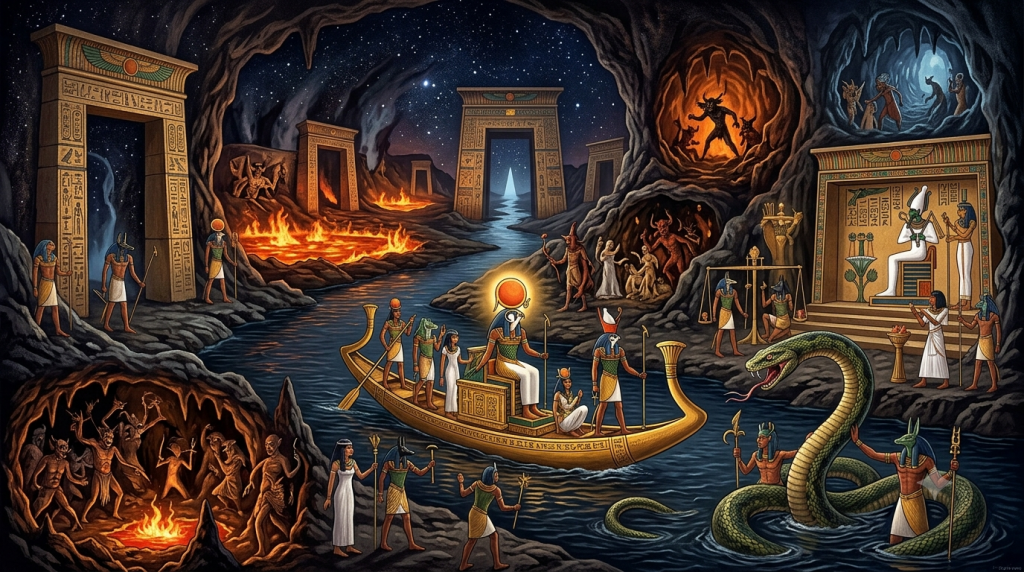
The Amduat, That Which Is in the Underworld, describes twelve hours of the night journey through the Duat, each corresponding to a distinct region with its own geography, inhabitants, and challenges. The Book of Gates describes the same journey organised around twelve sequential gates, each guarded by a triad of divine beings who must be correctly addressed before passage is permitted. The Book of Caverns maps the deepest regions of the underworld where the enemies of Ra and Osiris face their consequences. Together, these texts constitute a detailed theology of what happens after death that no other ancient civilisation produced with comparable specificity.
The Duat was not hell. It was not a place of punishment. It was the space through which the dead had to travel, and what happened to them there depended on whether they had the knowledge and the moral qualification to navigate it successfully.
Where the Duat Was
The location of the Duat within Egyptian cosmology is not entirely consistent across the sources, which reflects the tradition’s comfort with holding multiple perspectives simultaneously. In some texts it is beneath the earth, the realm below the surface of the world that the dead descended into. In others it exists in the sky, part of the celestial realm through which the sun travels at night, below the visible sky of the day but accessible from the western horizon where the sun sets. In still others it is described almost as a parallel dimension, occupying the same space as the living world but in a different register of existence that the dead enter at death.
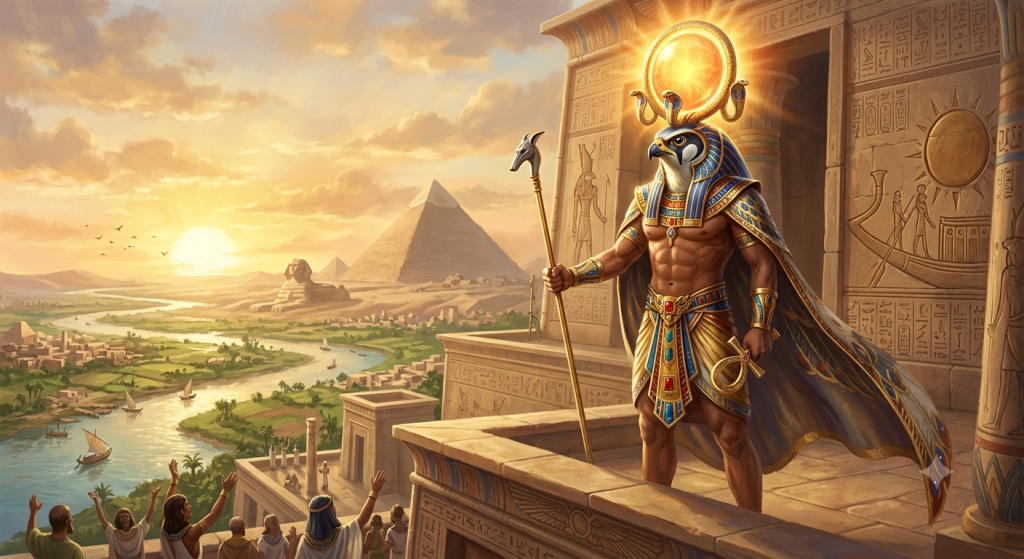
What is consistent is its relationship to the sun’s journey. Ra’s solar barque enters the Duat at sunset through the western horizon, travels through it during the twelve hours of the night, and emerges from the eastern horizon at dawn. The twelve hours of Ra’s night journey define the twelve regions of the Duat, and the deceased dead must travel the same path that the sun travels, making the afterlife journey coextensive with the daily cycle of the sun’s apparent death and rebirth.
This means that the Duat is experienced by both the dead and by the sun god every single night. It is not simply a static realm where the dead reside. It is a dynamic space through which both the divine light and the human dead pass in the same direction, the sun pulling the souls of the justified along in its wake toward the dawn that represents successful emergence into paradise.
The Twelve Hours of the Night
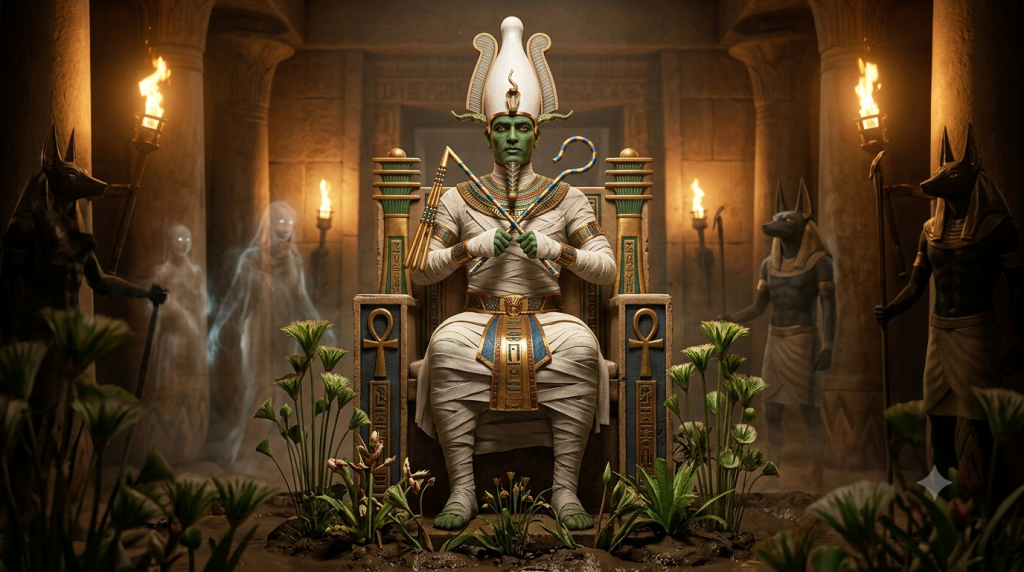
The first hour of the night begins when Ra’s barque passes through the western horizon, the gateway Nut, the sky goddess, who swallows the sun each evening and gives birth to it again each morning. The barque enters a marshy region associated with Osiris, the Waters of Osiris, where the dead who have already passed their judgment reside in a form of preliminary peace. This first hour is relatively gentle: the inhabitants are welcoming, the journey straightforward, the initial passage established.
As the hours progress the character of the Duat changes. In the second and third hours Ra’s light briefly illuminates regions where the dead await judgment, and his passage brings them temporary comfort before the darkness closes in again. The serpents and hostile beings that inhabit the Duat become more numerous and more threatening as the night deepens. Gates require passwords. Guardians demand that their names be spoken correctly. The knowledge of the Book of the Dead, the names and spells and declarations that the deceased have been provided with for exactly this purpose, becomes the currency of passage.
The sixth hour is the deepest point of the night, the midnight of the underworld, and in the Amduat it is described as the most important moment of the entire journey. Here Ra undergoes the temporary union with Osiris, the merging of the living light with the dead king, that the tradition describes as Ra-Osiris. In the deepest darkness of the Duat, the sun god and the ruler of the dead fuse briefly into a single entity, each renewing the other. Ra gains the regenerative power of Osiris’s resurrection. Osiris is illuminated by the light he would not otherwise have. The sun that will rise in the morning is not quite the same sun that set in the evening: it has been through death and has been renewed by it.
In the fifth hour of the Amduat, and at various points in the Book of Gates, Apep the chaos serpent makes his attack on the barque. Set stands at the prow and drives the serpent back with his spear. The crew recites spells to bind and weaken Apep. The barque passes through. The sun continues its journey.
The tenth and eleventh hours see the gradual brightening of the underworld as the barque approaches the eastern horizon. The scarab form of Ra, Khepri, the morning sun, begins to emerge within the barque. The darkness begins to recede. The hostile beings and the threats of the deep underworld are behind the journey now. The twelfth hour is the passage through the body of the serpent Mehen, whose coils surround and protect the barque in the final stage of the journey, emerging from his tail mouth into the eastern horizon as the reborn sun.
The Gates and What Knowledge Required
The Book of Gates presents the Duat as a series of twelve portals, each guarded by a specific divine triad: a gatekeeper, a watcher, and a herald. The gates themselves are depicted as massive doorways in the funerary texts, each with its own character and its own guardians who will destroy any soul that attempts to pass without the correct credentials.
The correct credentials were not strength or divine favour or social status. They were knowledge. The deceased who arrived at a gate needed to know the gate’s name, the names of its guardians, and the correct spell or declaration that permitted passage. This knowledge was encoded in the funerary texts placed in the tomb with the deceased: the Book of the Dead, the Book of Gates, and the other funerary papyri that formed the complete preparation for the afterlife journey. A well-prepared tomb was a well-equipped traveller.
The requirement for knowledge rather than force as the key to the underworld is one of the most distinctive features of Egyptian afterlife theology. You could not fight your way through the Duat. You could not buy your way through it at the gates, though the quality of your preparation depended on your wealth. You had to know the correct things and say them correctly. This placed the scribes and priests who produced and maintained the funerary texts at the centre of the afterlife economy: they were the keepers of the knowledge that the dead needed to make the journey.
The Inhabitants of the Duat
The Duat was not simply a transit zone for souls on their way to judgment. It was an inhabited world, and its inhabitants were as varied and as specifically described as anything in the Egyptian mythological tradition.
The justified dead, those who had passed the weighing of the heart and been admitted to the Field of Reeds, resided in specific regions of the Duat in conditions of eternal well-being. They were fed and watered by divine provision. They participated in the divine community of the underworld. When Ra’s barque passed through during the night journey, his light temporarily illuminated them and gave them renewed vitality, and the Amduat records their cries of joy when the barque appeared and their expressions of grief when it passed and the darkness returned.
The enemies of Ra and Osiris, the souls of those who had violated maat so completely that they faced consequences beyond the second death of Ammit’s devouring, resided in separate regions of the Duat in conditions of ongoing punishment. The Book of Caverns describes these regions in uncomfortable detail: pits of fire, pools of punishment, beings in inverted postures that represent the reversal of the proper cosmic order. This is the closest thing to a conventional hell in Egyptian theology, but it is notably not the destination of ordinary sinners whose hearts simply failed the weighing. It is the destination of the cosmically hostile, the enemies of the divine order itself, who face consequences proportionate to the magnitude of their opposition to maat.
The Field of Reeds as Destination
The Field of Reeds, Aaru, is the Duat’s paradise region and the destination of the justified dead. It is depicted in tomb paintings and funerary papyri as a landscape that closely resembles the Egyptian delta: waterways, reed beds, fertile fields, the productive and beautiful landscape that the Egyptians knew and valued most. The deceased work there, farm there, and enjoy all the activities of a good Egyptian life, but without the hardships: no drought, no disease, no tax collectors, no death.
The Field of Reeds is both within the Duat and separate from it. It is the Duat’s resolved destination, the place where the journey ends for those who have successfully completed it. The twelve hours of the night journey, the gates and their guardians, the challenges and the required knowledge, all of these are the path to this place. The deceased who set out from the tomb at death and who arrived in the Field of Reeds had completed a journey that the entire apparatus of Egyptian funerary preparation was designed to make possible.
For more on the Egyptian afterlife tradition, the Book of the Dead article covers the practical guide that prepared the deceased for the Duat journey. The Weighing of the Heart article covers the judgment that determined whether the dead were admitted to the Field of Reeds or faced the second death. The Ra article covers the sun god whose nightly journey through the Duat defines the twelve hours of its structure.
Never miss a myth
Thank you for being here. The site is brand new and every subscriber genuinely means something to me. If you're here, you care about this stuff as much as I do - and that's all the reason I need to keep going. New stories, videos and dark folklore from around the world, straight to your inbox. No algorithm. Just the stories, when they're ready.