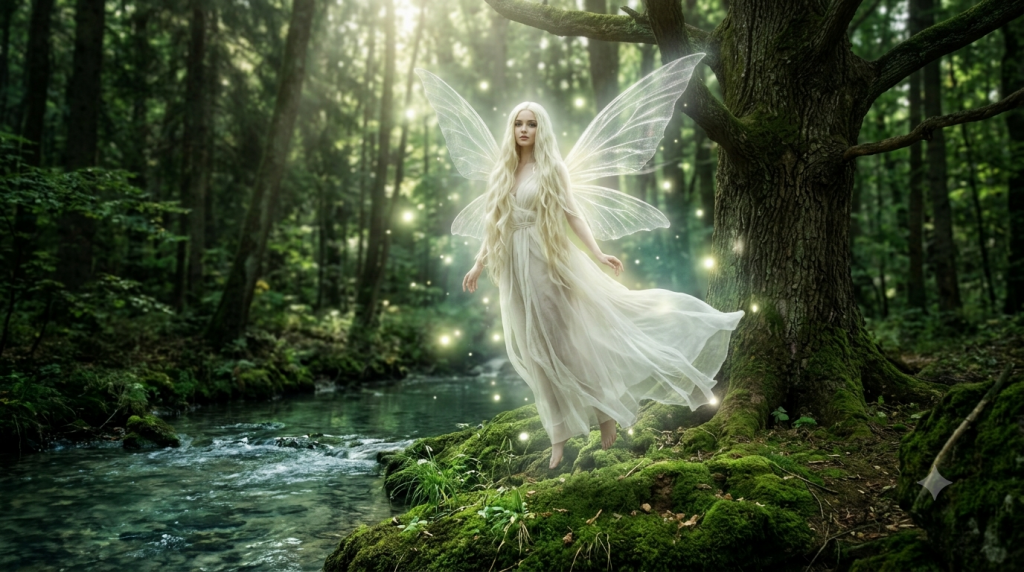
The Vila is one of the most beautiful and most dangerous supernatural figures in South Slavic folklore. She appears as a young woman of extraordinary beauty, dressed in white, dancing with her sisters in mountain meadows, forest clearings, and around springs and lakes at night. She controls storms, hail, and rain. She can heal or cause illness. She is a warrior of supernatural skill who rides horses and deer and fights with arrows that never miss. And if you disturb her dance, insult her, or break a promise made in her name, she will kill you, and the manner of it will be specifically connected to whatever offence you committed.
The Vila is not simply a fairy in the diminished Western European sense of a small winged creature of mischief and whimsy. She is a full supernatural being of considerable power, whose relationship with humans ranges from actively helpful to lethally hostile depending on the nature of the relationship and how well its terms have been maintained.
Origins and Nature
The origin of the Vila varies across regional traditions. In some accounts she was originally a human woman, a girl who died young and whose spirit became a Vila, connecting her to the same category of untimely female dead that produces the Rusalka in the eastern Slavic tradition. In others she is a purely supernatural being, never human, one of a category of beings who inhabit the wild places of the world and have their own existence entirely separate from humanity.
Her connection to weather is one of the most practically significant aspects of her tradition. Vilas were understood to control hail, which was one of the most destructive forces available to agricultural communities whose crops could be destroyed in minutes by a severe hailstorm. Appeasing the Vilas before hailstorm season, and performing specific rituals to divert their storms away from the fields, was serious community business rather than simple superstition.
The Vila as Warrior
The warrior dimension of the Vila tradition distinguishes her from most fairy figures in European folklore. She rides into battle on horseback or on deer. She shoots arrows with supernatural accuracy. She participates in the wars of heroes as an ally or an opponent, and her involvement in a conflict is a significant supernatural event rather than a minor magical intrusion.
In the South Slavic epic poetry tradition, the sworn sisterhood between a hero and a Vila is one of the most important relationships a hero can have. The Vila who adopts a hero as her sworn brother provides him with healing, intelligence, warnings of danger, and supernatural assistance in battle. She is his supernatural protector, and breaking the terms of the relationship, typically through betrayal or through failing to honour her, results in consequences as severe as her assistance was valuable.
The Dance and Its Danger
The Vila’s circular dances are among the most widely attested elements of her tradition, and the fairy rings that appear in grass where Vila have danced are understood as physical evidence of their nocturnal activity. Stepping into a fairy ring, or interrupting a Vila dance, was understood as a serious transgression that invited supernatural retribution.
The specific retribution varied but typically involved the transgressor being forced to dance with the Vilas until they collapsed or died of exhaustion, or being struck with illness that wasted them until they died. The connection between Vila dances and the dancing sickness outbreaks that occurred in medieval Europe has been noted by several scholars, though the relationship between folk belief and the actual epidemiology of those events remains debated.
For more on the Slavic tradition, the Rusalka article covers the eastern Slavic water spirit who shares some of the Vila’s origins in the female unquiet dead. The Marzanna article covers the death goddess whose seasonal rituals connect to the Vila’s weather control. The Slavic Mythology hub page has every article in the cluster.
Never miss a myth
Thank you for being here. The site is brand new and every subscriber genuinely means something to me. If you're here, you care about this stuff as much as I do - and that's all the reason I need to keep going. New stories, videos and dark folklore from around the world, straight to your inbox. No algorithm. Just the stories, when they're ready.