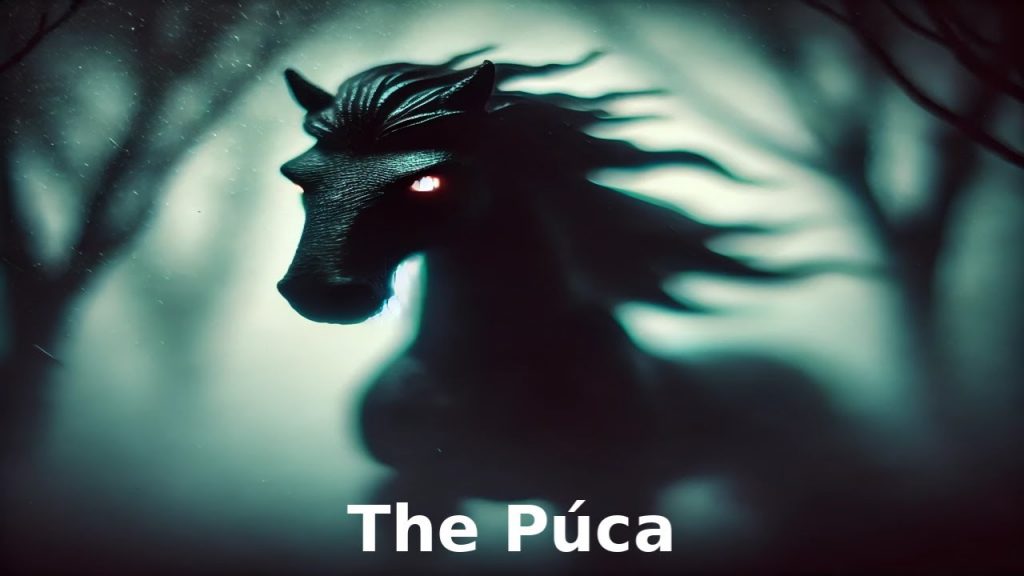
You are walking home late from the pub, the road dark and the night quiet, when you hear hooves behind you. The horse that draws alongside you is black and enormous, its mane tangled, its eyes catching the light in a way that no horse’s eyes should. It wants you to climb on. And the strange thing, the part that nobody who tells this story can quite explain, is that you find yourself doing it.
A Spirit That Refuses to Be Pinned Down
Most creatures of Irish folklore come with clear rules. The banshee wails for certain families and not others. The Dullahan comes for the dying. The leprechaun guards his gold. The Púca, sometimes spelled pooka or phouka, operates under no such constraints, and that refusal to be categorised or predicted is, in itself, the most important thing about it.
The word Púca comes from the Irish, carrying meanings that range from spirit and ghost to goblin, and possibly reaching further back to an Old Irish root connected to the word for a male goat. The name itself shifts depending on who is using it and where: Puca, Pooka, Phouka in Ireland, Pwca in Wales, Puck in English tradition. Each version carries a slightly different flavour, from the mischievous sprite of Shakespeare to the darker, more ambivalent creature that Irish oral tradition describes. They are related, and they are not identical.
What the Irish Púca is, above everything else, is a shapeshifter. It can take the form of a horse, a goat, a dog, a hare, a cat, a bull, a raven, a fox, or a human with unsettling animal features, and in any given region the form it most commonly takes will differ from the form believed in twenty miles away. The one consistent detail across almost every account is the colour: whatever shape the Púca chooses, it tends toward darkness, jet black with glowing or fiery eyes, the colour of something that belongs to the night side of the world rather than the daylight side.
It is neither good nor evil in any straightforward sense. It brings both fortune and misfortune, sometimes to the same person on different occasions, and the logic governing which it will offer on any given night is not always apparent. It is, in the most precise sense of the word, unpredictable, and in the Irish countryside where it was most actively believed in, that unpredictability was itself a form of terror.
The Black Horse and the Wild Ride
The form the Púca takes most consistently across Irish tradition is that of a horse, and it is in this form that the most famous category of Púca encounter occurs.
A person, frequently described in the tellings as having had a drink or several that evening, encounters a large black horse on a road or moorland at night. Something about the horse is wrong, though the person often cannot immediately identify what. The horse is too large, or its eyes catch light in the wrong way, or it simply appears on a road where no horse should be at that hour. And yet the person, through some combination of the creature’s influence and their own clouded judgment, climbs onto its back.
What follows is a wild ride through the Irish countryside at a speed that no natural horse could achieve, over terrain that would kill a real animal and its rider, through darkness and weather and across ground that should be impassable. The ride lasts until the Púca decides it is over, at which point the rider is deposited somewhere they did not intend to be, sometimes in a ditch, sometimes on a hilltop, occasionally in a location so far from where they began that their arrival there cannot be explained. They are unharmed, physically. Their memory of the night is unreliable. The Púca, whatever it wanted from the encounter, has already left.
This distinguishes the Púca sharply from related creatures that occupy similar territory in other parts of the Celtic world. The Scottish each uisce, the water horse, takes riders into lochs and drowns them. The kelpie gives a wild ride and then dives into the nearest body of water to drown and devour whoever made the mistake of mounting it. The Púca’s ride is frightening, disorienting, and deeply strange, but it does not end in death. The Púca has no particular interest in killing the people it takes for rides. It seems interested, if anything, in the ride itself.
The Only Man Who Rode the Púca Deliberately
Most encounters with the Púca as a horse are accidental, or at least unintentional on the rider’s part. There is, however, one figure in Irish tradition said to have deliberately ridden the Púca and come out of it with something other than confusion and a ruined evening.
Brian Boru, the High King of Ireland who died at the Battle of Clontarf in 1014 CE and who is remembered as the only king ever to unite all of Ireland under a single rule, is the figure most consistently named in this tradition. The story holds that Brian Boru managed to catch the Púca and, using a special bridle made from three hairs of the creature’s tail or mane depending on the telling, brought it under enough control to ride it and impose terms on it. In return for its freedom, the Púca gave Brian Boru a promise: it would never again harm an Irishman who was sober and going about legitimate business.
The promise, by all accounts, did not last. The Púca is described consistently across its folklore as notoriously untrustworthy, and the commitment made to Brian Boru eventually faded as Brian himself faded from living memory into the realm of legend. But the story serves a meaningful function in the tradition, establishing that even the most powerful human ruler in Irish history had to negotiate with this creature rather than simply overpower it, and that the best deal available was conditional protection for the sober and the innocent, with the drunk and the wicked left to whatever the night brought them.
The Púca’s Share
The relationship between the Púca and the agricultural cycle of Ireland is one of the most practically embedded aspects of the belief, connecting it to the rhythms of the harvest in a way that made it relevant to daily farming life rather than simply a story told in the dark.
The festival of Samhain, the ancient Celtic marking of the end of the harvest season and the beginning of the dark half of the year, falls at the end of October and the start of November. As the harvest was brought in, Irish farming tradition held that the reapers must leave a few stalks standing in the field, never cutting everything to the last stalk. What was left, this deliberate remainder, was known as the Púca’s share, an offering made to the creature to acknowledge its presence and its potential power over what grew in the ground.
After Samhain, any crops still in the fields and any wild fruits still on the hedgerows were considered contaminated. The Púca was said to have passed over them, to have spat on them or otherwise blighted them, and they were inedible and not to be touched. Anyone who ate the berries left on the bushes after November came with the risk of eating something the Púca had already claimed, with unpredictable consequences.
This is the specific date of the Púca’s closest engagement with the human calendar. November the first is traditionally known in Irish folklore as Lá na Púca, the Púca’s day, and it is, paradoxically, the one day of the year on which the Púca was said to be reliably civil. A creature that spent the rest of the year in entirely unpredictable oscillation between mischief and malevolence apparently set that aside for one day at the turn of the year, perhaps as acknowledgement of the harvest offering, perhaps simply because it, like everything else, operated by rules that humans had not fully deciphered.
Douglas Hyde, the scholar and first president of Ireland, recorded in his own folklore research an account of a speaking horse that descended from a hill in Leinster on November the first to address the people gathered there, an account specific and vivid enough to suggest it was not simply generic legend but something tied to a particular place and a particular community’s experience.
If you want more like this, the Tales of Myth and Magic newsletter delivers new creatures, legends, and forgotten folklore straight to your inbox.
No fixed schedule. No noise. Just the stories, when they are ready.
Sign up here →What the Púca Does When It Is Not a Horse
The black horse is the Púca’s most famous form, but the tradition is clear that it is far from the only one, and the other forms it takes illuminate different aspects of its character.
As a goat, the Púca tends toward direct mischief: knocking things over, scaring livestock, appearing in places goats have no business being at hours when no goat should be awake. As a hare it is elusive and seems more interested in being glimpsed and vanishing than in any direct engagement. As a dog it has been known to follow travellers for long distances without doing anything in particular, its presence simply a source of mounting unease. As a cat it appears in the stories of Sheridan Le Fanu, the Gothic horror writer who was a contemporary of Bram Stoker and who incorporated the Púca into several tales, his version emphasising the creature’s domestic uncanniness, the wrongness of something familiar that is not quite what it appears to be.
The human form is the most unsettling variation. A figure with an animal feature that only becomes apparent as you spend more time in its company, an ear too long or eyes set too wide or a quality of stillness that no human person has. By the time you have noticed what is wrong, you are already in a conversation with something that is not what it claimed to be.
W.B. Yeats, who was deeply interested in Irish folk tradition and incorporated it extensively into his own work, wrote about the Púca with genuine attention rather than simply using it as decorative local colour. Lady Wilde, Oscar Wilde’s mother and a serious folklorist in her own right, documented Púca stories in her 1888 collection Ancient Legends, Mystic Charms and Superstitions of Ireland. Flann O’Brien’s novel At Swim-Two-Birds, published in 1939 and widely regarded as one of the masterpieces of twentieth century Irish literature, features a character named Pooka MacPhillemey described simply as a member of the devil class, given fictional form but rooted in a specific folkloric tradition the novel takes entirely seriously.
Shakespeare and the Púca’s Shadow
The question of whether Shakespeare’s Puck in A Midsummer Night’s Dream owes a direct debt to the Irish Púca or simply draws on parallel English fairy traditions that developed alongside and sometimes in contact with their Irish counterparts is one that scholars have debated without final resolution.
What can be said is this: the linguistic connection is not in doubt. Puck, the word Shakespeare uses, is directly related to Púca. Both names travel back to the same root and carry the same sense of something small and supernatural and thoroughly untrustworthy. The character of Puck as Shakespeare writes him, the mischievous sprite who sets the entire plot of the play in motion through his interventions in human affairs and who seems motivated by something closer to amusement than any coherent goal, maps closely enough onto the Púca’s character that the resemblance is clearly not accidental, even if the precise route of transmission from Irish oral tradition into English literary culture cannot be definitively traced.
What the comparison makes clear is that the Púca is not simply a local Irish oddity. It belongs to a family of related supernatural trickster figures that spread across the Celtic world and the British Isles, each version adapted to its local landscape and local fears while sharing the same essential quality: a being that operates by its own rules, that cannot be reliably appeased or avoided, and that finds human predictability amusing in the way that something much older and stranger than humanity always will.
The Púca Festival
The Púca’s connection to Samhain has given it a particular relevance in contemporary Ireland that most creatures of its age and origin no longer enjoy. The Púca Festival, an annual event held at Samhain in the Boyne Valley, draws specifically on the deep relationship between this creature, the harvest season, and the ancient sites of the Boyne that connect Ireland to its pre-Christian past. The festival uses music, storytelling, and spectacle to keep the tradition alive and to give it a contemporary audience, an exercise in cultural memory that the Púca, with its long history of refusing to be entirely forgotten, would probably find appropriate.
The creature has also maintained a presence in contemporary fiction, film, and gaming, shape-shifting as naturally into modern storytelling as it does into a horse on a dark road. Neil Gaiman referenced it in his Sandman comic series. It appears in video games, fantasy novels, horror films. The forms change. The essential quality, a creature that is not what it seems, that cannot be fully trusted, that brings something to every encounter that was not bargained for, remains constant.
Whatever the Púca actually is, whether a survival of pre-Christian supernatural belief, a way of naming the unpredictability of the natural world, or something that genuinely made the roads of rural Ireland more interesting than the dark and the distance alone could account for, it has proven considerably harder to shake off than most things. It has been riding the countryside for over a thousand years of documented tradition.
It shows no sign of dismounting.
Never miss a myth
Thank you for being here. The site is brand new and every subscriber genuinely means something to me. If you're here, you care about this stuff as much as I do - and that's all the reason I need to keep going. New stories, videos and dark folklore from around the world, straight to your inbox. No algorithm. Just the stories, when they're ready.