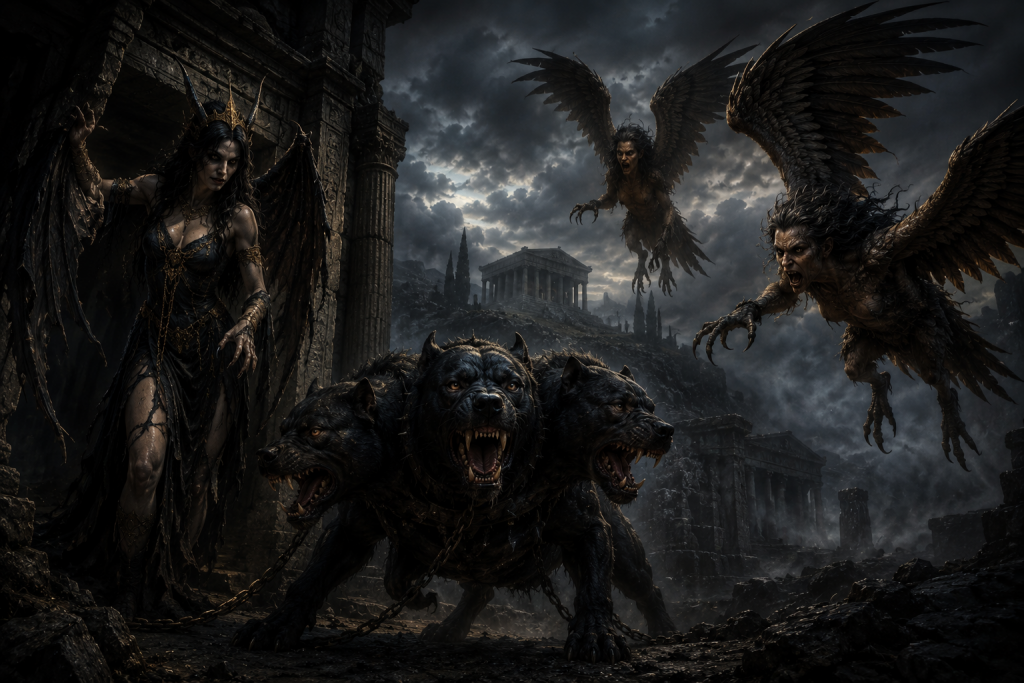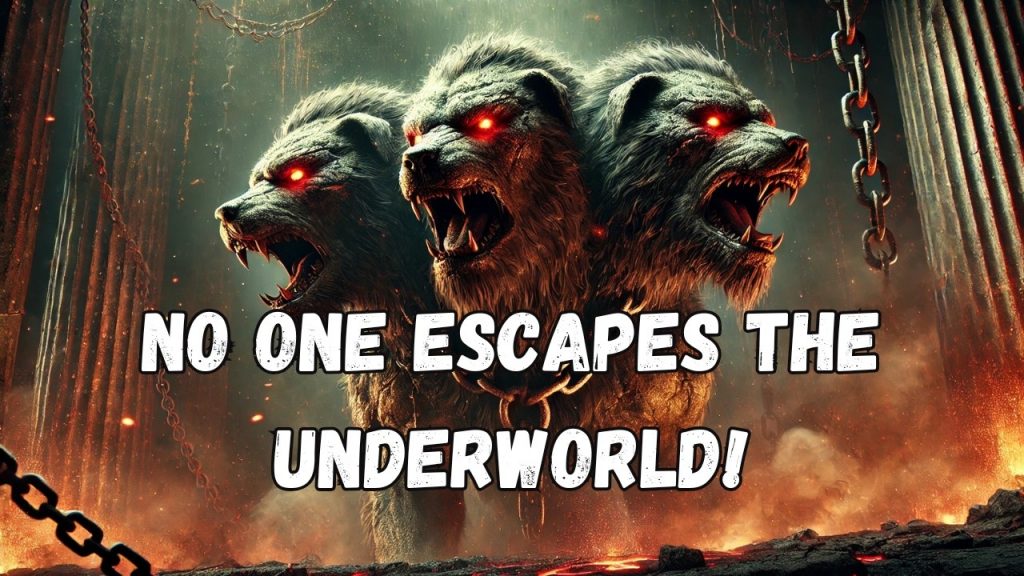
At the edge of the living world, where the rivers of the dead run dark and the ferryman takes only those with no return fare, a dog is waiting. It has been waiting since before the city of Athens was built. It will be waiting long after. And it has never let anything out.
A Monster That Is Also, Fundamentally, a Dog
There is something worth noticing at the very start of any account of Cerberus. Underneath the snake mane, the multiple heads, the serpent tail, and the darkness of its function as the eternal gatekeeper between the living and the dead, Cerberus is a dog. It is not a dragon, not a spirit, not a divine abstraction. It is an enormous, profoundly strange dog, and the ancient Greeks were always aware of that, which is part of why the stories about it are so much richer than a simple monster placed in a simple doorway.
The name Cerberus comes from the Greek Kerberos, which may derive from roots meaning spotted or speckled, or possibly from an ancient compound meaning death daemon of the dark, depending on which line of etymology you follow. The first interpretation is the more arresting: the terrifying guardian of the underworld, the creature that prevented every dead soul from ever returning to the light, possibly named for a characteristic of its coat that made it look, in some light, like an ordinary dog.
Cerberus appears first in Homer as simply the hound of Hades, a name rather than a description, mentioned in passing in the Iliad and the Odyssey in a way that suggests Homer’s audience already knew exactly what was being referred to and needed no introduction. The name and the fuller description come from Hesiod’s Theogony, written in the eighth or seventh century BC, which gives Cerberus his parentage and his basic character, and which began the long tradition of Greek writers disagreeing with each other about almost every specific detail of his appearance.
If you are interested in creatures from Greek Mythology, check out this page for more!
A Family of Monsters
Cerberus was born into the same monstrous lineage that produced many of the most feared creatures in Greek mythology, and understanding that family context explains a great deal about what he was and what he was meant to represent.
His father was Typhon, the most fearsome creature ever to challenge the Olympian gods, a being of such overwhelming power that even Zeus faced him in a battle that shook the foundations of the world before finally defeating him. His mother was Echidna, the half-woman and half-serpent known as the mother of all monsters, who lived in a deep cave and produced with Typhon a family of creatures that the Greeks used as the ultimate challenges for their greatest heroes.
From this union came the Lernaean Hydra, the Chimera, the Sphinx of Thebes, the Nemean Lion, the eagle that tormented Prometheus, and Cerberus’s brother Orthrus, the two-headed dog who guarded the cattle of the giant Geryon. Cerberus was, in a real sense, born into a dynasty of monster. The Greeks even had an explanation for why Zeus allowed all these creatures to exist rather than simply destroying them: they were necessary. They served as challenges against which heroes could be measured, obstacles that separated the genuinely extraordinary from the merely capable.
How Many Heads
The question of how many heads Cerberus actually had is one that ancient sources never resolved, and their failure to agree on something so apparently basic tells you something useful about how Greek mythology actually worked.
Hesiod, the earliest source to name and describe him, gives Cerberus fifty heads, a number so large it reads less like a physical description and more like an expression of the idea of overwhelming multiplicity. The poet Pindar, writing in the fifth century BC, doubled that count to one hundred. The Latin poet Horace, writing in the first century BC, described a single head with three tongues and a mane of snake heads. Various other writers across several centuries described the creature as simply many-headed, leaving the number deliberately unspecified.
Three became the standard, the number that almost all later writers settled on and that all modern depictions use, and it likely prevailed for two reasons. First, it was manageable enough to paint and sculpt, which the other numbers were not. Second, three carried specific symbolic resonance in Greek thought: various ancient commentators proposed that the three heads represented the past, the present, and the future, or alternatively birth, youth, and old age, three phases through which all things pass on their way to the underworld Cerberus guarded.
Beyond the heads, the physical description that became standard across later sources is precise and consistent: a serpent’s tail, a mane of living snakes writhing around each neck, and in some accounts the claws of a lion. He was vast, naturally. Ancient sources were specific about the fact that he was enormous even by the standards of divine animals. When he walked the cavern at the entrance to Hades, the sound of him moving was heard as something between a chain dragging and the sound of many animals breathing at once.
What Cerberus Actually Did
Cerberus is often described as preventing the dead from leaving the underworld and the living from entering it, but this is only half of the truth, and the wrong half to emphasise.
He welcomed the dead. Ancient sources are consistent on this point: Cerberus greeted each new soul that arrived at the underworld with something described as fawning, his great tails wagging, his heads pressing forward for attention in the way that dogs do when they are pleased. He was, for the dead arriving in Hades, the first familiar and somewhat comforting thing they encountered, a creature capable of affection, welcoming them in.
Then he made sure they could not leave. The logic of Cerberus’s guardianship was specifically one-way. He was not a creature of indiscriminate violence, killing anything that came near the entrance to the underworld. He was more precisely a door that could only be opened from one direction, a mechanism for ensuring that death, once it happened, was permanent. The dead were not to return to the world of the living. That was the rule Cerberus enforced, the boundary he existed to maintain.
As for the living, they had no business entering the realm of the dead at all, and Cerberus ensured that too. Most who approached the entrance would be driven back or destroyed. Only those with divine assistance or extraordinary qualities could pass him, and even then, as the myths make clear, they had to find some way around him rather than through him.
Three Ways Past a Three-Headed Dog
What is genuinely fascinating about Cerberus in the wider body of Greek mythology is how consistently, across story after story, heroes and mortals find ways past him, and how different each method is. Every encounter with Cerberus reveals something about the person trying to get by him rather than simply about the dog.
The most famous encounter is also the most direct. Heracles, set the twelfth and final labour by King Eurystheus, was commanded to descend to the underworld and bring Cerberus back alive. Before descending, Heracles prepared carefully: he was initiated into the Eleusinian Mysteries, the sacred rites that concerned themselves specifically with death and what lay beyond it, acquiring knowledge of the underworld before entering it physically. Guided by Hermes and Athena, he crossed the river, entered Hades’ realm, and asked the god himself for permission to borrow his dog.
Hades agreed, on one condition: Heracles could take Cerberus, but without weapons and without any assistance. He had to subdue the creature using only his bare hands.
Heracles managed it. Wrestling Cerberus into submission, likely using a choke hold given the strength involved, he brought the dog blinking into the sunlight for the first time in its existence and dragged it to the court of King Eurystheus, who had presumably been hoping this particular labour would be the one Heracles did not survive. Eurystheus, by all accounts, was so terrified by what was presented to him that he hid inside a bronze storage jar and screamed at Heracles to return it immediately.
Cerberus was taken back. His time in the daylight had evidently not agreed with him: Ovid describes the creature retching as it came above ground, the foam from its mouths falling to earth and from that foam springing the first aconite flowers, the poisonous plants also known as wolfsbane, Cerberus’s gift to the living world.
Orpheus went about it entirely differently. The greatest musician who ever lived, descending to the underworld to try to recover his dead wife Eurydice, played his lyre as he travelled and played it still when he came to the gate and found Cerberus waiting. The music was of a quality that no living thing had ever produced, a sound that moved not just the emotions but something deeper. Cerberus simply lay down, all three heads closing their eyes, and Orpheus walked past. A guard dog lulled to sleep by a song is, as one ancient commentator observed, a creature that has something responding to beauty inside it, something that recognised the music as belonging to a different order of reality from the one it usually dealt with.
The Cumaean Sibyl, accompanying the Trojan hero Aeneas on his journey into the underworld in Virgil’s Aeneid, took the most practical approach of the three. She prepared a honey cake in advance, laced with soporific herbs and drowsy essences, and when Cerberus came forward to challenge them, she simply threw it to him. Cerberus ate it. Cerberus fell asleep. Aeneas walked past.
From this episode in the Aeneid comes a phrase that has survived into modern English: a sop to Cerberus, meaning a bribe or a concession offered to quieten an otherwise implacable obstacle. The Sibyl’s practical solution to the problem of death’s gatekeeper became the template for a specific kind of human behaviour, recognised and named ever since.
If you want more like this, the Tales of Myth and Magic newsletter delivers new creatures, legends, and forgotten folklore straight to your inbox.
No fixed schedule. No noise. Just the stories, when they are ready.
Sign up here →The Dog at the Gate and What It Means
The ancient Greeks and Romans placed Cerberus in a specific position that carries a meaning worth pausing over. He is not inside Hades. He is not above ground in the world of the living. He stands exactly at the threshold between the two, the point where one world ends and the other begins, and his function is to enforce that threshold, to make it real.
Liminal figures, figures that stand at boundaries and doorways, appear across almost every major mythological tradition. The Sphinx sits at the gate of Thebes. Janus faces both ways at the threshold of the Roman year. Guardian figures mark sacred entrances across Egyptian, Mesopotamian, and Near Eastern religious architecture. What Cerberus represents is the specific understanding that the boundary between the living and the dead is not a passive geographical feature but something that requires active enforcement, something that must be maintained against the inevitable tendency of the living to want to cross it in one direction and the dead to want to cross it in the other.
The three methods used to pass Cerberus map onto something real about the different ways human beings have always tried to negotiate with death. Heracles uses force and divine permission, the method of the hero and the king, demanding access on the strength of who he is. Orpheus uses art, the belief that beauty and grief expressed at their fullest pitch can move even the immovable. The Sibyl uses cunning, the understanding that every system, however absolute, has a practical mechanism that can be worked with rather than against.
None of them defeat Cerberus. None of them damage him or change what he is. They get past him temporarily, accomplish what they came for, and leave him at his post. Death does not get defeated. Its gatekeeper does not fall. The temporary passage is the most that can be won, and the phrase a sop to Cerberus reminds us, in whatever language we happen to be using, that this has always been the case.
Guardian Dogs and the Ancient World
The image of a dog guarding the entrance to the realm of the dead is not unique to Greek mythology, and its appearance across different cultures suggests it taps into something consistent about how human beings have understood the relationship between dogs and death.
In ancient Egyptian tradition, Anubis, the jackal-headed god of the dead, guided souls to the afterlife and presided over the weighing of the heart that determined their fate. In Norse mythology, Garmr is a blood-stained hound who guards the gates of Hel and who is destined to fight and kill the god Tyr at the end of the world during Ragnarok. In Aztec mythology, the dog Xolotl guided the dead through the underworld. The convergence of the dog and the boundary between the living and the dead across so many separate traditions speaks to something about how dogs were understood in the ancient world: animals that existed at the edge of the human community, domesticated but still retaining their connection to the wild, capable of great loyalty and also of violence, present at the deaths of their owners in a way that gave them a specific association with mortality.
Cerberus is the Greek articulation of that association, scaled up to mythological proportions and given a specific function within a fully developed geography of the afterlife. He is the loyalty of a dog applied to the task of death itself, faithful to his master Hades and to the boundary he was set to guard, magnificent in his wrongness, and according to ancient sources, happy to see you when you arrived, just as long as you understood you were not leaving.
Further Reading
If this article sparked your interest, these are the books worth reading next.
The Iliad — Homer (Penguin Classics)
by Homer — the primary source for everything in this article, and still the most vivid account of the Trojan War ever written.
The Odyssey — Homer (Emily Wilson translation)
by Homer, translated by Emily Wilson — the best modern English translation, and the book that contains Odysseus’s own account of the horse.
The Trojan War: A Very Short Introduction
by Eric Cline — the clearest and most up to date account of what archaeology actually tells us about Troy and whether any of it happened.
Never miss a myth
Thank you for being here. The site is brand new and every subscriber genuinely means something to me. If you're here, you care about this stuff as much as I do - and that's all the reason I need to keep going. New stories, videos and dark folklore from around the world, straight to your inbox. No algorithm. Just the stories, when they're ready.