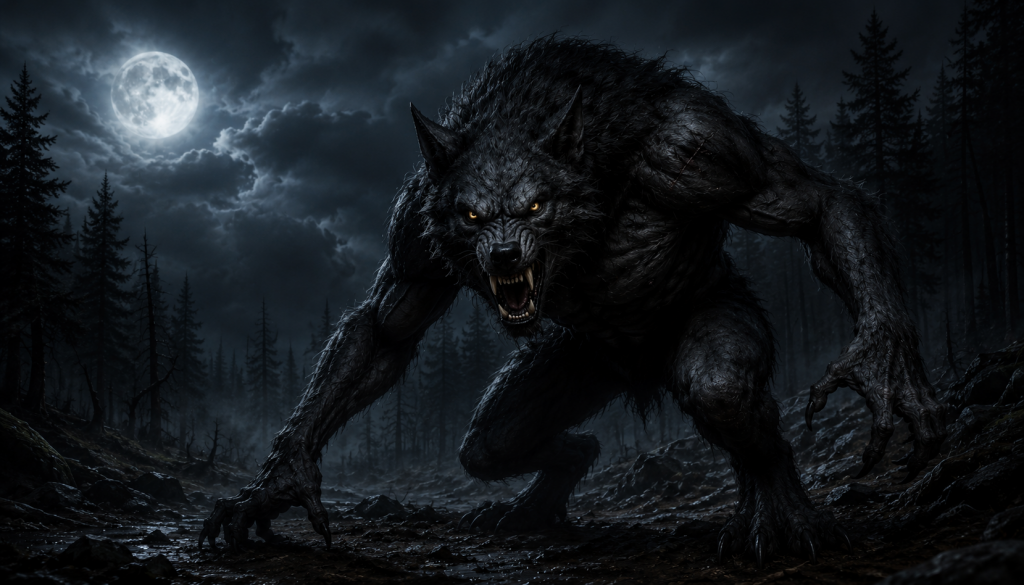
The werewolf has a specific origin point in Western mythology, and it is not medieval Europe. It is ancient Greece, and the man who became the first werewolf was a king. Lycaon, ruler of Arcadia, heard that Zeus was travelling through his kingdom in mortal disguise and decided to test whether his guest was truly divine. He killed a hostage, or in some versions his own son Nyctimus, mixed the flesh with animal meat, and served it to Zeus at a banquet.
Zeus knew immediately what had been placed before him. His response was total. He overturned the table, struck the palace with lightning, and transformed Lycaon into a wolf. The king who had served human flesh would spend the rest of his existence as a creature whose nature matched his act: a predator, an eater of flesh, something that had crossed the line between civilised humanity and animal violence and could not cross back.
The word lycanthropy, the clinical and folkloric term for werewolf transformation, derives directly from Lycaon’s name. Every werewolf in every tradition that followed him, from the medieval trial records of Peter Stumpp to the Rougarou of Louisiana, carries his name in the word used to describe what they are.
The Sources
The Lycaon myth appears in multiple ancient sources, most fully in Ovid’s Metamorphoses and in Pausanias’s Description of Greece. The two accounts differ in significant details. Ovid’s version, written in the first century BCE, presents Lycaon as a sceptic who wanted to test Zeus’s divinity and chose the most transgressive possible test: serving him human flesh. Pausanias, writing in the second century CE, gives a different emphasis, connecting the transformation to the ritual sacrifice practices at Mount Lycaon in Arcadia, where ancient accounts described human sacrifice and where the person who performed the sacrifice was said to transform into a wolf for nine years.
The Mount Lycaon connection is the most archaeologically interesting aspect of the tradition. Mount Lycaon was a real place with a real cult, and the ancient accounts of transformative ritual there suggest that the Lycaon myth may have had roots in actual religious practices whose nature the later tradition encoded in mythological form. Whether those practices genuinely involved human sacrifice or whether the accounts reflect a cultural memory of older and stranger rites that later Greeks found alarming is a question the evidence does not settle cleanly.
What the Myth Is About
The Lycaon story is fundamentally a myth about hospitality and its violation. Zeus was travelling as a guest, and Lycaon violated the sacred obligations of the host in the most extreme way possible: rather than feeding his guest properly, he tried to feed him human flesh. The Greek concept of xenia, the sacred law of hospitality that governed the relationship between host and guest, was one of Zeus’s specific domains as Zeus Xenios, and the violation of it in Lycaon’s house was therefore both a personal insult to Zeus and a cosmological transgression against the order he maintained.
The punishment transforms the transgressor into what his act implied he already was. Lycaon behaved like a predator rather than a host, like an animal rather than a civilised ruler, like something outside the boundaries of human society rather than a king within it. The transformation makes the inner nature visible in the outer form. He became what he had already shown himself to be.
This logic, that werewolf transformation reveals rather than creates the beast within, runs through the entire Western werewolf tradition that follows from Lycaon. The medieval werewolf trials consistently framed the accused as people whose bestial inner nature had found physical expression. The folkloric tradition in which evil or sinful people were more susceptible to werewolf transformation reflects the same understanding. Lycaon established the template.
The Nine-Year Transformation
Pausanias’s account of the Mount Lycaon ritual includes one of the most distinctive details in the entire werewolf tradition: the transformation was not permanent. A person who ate human flesh at the mountain’s sacred sacrifice transformed into a wolf, but if they refrained from eating human flesh for nine years, they could return to human form. If they ate human flesh during those nine years, the transformation became permanent.
This reversibility, conditional on behaviour during the transformed period, is an early version of the redemption possibility that appears in various werewolf traditions, the idea that the wolf-state is not a permanent condemnation but a test, and that the outcome depends on what the transformed person chooses to do with their time in the other form. The Langsuir of Malaysian tradition can similarly be restored to human form if certain conditions are met. The Bisclavret of Marie de France’s poem is a fundamentally good man trapped in wolf form by his wife’s treachery. The theme of werewolf transformation as a state to be endured and potentially escaped rather than a final damnation has deep roots in the Lycaon tradition.
Further Reading
If this article sparked your interest, these are the books worth reading next.
The Beast of Gévaudan
by Jay M. Smith — the most thorough historical investigation into the creature that terrorised southern France between 1764 and 1767, and what the historical record actually reveals about what it was.
The Werewolf Book: The Encyclopedia of Shape-Shifting Beings
The most comprehensive reference on the werewolf tradition across world cultures — every regional variant, every historical case, every folkloric and literary expression of the shape-shifting being.
The Werewolf in Lore and Legend
by Montague Summers — the classic scholarly treatment of werewolf belief, drawing on primary sources from across Europe. Dense, serious, and still the best single academic treatment of the tradition.
For more on the werewolf tradition, the Dark Origins of the Werewolf article covers the broader history of werewolf belief. The Peter Stumpp article covers the most infamous werewolf trial in European history. The Werewolf Trials of Europe article covers the full history of werewolf prosecutions.
Never miss a myth
Thank you for being here. The site is brand new and every subscriber genuinely means something to me. If you're here, you care about this stuff as much as I do - and that's all the reason I need to keep going. New stories, videos and dark folklore from around the world, straight to your inbox. No algorithm. Just the stories, when they're ready.