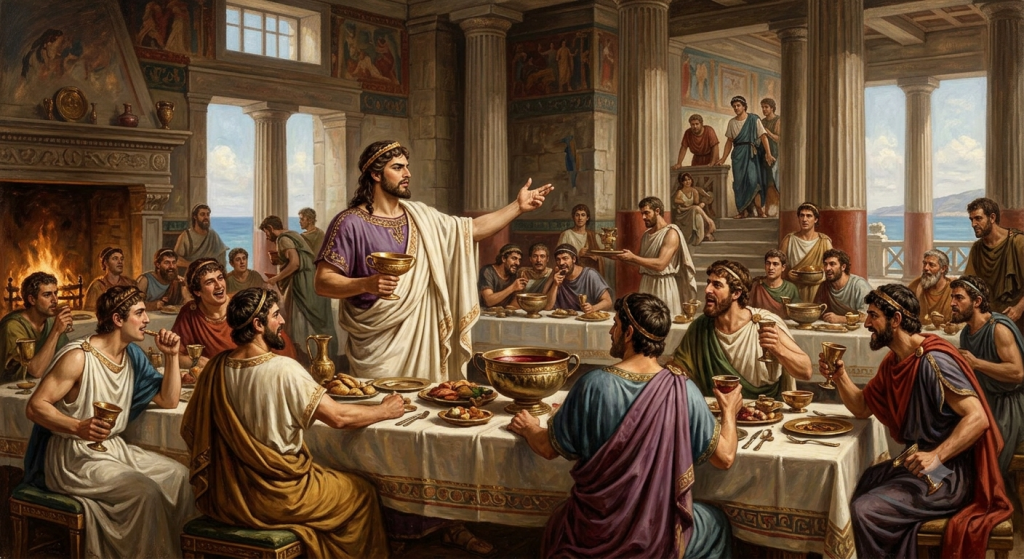
There are one hundred and eight suitors in Odysseus’s palace when he returns to Ithaca. Homer names many of them: Antinous, Eurymachus, Amphinomus, Ctesippus, Agelaus, Leocritus and others. Some of them get a line or two of characterisation. Most are simply present, eating and drinking and waiting. At the end of Book 22, every one of them is dead.
The killing of the suitors is one of the most violent episodes in Homer, and it is sometimes read as disproportionate: a hundred and eight men killed for the crime of eating someone’s food and pursuing his wife while he was absent. That reading misses what the Odyssey understands the suitors’ crime to actually be. They are not simply rude houseguests. They are men who have violated xenia, the sacred obligation of guest-host reciprocity that in the Greek world was protected by Zeus himself and constituted one of the foundations of civilised life. Odysseus does not kill them out of anger or revenge. He kills them because the crime they have committed demands it, and because in the theological framework of the Odyssey, allowing it to go unpunished would be a greater disorder than the slaughter required to correct it.
Understanding why requires understanding what xenia was, and what Antinous does to it.
Interested in Greek Mythology? Check out my YouTube channel below
Xenia: The Sacred Law They Broke
Xenia, sometimes translated as guest-friendship or hospitality, was one of the most important social and religious institutions in ancient Greece. It governed the relationship between host and guest with a precision that goes well beyond the modern concept of being a good host. A traveller arriving at your door was entitled to food, shelter, and protection before you even asked his name. The host was obliged to provide these things regardless of who the guest was. The guest was obliged to be respectful, to not overstay their welcome, and to reciprocate the hospitality when the opportunity arose. The relationship, once established, could pass down through generations: if your grandfather had hosted someone’s grandfather, you had an obligation to that person’s descendants that carried real social and legal weight.
Zeus Xenios, Zeus in his aspect as protector of guests and strangers, was the divine guarantor of xenia. To violate it was not merely a social failing. It was an offence against the king of the gods, which is why violations of xenia throughout Greek mythology are punished with a consistency and severity that might otherwise seem disproportionate. The Trojan War itself, in the Greek understanding, was a consequence of Paris violating xenia: he was Menelaus’s guest when he left with Helen, and the war was divine justice for that breach.
The suitors violate xenia in the most comprehensive possible way. They are not guests of the household in any legitimate sense. They arrived uninvited, installed themselves, and have been there for years. They eat Odysseus’s food, drink his wine, sleep with his serving women, plot against his son’s life, and pressure his wife to remarry a man who may still be alive. They are guests who have taken the host’s place, which in the framework of xenia is the deepest possible inversion of the institution’s purpose. They have turned the obligation of hospitality into its own violation.
When Odysseus arrives disguised as a beggar and Antinous throws a footstool at him, refusing him food and insulting him in his own hall, the act is not simply rude. It is a further offence against Zeus Xenios, committed by a man who is himself in another man’s hall without right. The suitors are simultaneously failing the obligations of guests and failing the obligations of hosts, which is the complete inversion of everything xenia requires.
Antinous: The Ringleader
Antinous, son of Eupeithes of Ithaca, is the first suitor named in the Odyssey and the most consistently dangerous. Homer constructs him as the embodiment of the suitors’ worst qualities: aggressive where others are merely self-interested, violent where others are merely greedy, and the driving force behind the actions that move the suitors from violation to active crime.
It is Antinous who organises the ambush of Telemachus. When the young prince travels to Pylos and Sparta to seek news of his father, Antinous proposes intercepting his ship on the return journey and killing him before he can reach Ithaca. The motivation is political: a Telemachus who returns safely from a successful journey, who has been treated as an equal by veterans like Nestor and Menelaus, is a Telemachus who is becoming the kind of man that the suitors cannot simply dismiss. Killing him is not passion or spite. It is calculated political violence designed to remove the legitimate heir before he becomes a genuine obstacle.
The ambush fails because Athena warns Telemachus to take a different route. But the attempt reveals something important about Antinous that distinguishes him from most of the other suitors: he is not simply consuming Odysseus’s household in the hope that patience will eventually win him Penelope and the throne. He is actively managing the political situation, removing threats, and doing what is necessary to ensure the outcome he wants. He is, in the language the Odyssey uses, hubris made flesh: the excessive pride and aggression that in Greek tragedy reliably produces catastrophe.
His death is the most precisely rendered in the slaughter. Odysseus, his disguise finally dropped, takes his bow and shoots Antinous through the throat as he lifts a golden cup to drink. The detail of the cup is exact: Antinous dies in the act of consuming another man’s wine, which is what he has been doing for years, and the arrow through the throat stops the consumption permanently. He never realises what is happening. He has no time to react, no opportunity for the speech and negotiation that the other suitors will attempt. He simply dies, the first and the worst.
Eurymachus: The Politician
Eurymachus is the second most prominent suitor and in some ways the more interesting one, because Homer gives him qualities that Antinous lacks and that make him more morally complex than a straightforward villain.
Where Antinous is openly aggressive, Eurymachus is charming. He manipulates situations through rhetoric rather than force, presenting himself as reasonable when it suits him and concealing his intentions behind a facade of apparent goodwill. He tells Penelope that Telemachus is his dearest friend on earth and that he will protect him, while simultaneously having arranged for Telemachus’s murder. The gap between what Eurymachus says and what Eurymachus does is consistent and deliberate: he is a politician in the worst sense, someone who uses the language of obligation and affection as a tool for getting what he wants rather than as a genuine expression of how he feels.
When Odysseus reveals himself and begins killing suitors, Eurymachus attempts to negotiate. He blames everything on the dead Antinous: it was Antinous who led them astray, Antinous who plotted against Telemachus, Antinous whose death should satisfy any reasonable demand for justice. He offers restitution: the suitors will collectively repay what they have consumed, twenty oxen each, bronze and gold, everything that has been taken will be returned. The offer is coherent and it might, in different circumstances, be the basis for a real negotiation.
Odysseus does not negotiate. He tells Eurymachus that he would not stop even if the suitors offered him everything they had, because what they have done cannot be settled with livestock and metal. The refusal is final. Eurymachus dies shortly afterward, killed by Odysseus directly, reaching for his sword and trying to rush the archer who has already shot two of his companions. Even in his last moment he is choosing the aggressive option because charm has failed.
Amphinomus: The Exception That Proves the Rule
Homer gives one suitor a quality the others do not have: genuine decency. Amphinomus of Dulichium is described as among the most agreeable of the suitors, a man who sometimes speaks up for restraint and who makes Penelope feel more comfortable than most of the others do. When Antinous proposes killing Telemachus, it is Amphinomus who argues against it, saying that gods should be consulted before anyone commits murder against a prince.
Odysseus, in his disguise as a beggar, warns Amphinomus directly. He tells him that Odysseus is coming home, that the suitors are doomed, and that Amphinomus should leave now while he still can. The warning is the clearest act of mercy in the entire episode, and Amphinomus almost certainly understands what he is being told. He leaves the conversation troubled, feeling something ominous that he cannot quite articulate. But he stays. He does not leave. And he dies with the others in Book 22.
His death is the most troubling in the slaughter, and it is meant to be. The Odyssey is not interested in a simple moral where the good ones escape and the bad ones get what they deserve. Amphinomus is decent and he dies anyway because he chose to stay in a situation he knew was wrong rather than leave when he had the chance. The tragedy is not that he was as bad as Antinous. It is that he knew better and did nothing with that knowledge.
The Aftermath: Were They Wrong to Die?
The Odyssey does not end with the death of the suitors. It ends with the families of the suitors gathering to take revenge for their sons, led by Eupeithes, the father of Antinous. The near-civil war that follows is only prevented by Athena’s direct intervention, which stops the fighting and imposes peace by divine command.
The fact that Homer includes this aftermath is significant. It acknowledges that from the perspective of the suitors’ families, a hundred and eight young men were killed by one man who had been away for twenty years. The families have a point, or at least a grievance, even if the theological framework of the poem places the suitors entirely in the wrong. The Odyssey ends with a forced peace rather than a satisfying resolution, which is the most honest thing it could do: the violence required to correct the suitors’ violation of xenia was real violence, and the consequences of real violence do not disappear when the justice that demanded them has been served.
In Christopher Nolan’s 2026 film, Robert Pattinson plays Antinous. Early reviews describe him as the film’s most detestable presence, playing the character with a smug cruelty that makes every scene in Ithaca feel dangerous. The casting is well-suited to the role: Pattinson has spent much of his career playing attractive men with the capacity for coldness beneath the surface, which is exactly what Antinous requires. The film apparently gives the Ithaca storyline significant weight alongside the voyage narrative, which means the suitors are not simply a problem to be solved in the final act but a sustained political and domestic crisis that the audience lives with for most of the film’s running time.
Further Reading
If this article sparked your interest, these are the books worth reading next.
The Iliad — Homer (Penguin Classics)
by Homer — the primary source for everything in this article, and still the most vivid account of the Trojan War ever written.
The Odyssey — Homer (Emily Wilson translation)
by Homer, translated by Emily Wilson — the best modern English translation, and the book that contains Odysseus’s own account of the horse.
The Trojan War: A Very Short Introduction
by Eric Cline — the clearest and most up to date account of what archaeology actually tells us about Troy and whether any of it happened.
For more on the characters of the Odyssey, the Penelope article covers the woman the suitors were pressuring to remarry and the strategies she used to resist them. The Telemachus article covers the son whose murder Antinous planned and who helped kill the suitors when his father returned. The Is the Odyssey a True Story article examines what is historically real in Homer’s poem.
Never miss a myth
Thank you for being here. The site is brand new and every subscriber genuinely means something to me. If you're here, you care about this stuff as much as I do - and that's all the reason I need to keep going. New stories, videos and dark folklore from around the world, straight to your inbox. No algorithm. Just the stories, when they're ready.