
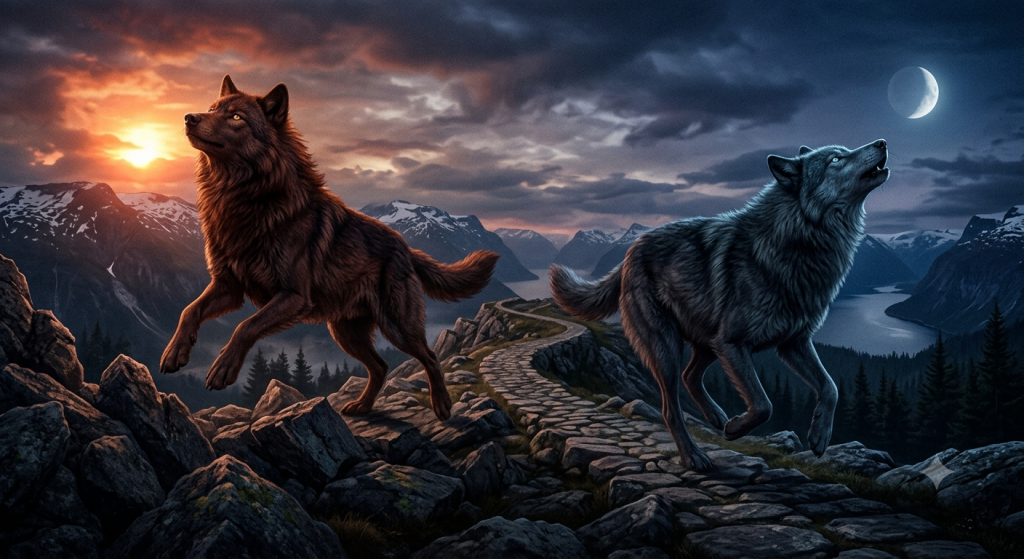
The sun and moon move across the Norse sky because they are being chased. Sol, the sun goddess, drives her chariot as fast as she can. Máni, the moon god, drives his. Both of them are running. The reason they keep moving, the reason the days and nights continue in their rhythm, is that the wolves chasing them have not caught them yet.
Sköll pursues one. Hati pursues the other. They have been running since before the current mythological age began, and they will be running until Ragnarök, at which point they will finally catch what they have been chasing across the entire duration of the cosmos.
The sun goes down each evening not because it has completed a natural cycle but because the wolf behind it is gaining ground. It rises the next morning because the wolf has not yet caught it. The rhythm of day and night, the most fundamental structure of experienced time in the Norse world, is a product of a pursuit that has always been on the verge of succeeding and never quite has.
At Ragnarök it does. Sköll catches the sun. Hati catches the moon. The light ends. Then the stars go out. Then the earth shakes, and Fenrir breaks free, and the world ends.
Their Names and What They Mean
Sköll derives from the Old Norse skǫll, meaning treachery or mockery. Hati derives from hati, meaning he who hates or simply enemy. The names are not incidental. They encode what the chase is: a hateful and treacherous pursuit of the light, relentless and purposeful and aimed at destruction. These are not wolves that happen to be in the vicinity of the sun and moon. They are beings defined by their function, and their function is to unmake the light.
Hati’s full recorded name in the Grímnismál is Hati Hróðvitnisson, Hati son of Hróðvitnir. Hróðvitnir is a kenning meaning fame-wolf or renowned wolf, and it is used elsewhere in the Eddic tradition as a name for Fenrir. If the identification is correct, Hati is Fenrir’s son, which places the wolves who chase the sun and moon in the same family as the wolf who will swallow Odin and the serpent who will kill Thor. The destruction of the light at Ragnarök is a family project.
The Völuspá describes the cosmic scene in the stanza that comes just before Ragnarök is described in detail: an old woman sits in Járnviðr, the Ironwood, a dark forest east of Midgard, and she breeds Fenrir’s offspring. One in particular, described as the devourer of the sun, will take a troll’s shape. This is the tradition’s most direct connection of the wolves to Fenrir’s bloodline, though the sources are not entirely consistent and the precise genealogy differs across different texts.
Sol and Máni: What Is Being Chased
The sun and moon in Norse cosmology are not simply astronomical objects. They are persons: Sol, the sun goddess, and Máni, the moon god, who drive their respective chariots across the sky. Sol’s chariot is pulled by two horses named Árvakr and Alsviðr, Early Awake and Very Quick. The speed of the horses is not their natural pace but the pace forced upon them by what follows behind them.
The Eddas describe Sol as the daughter of a man named Mundilfari who named his children after the sun and moon out of pride in their beauty. The gods, offended by this presumption, took both children and set them to drive the celestial bodies across the sky as their punishment and function. Sol drives the sun. Máni drives the moon and governs its phases, taking two children from the earth named Hjúki and Bil who follow the moon’s waxing and waning. The tradition records this without apparent irony: the rhythm of the month is governed by a lunar deity accompanied by two earthly children he has collected.
What drives the celestial chariots at their pace is the wolves behind them. Sol and Máni move as fast as their horses can carry them because if they slow down the wolves catch up. The speed of the sun across the sky is the speed of something being chased.
The Source Contradiction: Which Wolf Chases Which
The sources do not agree on which wolf pursues the sun and which pursues the moon, and this is worth being honest about rather than presenting a false confidence.
The Grímnismál, one of the poems in the Poetic Edda, states that Sköll follows the shining one into the desolate forest, using a masculine noun that appears to refer to Máni the moon god, while Hati chases the bright bride of the sky, a feminine phrase that appears to refer to Sol the sun goddess. Under this reading, Sköll chases the moon and Hati chases the sun.
Snorri’s Prose Edda appears to reverse this, identifying Sköll as the wolf that pursues the sun and Hati as the one that chases the moon. This is the more commonly cited arrangement in popular accounts of the mythology, and it may be that Snorri had access to sources that resolved the ambiguity in this direction.
The names offer a partial clue. Hati means hatred or enemy, and the sun is the more important target: catching the sun would plunge the world into darkness more dramatically than catching the moon. A wolf named enemy targeting the sun is a more dramatically coherent image than a wolf named enemy targeting the moon. But this is inference from naming rather than direct textual confirmation, and the tradition simply does not give us a definitive single answer that all sources agree on.
The Chase as Cosmological Constant
The pursuit of the sun and moon by the wolves is not an event in Norse mythology in the way that the binding of Fenrir or the death of Baldr are events. It is a permanent condition of the cosmos. For the entire duration of the pre-Ragnarök world, from before the current mythological age through all the events preserved in the Eddas, Sköll and Hati are chasing the sun and moon. They are not mentioned in the stories about the gods. They are not characters who interact with other figures. They are simply always there, behind the light, running.
This is the most unusual thing about them in the tradition: they have no story except the chase itself. They do not make decisions. They do not have relationships. They are not drawn into the politics of Asgard or the plans of Odin or the mischief of Loki. They simply pursue, because pursuit is what they are.
The Norse tradition is elsewhere full of figures who have specific roles and then participate in the broader mythological narrative. Tyr is the god of justice who also puts his hand in Fenrir’s mouth. Freyr is the fertility god who also falls in love with a giantess. Sköll and Hati have no second dimension. They are their function.
In this sense they are more cosmological than mythological: elements of the structure of the Norse cosmos rather than characters within its stories. The reason the sun and moon move at their pace is Sköll and Hati. The reason each day ends is Sköll gaining ground. The reason it begins again is that Sköll has not caught Sol yet. Every Norse person who watched the sun move across the sky was watching a wolf chase.
The Ironwood and the Family
The Völuspá’s reference to the old woman in Járnviðr, the Ironwood, breeding Fenrir’s offspring points to a tradition about a specific location beyond Midgard’s eastern edge where the wolves connected to Fenrir’s bloodline originate. Járnviðr, whose name means iron wood, is a dark forest associated in the tradition with monstrous wolves and with forces hostile to the ordered cosmos.
The image is a useful one for understanding Sköll and Hati’s place in the tradition: they come from the same darkness that produced Fenrir, from a place at the edge of the mapped world where the things that will end the cosmos are being bred. They are not intrusions from outside the Norse cosmological system. They are endemic to it, part of its structure from the beginning, built into the fabric of the world in the same way that Ragnarök itself is built into the world’s fate.
The wolves chasing the sun and moon are the cosmos’s own undoing, present in every sunrise and sunset, waiting for the moment that the tradition has always said would come.
Ragnarök: When the Chase Ends
The Völuspá’s description of the moment the wolves catch their prey is brief and appropriately violent. The sun goes dark. The earth sinks into the sea. The bright stars vanish from the heavens. Then the chaos that has been held at bay by the ordered cosmos breaks through and Ragnarök proceeds.
The catching of the sun and moon is not a climactic battle. There is no described conflict between the wolves and Sol and Máni. The chase simply ends in capture, because the chase was always going to end in capture, and the world ends with the light.
What happens to Sköll and Hati after they catch their prey is not described in the surviving sources. They have performed their function. The tradition does not follow them further.
What it does describe is the sun that rises over the new world. The Völuspá ends the destruction with the image of a new earth rising from the water, green and fertile, with eagles flying and waterfalls flowing. And in the new sky, a new sun: not Sol, who was swallowed, but Sol’s daughter, who takes her mother’s place and drives the new day across the new world’s sky.
Whether a new Sköll and Hati will follow this new sun is a question the tradition does not address. The new world’s sky may simply be a sky. But the old world’s sky was always a chase, and the beauty of every sunrise was the beauty of something that had survived one more night of being hunted.
Further Reading
If this article sparked your interest, these are the books worth reading next.
Norse Mythology
by Neil Gaiman — the most accessible modern retelling of the Norse myths, written with genuine respect for the source material.
The Prose Edda (Penguin Classics)
by Snorri Sturluson — the thirteenth century Icelandic text that is the primary source for almost everything we know about Norse mythology.
The Viking Spirit
by Daniel McCoy — the best modern scholarly introduction to Norse mythology, written for general readers without being dumbed down.
For more on the Norse tradition, the Fenrir article covers the wolf whose bloodline produced Sköll and Hati and whose binding by the gods is the central act of containment in the pre-Ragnarök cosmos. The Ragnarök article covers the end that the wolves’ successful chase initiates, and the new world that rises from the water afterward. The Fimbulwinter article covers the three winters that precede the battle and the human collapse that accompanies them.
Never miss a myth
Thank you for being here. The site is brand new and every subscriber genuinely means something to me. If you're here, you care about this stuff as much as I do - and that's all the reason I need to keep going. New stories, videos and dark folklore from around the world, straight to your inbox. No algorithm. Just the stories, when they're ready.

