Before we go any further, the name is pronounced roughly Koo Kullen. Not Koo Choo-lin, not Kyoo Chulainn, not anything that resembles how it looks on the page. Irish mythology has a habit of spelling things in ways that bear almost no relationship to how they are actually said, and Cú Chulainn is among the most extreme examples. The name means Hound of Culann, and how he earned it is the first story worth telling about him.
He was born Sétanta, the son of the god Lugh and Deichtire, the sister of Conchobar mac Nessa, king of Ulster. He arrived at Emain Macha, the royal seat of Ulster, at the age of seven and immediately fought and defeated all one hundred and fifty boys of the royal boy-troop single-handed, which was apparently considered a reasonable introduction. Shortly afterward, he killed the ferocious guard dog of a smith named Culann with his bare hands while Culann was hosting a feast, because the dog attacked him and he was seven years old and did not have a weapon but did have extraordinary reflexes and strength that he could not yet fully account for. Culann was aggrieved about his dog. Sétanta offered to serve as his guard dog himself until a replacement could be trained. From that point forward, he was the Hound of Culann. The name stuck.
He was prophesied, at the beginning of his life, to have a short life and an immortal reputation. He chose the short life. He made this choice consciously, understanding what it meant, and the tradition treats this as the defining decision of his existence: the hero who understood the terms and accepted them anyway.
The Son of a God, the Champion of Ulster
Cú Chulainn’s divine parentage is handled with characteristic Irish mythological complexity. Lugh, the god of light and skill, is consistently identified as his father, but the manner of his conception involves a narrative in which Deichtire and her women disappear for three years and return with a child, and Lugh appears to explain what happened. The story is told in the Compert Con Culainn, the Conception of Cú Chulainn, and it is one of several texts that form the pre-tales of the Táin Bó Cúailnge, the great Cattle Raid of Cooley that is the central text of the Ulster Cycle.
His appearance is described in specific and unusual detail in the manuscripts. His hair is three colours: dark at the roots, red in the middle, and bright gold at the tips. Each of his cheeks has four dimples of different colours: blue, crimson, green, and yellow. He has seven pupils in each eye. He has seven fingers on each hand and seven toes on each foot. These details are not presented as monstrous. They are presented as marks of his exceptional nature, the physical signs of a being who exists at the edge of what a human body can be.
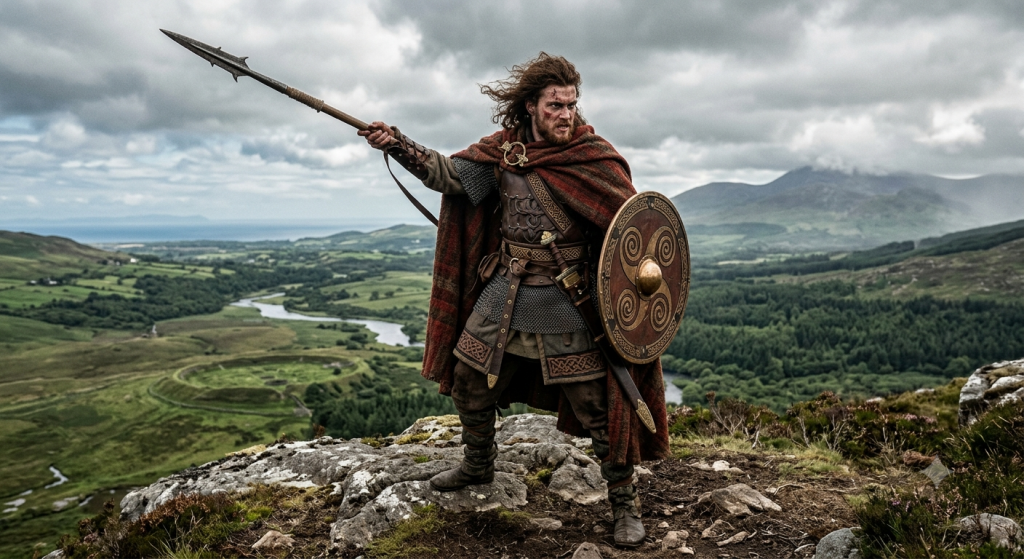
He was trained in martial arts by Scáthach, a warrior woman who lived on an island off the coast of Scotland, accessible only by crossing a bridge that threw off anyone who tried to cross it in a state of fear. Cú Chulainn crossed it. Scáthach trained him in techniques available to no other warrior, including the Gáe Bolg, a spear thrown with the foot that entered the body as a single wound and opened into thirty barbs inside the flesh. He also fought and defeated Aífe, Scáthach’s rival and enemy, sparing her life in exchange for a night together and the promise that she would bear him a son. The son was Connla, and that story ends badly.
The Ríastrad: The Warp-Spasm
The most distinctive and most disturbing thing about Cú Chulainn in combat is the ríastrad, the Irish term that Thomas Kinsella translated as the warp-spasm in his 1969 version of the Táin. It is a transformation that overcomes him in battle, and the Táin describes it in detail that has no real parallel in any other mythological tradition.
One eye sucks back into his skull until a heron could stand in the socket. The other eye bulges forward onto his cheek. His mouth opens until his jaw touches his chest. His hair stands on his head with such force that, the text says, if a tree were above him the bristling of his hair would stick into the bark. He turns around inside his own skin: his shins and his knees face backward, his calves and his heels face forward. A pillar of dark blood rises from the top of his skull. He becomes, in this state, something that does not recognise friend from enemy and cannot be approached by anyone who values their life.
The word ríastrad means distortion or torque in Irish, the sense of something being twisted past the point where it can recover. It is not berserker rage in the Norse sense, which is heat and frenzy. It is something colder and more structural: a fundamental reorganisation of the body’s relationship to itself, a transformation that the tradition treats as genuinely happening rather than as a metaphor for extreme anger.
The method developed in the Ulster tradition for calming Cú Chulainn after the ríastrad involves three vats of cold water. He is plunged into the first and the water boils around him. He is plunged into the second and the water becomes too hot to touch. He is plunged into the third and the water becomes merely warm. After the third vat, he is himself again.
The ríastrad is the most Irish thing about him. Greek heroes have superhuman strength and divine parentage. Norse heroes have berserker fury and destiny. Cú Chulainn has something that does not fit neatly into either category: a physical transformation so extreme that the text has to describe it joint by joint, that makes him simultaneously more dangerous than any human warrior and completely unmanageable by the people he is fighting for.
The Táin: One Man Against an Army
The Táin Bó Cúailnge, the Cattle Raid of Cooley, is the central text of the Ulster Cycle and one of the most important works in Irish literature. It has been compared to the Iliad in terms of its cultural significance to the tradition that produced it, and while the comparison is imperfect it captures something true about what the Táin is: the epic narrative of a conflict between provinces, built around the actions of a single extraordinary hero, that has defined how a culture understands heroism for over a thousand years.
The premise is that Queen Medb of Connacht wants the Brown Bull of Cooley, the finest bull in Ireland, which belongs to a man in Ulster named Dáire mac Fiachna. Dáire will not sell it. Medb decides to take it by force. She assembles the armies of the four provinces of Ireland, with warriors and heroes from every corner of the island, and marches on Ulster.
The men of Ulster cannot fight. They are under a curse laid by the goddess Macha, who had been forced to race horses while pregnant and whose suffering placed a curse on the men of Ulster that they would suffer labour pains for nine days whenever Ulster faced its greatest need. The curse exempts Cú Chulainn, who is not fully of Ulster through his divine parentage.
He holds the army of Ireland alone. He does this not through open battle, which would be suicidal against an army of tens of thousands, but through the convention of single combat at the ford: under the rules of heroic engagement, Medb’s army agrees to send one champion at a time to face him, in exchange for not advancing while the combat continues. Cú Chulainn fights a different champion every day, killing each one, while the army waits on the other side of the ford.
This continues for months. He fights in the ríastrad. He fights wounded. He fights Fer Diad, his closest friend and foster brother, in a combat that lasts four days and that the tradition treats as the most painful episode in his story, because Cú Chulainn kills Fer Diad with the Gáe Bolg and then holds his friend’s body and mourns over it in terms that the text renders in verse, the formal poetry of genuine grief. He wins every combat and he never recovers from any of them in the way that a purely mythological figure would. Each fight costs him something.
The Killing of Connla
The pre-tales of the Táin include the Aided Óenfhir Aífe, the Tragic Death of Aífe’s Only Son, which tells what happened to the son Cú Chulainn fathered on Aífe during his training with Scáthach.
Aífe raised the boy, named Connla, alone in Scotland. When Connla was old enough to be a warrior, she sent him to Ireland to find his father, but she placed a geasa on him: he must not reveal his name to any man, he must not refuse a combat, and he must not give way to any man. These three prohibitions, in combination, make his death almost inevitable. A young warrior who cannot name himself, cannot refuse a fight, and cannot yield will walk into a situation he cannot survive.
Connla arrives at the shore of Ulster and the warriors of Ulster challenge him. He defeats them all. Cú Chulainn goes to face him. Neither recognises the other. Cú Chulainn asks his name and Connla refuses to give it. They fight. Cú Chulainn uses the Gáe Bolg. Connla falls. As he is dying he tells Cú Chulainn who he is. Cú Chulainn carries his son’s body back to the Ulster warriors and presents it to them, and then apparently there is nothing more to say.
The story is one of the oldest in the tradition of the son killed by the father who does not recognise him, appearing in Persian mythology with Rostam and Sohrab, in Norse mythology with Hildebrand and Hadubrand. The parallel is close enough that scholars have discussed shared Indo-European roots. What makes the Irish version distinctive is the geasa: Connla is killed not simply by tragic misrecognition but by obligations that were placed on him specifically by his mother to ensure this outcome. Whether that makes Aífe a villain or a mother ensuring her son would have the death of a hero rather than something lesser is a question the tradition leaves open.
The Morrigan and the Geasa
The relationship between Cú Chulainn and the Morrigan, covered in detail in the Morrigan article elsewhere on this site, runs through the Ulster Cycle as a sustained and increasingly dark thread. She offers him her love and her help before the Táin. He refuses both, telling her he has no time for a woman during a battle. She attacks him in three animal forms during the fighting. He wounds her in each form without recognising her. She appears to him in disguise as an old woman milking a cow and he blesses her three times, healing the wounds he inflicted without knowing it. Each blessing exhausts some of the protection that has kept him alive.
The geasa, the sacred obligations that govern his life, are where she finally finds her leverage. Cú Chulainn is bound by two geasa that are incompatible with each other: he must never eat dog meat, because of his name and his origins, and he must never refuse the hospitality of food from a woman. The enemies who kill him engineer a situation in which both geasa must be broken simultaneously. Three hags, working for Lugaid and Erc, offer him dog meat cooked over a fire. He cannot refuse the hospitality. He cannot eat the meat. Breaking the first weakens him physically. Breaking the second weakens him spiritually. He walks into his final battle already diminished.
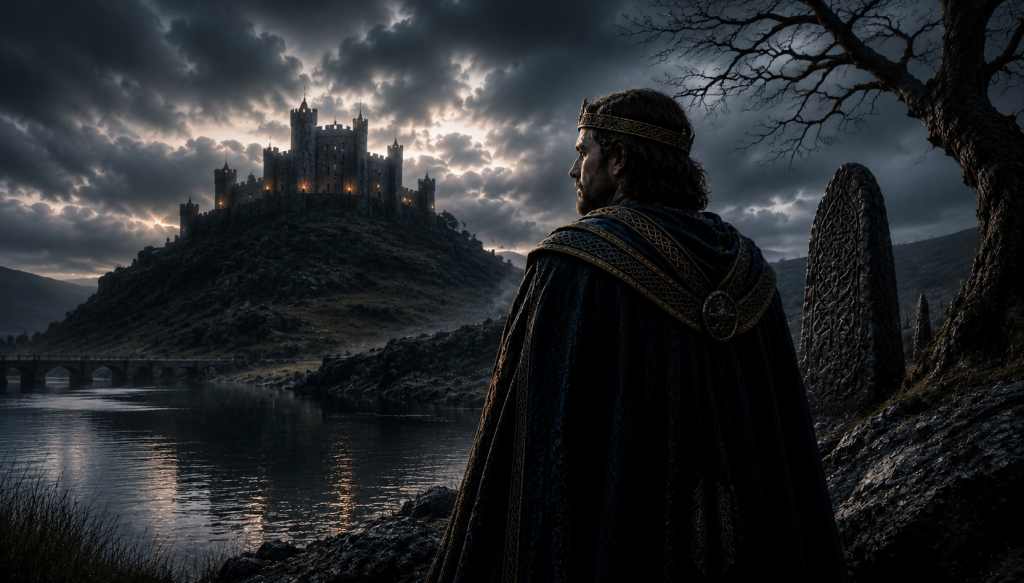
He is killed at Mag Murthemne, struck by the spear of Lugaid mac Con Roi, one of three magical spears that have been prophesied to kill kings: a king of charioteers, a king of warriors, and a king of Ireland. As he is dying, he ties himself to a standing stone so he can face his enemies upright rather than falling. It is the Morrigan, appearing as a crow, who lands on his shoulder and whose presence tells his enemies he is finally dead. He does not fall until the crow lands. Even dying, he holds his position.
His Legacy in Ireland and Scotland
Cú Chulainn belongs to Ireland and Scotland in roughly equal measure, which is worth noting because the popular presentation of him is almost entirely Irish. The tradition places his training with Scáthach in Scotland, on an island usually identified with the Isle of Skye. His son Connla was raised in Scotland. The Manx tradition has its own version of the Ulster Cycle material. The Gaelic-speaking world on both sides of the narrow sea shared this mythology in the way it shared the language, without particular concern for the political boundaries that later divided them.
In more recent history, Cú Chulainn has been claimed by both sides of the Irish political divide in ways that the mythology itself does not particularly support. A large statue of him dying at the standing stone stands in the General Post Office in Dublin, placed there to commemorate the 1916 Rising. The Ulster Defence Association in Northern Ireland also used his image, on the grounds that he defended Ulster. The tradition is old enough and complex enough to contain all of these readings, which is characteristic of mythology that has been living and changing for over a thousand years rather than being fixed in a single canonical form.
He appears in video games, in graphic novels, in fantasy fiction, and in a growing body of modern retellings that range from faithful to completely reimagined. The audience that encounters him through those routes and then wants to know what the actual tradition says is a large and growing one, and what they find when they look is considerably stranger and more interesting than any modern retelling has fully captured.
The warp-spasm alone is worth the price of admission. Nothing in Greek mythology, nothing in Norse mythology, nothing in any other tradition quite prepares you for the specific texture of what the Táin describes happening to Cú Chulainn’s body when he goes into battle. It is one of the most original things in world mythology, and it belongs to Ireland.
For more on the figures connected to his story, the Morrigan article covers the goddess whose relationship with him runs through the Ulster Cycle from his refusal of her love to the crow that signals his death. The Fionn Mac Cumhaill article covers the other great hero of Irish mythology, from a different cycle and a different tradition. The broader Ireland category has more on the mythology and folklore of the Irish tradition.
Never miss a myth
Thank you for being here. The site is brand new and every subscriber genuinely means something to me. If you're here, you care about this stuff as much as I do - and that's all the reason I need to keep going. New stories, videos and dark folklore from around the world, straight to your inbox. No algorithm. Just the stories, when they're ready.