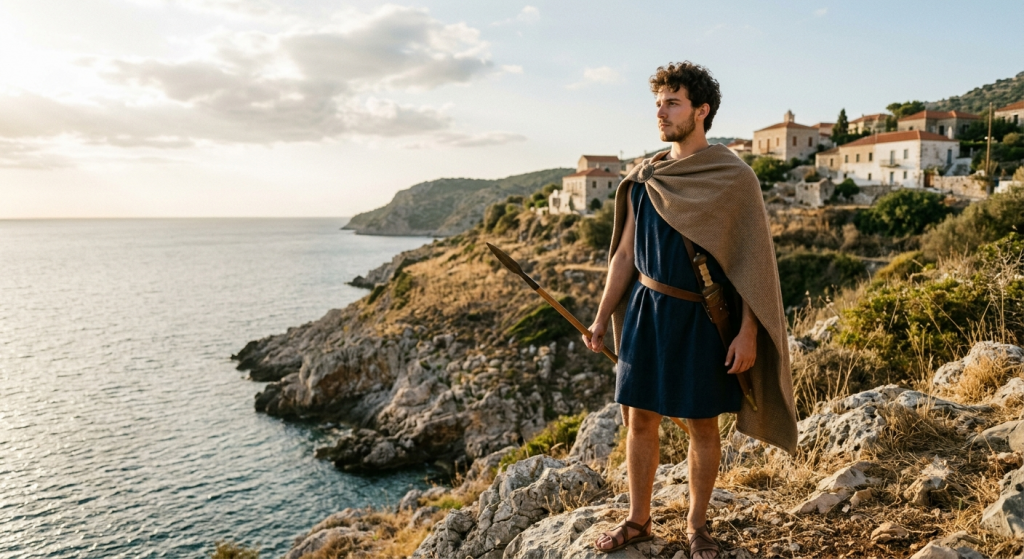
Telemachus is one of the most underrated figures in classical literature. He appears in the shadow of his famous father, and the Odyssey is read primarily as Odysseus’s story, which means Telemachus tends to be treated as a supporting character in his own coming-of-age narrative rather than as a figure of genuine complexity and genuine importance to what the poem is doing. This is a misreading of Homer’s intentions. The first four books of the Odyssey, the section scholars call the Telemachy, follow Telemachus rather than Odysseus, and they do so for a reason: Telemachus is the person through whose eyes the poem wants you to understand what Odysseus’s absence has cost, what Odysseus’s return will mean, and what kind of world the Odyssey is set in before the hero arrives to transform it.
He is also the character who raises the most immediately searchable question about the Odyssey: how old is he? The answer is approximately twenty years, and the poem’s handling of his age is considerably more sophisticated than a simple number suggests. His age is both a literal fact within the narrative and a structural principle that organises the poem’s moral logic, because Telemachus is old enough to understand what has been lost but young enough to have no experience of the father he is asked to believe in, emulate, and eventually fight alongside.
How Old Is Telemachus? The Poem’s Own Answer
Telemachus was an infant when Odysseus left for Troy. The Odyssey itself states this clearly: when Odysseus departed for the war, Telemachus was too young to have any memory of his father. The Trojan War, according to the tradition, lasted ten years. Odysseus’s subsequent wandering, which is the subject of the Odyssey, also lasted ten years. When the poem opens, Odysseus has been absent for twenty years, which means Telemachus, who was an infant at the time of his father’s departure, is now approximately twenty years old.
The poem confirms this with specific language. At several points characters describe Telemachus as having recently reached the age of a young man, as being newly capable of understanding his situation and acting on it, and as being at precisely the moment in his development when he must choose what kind of man he will become. Athena, who becomes Telemachus’s patron and guide in the first books of the poem, explicitly describes him as having reached manhood and being ready to take action, and she frames the Telemachy as a test of whether he can rise to the challenge that his father’s absence and his household’s deterioration present.
The specific age of twenty is not stated directly in the poem but is consistently implied by the arithmetic of the timeline and by the poem’s characterisation of Telemachus as young but no longer a child, capable but inexperienced, intelligent but untested. Ancient commentators on the Odyssey generally agreed on approximately twenty as his age, and modern scholars working from the poem’s internal chronology have confirmed this reading.
His age matters narratively for several reasons. A teenager could not credibly stand up to the suitors, confront them in assembly, or travel independently to visit Nestor and Menelaus, which are the actions the poem requires of him in the Telemachy. A man in his late twenties or thirties would be past the specifically transitional moment of early adulthood that the poem is interested in examining. Twenty is the age at which the poem needs him: old enough to act, young enough for the actions to be genuinely costly in terms of effort and courage.
The Telemachy: What the First Four Books Are Actually Doing
The first four books of the Odyssey are sometimes taught as a prologue or a preliminary section that the poem must get through before it can reach the proper subject of Odysseus’s adventures. This is wrong in a way that misses what is most interesting about the poem’s structure. The Telemachy is not a prologue. It is the poem’s establishment of the moral stakes that make Odysseus’s return meaningful rather than simply exciting.
When the poem opens, the situation on Ithaca is as follows: over a hundred young men from the noble families of Ithaca and the surrounding islands have taken up residence in Odysseus’s palace on the grounds that his wife Penelope must choose one of them as her husband, since Odysseus has been absent for twenty years and must be presumed dead. These men, the suitors, are consuming Odysseus’s estate at an extraordinary rate. They eat his livestock, drink his wine, sleep in his halls, and treat his household servants with contempt and occasional violence. They are also beginning to discuss the possibility of killing Telemachus to prevent him from inheriting his father’s position and estate.
Telemachus is living in his father’s house as a guest in his own home, too young to have established himself as master of the household, too aware of what is happening to simply ignore it, and too isolated to have any practical means of stopping it. His mother is performing a strategic delay by weaving and unweaving a shroud — she promises to choose a husband when the shroud is complete, then unpicks her work each night — but this strategy has been discovered and cannot be maintained much longer. The situation is deteriorating and Telemachus knows it.
Into this situation comes Athena, disguised as an old family friend named Mentes, who advises Telemachus to call the suitors to assembly, demand that they leave, and then travel to the mainland to seek news of his father from the heroes who fought at Troy and have since returned home. The advice is not practically useful in the sense of solving the immediate problem, since calling an assembly will not make the suitors leave and travelling abroad will not bring Odysseus back. Its value is developmental: it forces Telemachus to act publicly as the master of his household, to assert himself against the suitors in front of the community, and to take the initiative in seeking his own father rather than simply waiting for events to resolve themselves.
Telemachus in Assembly: His First Public Act
The assembly scene in Book Two of the Odyssey is one of the most carefully constructed in the poem, and Telemachus’s performance in it tells you everything about where he is at the opening of his story and where the poem needs him to go. He calls the assembly — the first assembly called on Ithaca since Odysseus’s departure twenty years before — and addresses it. He lays out the situation clearly and correctly. He names what the suitors are doing and identifies it as wrong. He appeals to the community to intervene.
The suitors respond with contempt, shifting the blame onto Penelope for her delays and effectively telling Telemachus that his household’s situation is his mother’s fault and therefore not their problem. The community does nothing. Telemachus has done everything right — he has spoken truly, argued correctly, and appealed to legitimate communal authority — and it has made no practical difference whatsoever.
This failure is not the poem demonstrating that Telemachus is inadequate. It is the poem demonstrating that the situation on Ithaca is genuinely unjust in ways that the normal mechanisms of communal resolution cannot address, which is why Odysseus’s return is necessary and why his return will require violence rather than simply legal or social remedy. Telemachus’s correct but ineffectual assembly speech establishes the moral stakes: the suitors are in the wrong, the community knows it, and nothing short of Odysseus’s return will set it right.
The Journey to Pylos and Sparta
Telemachus’s journey to the Greek mainland, visiting Nestor at Pylos and Menelaus at Sparta, is the practical content of the Telemachy and the mechanism through which the poem achieves several things simultaneously. It gets Telemachus out of the palace where he is powerless, introduces him to the surviving heroes of the Trojan War who can tell him about his father and model what heroic manhood looks like, and provides the poem with an opportunity to establish the wider context of the post-war Greek world.
Nestor at Pylos is the oldest of the surviving Greek heroes, a man of vast experience and endless reminiscence who fought at Troy and returned safely home to a prosperous kingdom with an intact family. He tells Telemachus about the returns of the various Greek heroes, including the disastrous return of Agamemnon who was murdered by his wife on his arrival home, and he establishes the specific contrast that the poem wants the reader to carry forward: Agamemnon came home to treachery and death; Odysseus will come home to treachery as well, but the poem is about to demonstrate that the outcome need not be the same if the man returning is Odysseus rather than Agamemnon.
Menelaus at Sparta is more useful in terms of direct information about Odysseus’s whereabouts. He tells Telemachus about his own encounter with the sea god Proteus during his wanderings, and reports that Proteus told him Odysseus was alive but stranded on the island of the nymph Calypso, unable to leave. This is the first confirmed information about Odysseus’s actual location, and it is significant that the poem delivers this information not to the gods or to Odysseus himself but to Telemachus, establishing that Telemachus’s journey has been productive in a way that matters.
The contrast between the two visits is itself instructive. Nestor’s Pylos is orderly, pious, and somewhat formal: Telemachus is impressed but not transformed by what he finds there. Menelaus’s Sparta is wealthier, more glamorous, and more emotionally charged: Menelaus is still processing his own return and his own guilt about the war, Helen is present and her specific complicated role in the events of Troy hangs over the visit. Telemachus is navigating adult emotional complexity for the first time, and the poem is interested in how he handles it.
Telemachus and Penelope
The relationship between Telemachus and his mother Penelope is one of the most subtly drawn in the poem, and it is worth examining carefully because it illuminates the specific challenge of Telemachus’s situation. Penelope is an extraordinarily capable woman who has managed to delay the suitors for three years through the weaving deception and who has maintained her household under conditions of sustained pressure and occasional threat. She loves her son and fears for his safety. She is also, from Telemachus’s perspective, in a situation that his developing sense of male responsibility makes genuinely uncomfortable.
In Book One, when Penelope comes downstairs and asks the bard to stop singing about the difficult returns of the Greek heroes because it pains her, Telemachus tells her firmly to go back to her room and attend to her own work, because speech is the business of men and of him in particular as master of the house. This is a jarring moment for modern readers, and it is meant to be jarring. Telemachus is performing the authority he has been told he must assert, but he is performing it clumsily, in the wrong context, against the wrong person. He is not wrong that he needs to establish his authority in his household, but he is wrong about how and where to begin establishing it.
The poem does not endorse Telemachus’s treatment of Penelope in this moment. It records it as what Telemachus does, and the gap between what he does and what the situation actually requires is part of the characterisation: he is twenty years old, he has no experience of authority, and he is trying to inhabit a role that has been empty for his entire life. His errors in the first books of the poem are the errors of someone learning how to be who he needs to be, not the errors of someone who is fundamentally incapable of becoming that person.
Telemachus as a Fighter
By the time Odysseus returns and reveals himself to Telemachus in Book Sixteen, Telemachus has been transformed by his journey and his experiences into someone capable of participating in the violence that restoring order to Ithaca will require. The reunion between father and son in Book Sixteen is one of the most emotionally affecting passages in the poem, and it is followed immediately by Odysseus outlining the plan for dealing with the suitors and Telemachus agreeing to his assigned role in it.
Telemachus’s role in the killing of the suitors in Book Twenty-Two is not that of the hero who carries the action: Odysseus kills most of the suitors himself, and Telemachus is one of the four men fighting alongside him. But Telemachus fights, and his presence in the battle matters. He is the person whose inheritance is being reclaimed, whose household is being restored, and whose future on Ithaca is being secured. The violence is partly on his behalf, and his participation makes it his act as well as his father’s.
There is one moment in the battle scene where Telemachus makes a significant error: he fails to close a storeroom door, allowing the suitors’ supporters to access weapons that temporarily complicate the fight. Homer records this mistake matter-of-factly, without either excusing it or belaboring it. Telemachus is not the perfect hero, but he is fighting alongside the perfect hero, and that is what the poem requires of him at this point in the story.
What Telemachus Represents in the Poem
Telemachus is the poem’s answer to the question of what Odysseus’s absence has cost beyond the immediately visible destruction of his estate and the suffering of his wife. Odysseus has a son who has grown to adulthood without a father, who has never learned from his father how to be a man, who has had to piece together his identity from stories other people tell about someone he cannot remember. The emotional weight of this situation is something the poem takes seriously and handles with great care.
The first four books of the Odyssey are in this sense a bildungsroman, a coming-of-age narrative, embedded within an epic about homecoming. Telemachus begins the poem as a young man paralysed by his situation and ends it as someone capable of fighting for his household and his future. The transformation is not dramatic or sudden: it happens gradually, through the accumulation of experience that the Telemachy provides, and it is not complete by the end of the poem. Telemachus is still young at the poem’s close, still learning, still in the process of becoming.
The poem’s interest in Telemachus is also an interest in the problem of inheritance and continuity. Odysseus is Ithaca’s legitimate king, but Odysseus is absent and the community needs a king now. Telemachus is the heir, but Telemachus is not yet the king. The suitors are exploiting exactly this gap between the legitimate heir and his ability to exercise legitimate authority, and the poem’s resolution requires not just Odysseus’s return but Telemachus’s development to the point where the gap can begin to close. The killing of the suitors does not make Telemachus the king. It makes him the son of the king who has returned, which is a different thing, and the poem is honest about the difference.
Further Reading
If this article sparked your interest, these are the books worth reading next.
The Iliad — Homer (Penguin Classics)
by Homer — the primary source for everything in this article, and still the most vivid account of the Trojan War ever written.
The Odyssey — Homer (Emily Wilson translation)
by Homer, translated by Emily Wilson — the best modern English translation, and the book that contains Odysseus’s own account of the horse.
The Trojan War: A Very Short Introduction
by Eric Cline — the clearest and most up to date account of what archaeology actually tells us about Troy and whether any of it happened.
For more on the world of the Odyssey, the Sirens article covers one of the most misunderstood encounters in the poem and what Homer actually says about them. The Circe article covers the most important supernatural figure in the second half of the Odyssey. The Penelope article covers Telemachus’s mother and the extraordinary intelligence behind her strategy of delay. The Greek Mythology hub page has every article in the cluster.
Never miss a myth
Thank you for being here. The site is brand new and every subscriber genuinely means something to me. If you're here, you care about this stuff as much as I do - and that's all the reason I need to keep going. New stories, videos and dark folklore from around the world, straight to your inbox. No algorithm. Just the stories, when they're ready.