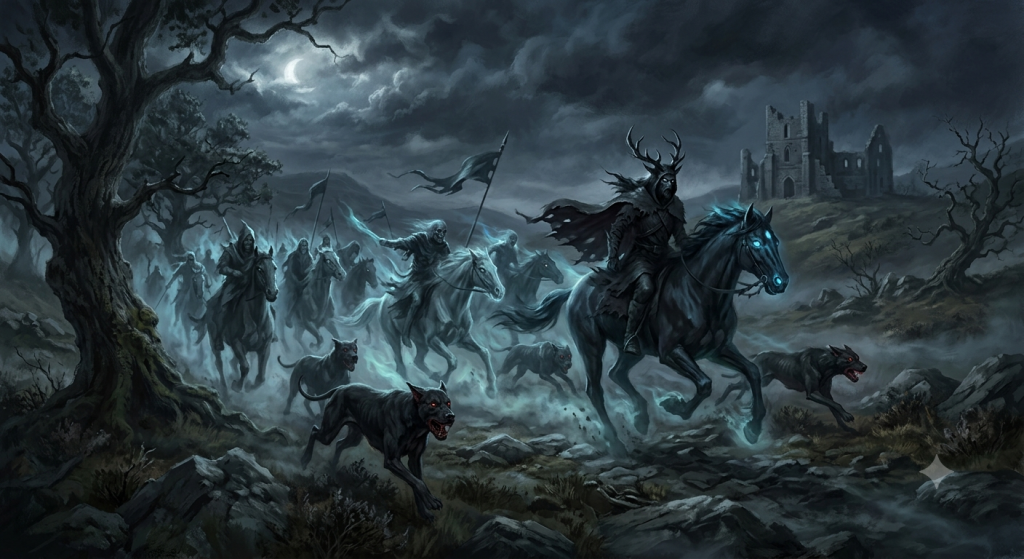
In the winter of 1127, according to the Peterborough Chronicle, several reliable witnesses including monks reported seeing something extraordinary in the skies above Peterborough, continuing over a period of nine weeks between Peterborough and Stamford. What they saw was a company of riders: twenty or thirty of them, huge, on black horses and black goats, with hounds in attendance. The riders made noise but the witnesses could not quite describe what kind. The company appeared at night and the monks who recorded the account were apparently confident that what they were describing was real and significant and worth preserving.
This is the earliest substantial English documentary record of the Wild Hunt. It is not a myth retold at a safe distance of centuries. It is a contemporary account written by people who believed they were reporting something they had actually seen, and it sits in the middle of a tradition that stretches from the pre-Christian Germanic world to the present day, changing its leader and its specifics while remaining recognisably itself across two thousand years of European history.
The Wild Hunt is one of the most persistent and most widely distributed supernatural traditions in the western world. It appears in some form across Germanic, Norse, Celtic, Slavic, and Romance language cultures, always with the same essential structure: a company of spectral riders moving through the sky or across the earth, usually at night, usually in winter, led by a figure whose identity changes with the tradition but whose authority over the dead and the dying is consistent. To see the Hunt is an omen. To be caught by it is worse.
Odin and the Germanic Roots
The earliest and most thoroughly documented version of the Wild Hunt is Germanic, and its leader is Odin. Jacob Grimm, the philologist and folklore scholar whose Teutonic Mythology remains one of the foundational texts of Germanic folklore studies, called it Woden’s Hunt and traced its roots to the pre-Christian Germanic understanding of Odin as a god of the dead, the wind, and the transition between worlds.
In Norse and Germanic tradition, Odin led the Einherjar, the chosen dead who had fallen in battle and been gathered by his Valkyries to await the final conflict at Ragnarok. The Wild Hunt in this framework was Odin riding out with his host, moving through the world during the darkest and most spiritually active time of the year. In Scandinavia it was called the Oskoreia, the Terrifying Ride, or Odensjakt, Odin’s Hunt. In Middle High German it was Wuotanes Her, Odin’s Army. The modern German term Wilde Jagd, the Wild Hunt, comes from the same tradition.
The connection to winter was specific and meaningful. The Twelve Nights, the period between Christmas and Epiphany that the Germanic tradition understood as a time of maximum supernatural activity, was the primary season for the Hunt. The howling winter winds were Odin’s breath or the sound of his eight-legged horse Sleipnir. The storms that came down from the north had a rider behind them, and the rider was not benevolent.
When Christianity spread across the Germanic world, it did not eliminate the Wild Hunt. It reinterpreted it. The pre-Christian Odin, who gathered the honoured dead and rode with warriors, became the Christian devil leading the damned. The Valkyries became demons. The fallen warriors became the souls of the wicked. The same procession, the same winter sky, the same omen of death and disaster: but the theological framework shifted from a pagan understanding of the afterlife to a Christian one. Jacob Grimm argued that this process of demonisation was what gave the Hunt its particularly terrifying quality in the medieval period. A tradition that had originally been morally complex, the gathering of the honoured dead was not straightforwardly evil, became unambiguously sinister once Christianity decided that anything connected to the old gods was by definition diabolic.
The English Tradition: Multiple Leaders, One Hunt
The English Wild Hunt is unusual within the broader European tradition because it has more named leaders than almost any other regional version, and those leaders come from very different mythological and historical backgrounds. This multiplicity reflects the layered nature of English culture itself: a country with pre-Roman Celtic roots, Roman occupation, Anglo-Saxon settlement, Viking incursion, and Norman conquest, each wave bringing its own supernatural traditions and finding them absorbed into what was already there.
Woden, the Anglo-Saxon name for Odin, was the god of the Angles who controlled the area of Windsor Forest in the early medieval period. When Christianity became dominant, belief in Woden passed into folklore rather than disappearing, and the Wild Hunt in parts of England continued to be led by a Woden figure long after the formal worship of Woden had ended. The connection between Herne the Hunter, the antlered ghost of Windsor Forest who you will find covered in detail elsewhere on this site, and Woden is made by several scholars on the basis of the name Herne being related to Herian, one of Woden’s titles as leader of fallen warriors. The connection is speculative rather than proven, but it is consistent with the pattern by which the pre-Christian divine figures of England were absorbed into localised folklore rather than simply forgotten.
King Herla is one of the stranger English leaders of the Hunt, and his story belongs to the tradition of fairy time distortion that runs through British supernatural belief. Herla was a legendary British king who visited the Fairy King and attended a celebration in the Otherworld. When he left, the Fairy King gave him a small greyhound and instructed him not to dismount from his horse until the greyhound jumped down first. Herla and his company rode back into the human world. Three centuries had passed while they were in the Otherworld. His men who tried to dismount crumbled to dust. The dog has never jumped down. Herla and his company have been riding ever since, unable to stop, unable to return, condemned to the perpetual motion of the Hunt because no one can end it until the dog decides to end it.
King Arthur appears as a Wild Hunt leader in some Welsh and English accounts, which fits the broader pattern of the sleeping king tradition: Arthur is not simply dead but waiting, and in some versions of his mythology he rides out in the interim with the dead behind him. Wild Edric, an Anglo-Saxon nobleman who led resistance against the Norman conquest, appears in Shropshire tradition as a Wild Hunt leader whose company is seen before times of national crisis, most recently reported before the First and Second World Wars.
The Gabriel Hounds
One of the most distinctive elements of the English Wild Hunt tradition is the dogs, and specifically the phenomenon that gave the English Hunt one of its most evocative names. The Gabriel Hounds are the spectral pack of the Wild Hunt as heard rather than seen: a yelping, crying sound heard in the night sky, moving fast, belonging to something that is passing overhead without being visible.
The name Gabriel connects them to the archangel, which is a Christian overlay on something older. The sound itself is almost certainly the sound of migrating geese, whose formations move at night and produce a haunting collective cry that is difficult to identify and easy to misattribute to something supernatural when heard in the dark with no visual reference. The tradition that the Gabriel Hounds were an omen of death, that hearing them meant someone was about to die, would have been reinforced every time the geese migrated in autumn and winter brought sickness and death as it reliably did in pre-modern communities.
But the Gabriel Hounds are also described in traditions that cannot be reduced to misidentified geese: white hounds with red ears, the specific colouring of the supernatural dogs that appear across British and Irish folklore from the Cŵn Annwn of Welsh tradition to the hounds of the Irish Otherworld. The consistent description of red-eared white dogs across traditions that are geographically separate and linguistically distinct suggests something older than any individual regional account: a pan-British supernatural canine tradition whose specific origin is now irrecoverable.
What Happens If the Hunt Finds You
The consequences of encountering the Wild Hunt vary significantly across the European tradition, but the English and Germanic accounts are consistent on a few points. Hearing the Hunt is an omen of death or disaster, though not necessarily your own. Seeing the Hunt and being caught by it is considerably worse. Being swept up into the company, taken along for the ride as an involuntary member of the dead host, is the outcome that the tradition treats with the most fear.
The practical rules for surviving an encounter with the Hunt are documented across several traditions. Lying face down on the ground was one recommended approach, avoiding eye contact with the riders and presenting yourself as already below their notice. Throwing yourself into a ditch and covering your head was another. Some accounts recommended that if you heard the Hunt approaching you should immediately join in, shouting and making noise as if you were a voluntary participant, because the Hunt’s hostility was directed at those who stood apart from it rather than those who appeared to be part of it.
The Peterborough Chronicle account of 1127 does not record what happened to the witnesses beyond their observation of the Hunt. The monks who wrote it down were apparently not taken. Whether this is because they followed the correct protocols or simply because the Hunt had business elsewhere is not specified. The account ends with the observation and nothing further, which is characteristic of the kind of record that is more interested in documenting the phenomenon than in resolving it.
The Hunt Across Europe
The Wild Hunt is not exclusively English or Germanic. Versions of the same tradition appear across Europe with enough structural consistency to suggest a common root, even where the specific leaders and the specific rules differ considerably.
In Wales, the Hunt is the Cŵn Annwn, the Hounds of the Otherworld, led by Gwynn ap Nudd, the Lord of the Dead whose white hounds with red ears are the most consistent identifying feature of the Welsh version. In Brittany it is the Chasse Fantastique, the Phantom Hunt. In France the tradition arrived with the Normans and developed regional variations across the country, eventually reaching Francophone Canada where a version of the Hunt is known to fly through the air in a canoe, which is one of the more imaginative adaptations the tradition has undergone.
In Scandinavia the Oskoreia, mentioned earlier, was particularly associated with the Twelve Nights of Yule and with the spirits of the restless dead who rode out during that period to steal food and drink from human households, and occasionally to take human souls. This aspect of the Hunt, the hungry dead making demands of the living during the midwinter festival, is one that several folklorists have connected to the origins of the Christmas tradition of leaving food out for visitors: the hospitality offered to the Hunt as a way of appeasing it and encouraging it to move on.
The possible connection between the Wild Hunt and the Santa Claus tradition has been noted by several scholars. Odin riding through the sky on his eight-legged horse during midwinter, leaving gifts for the hospitable and passing over those who had offended him, bears a structural resemblance to the later tradition that is difficult to ignore. Whether the connection is direct or coincidental is debated, and the evolution of the Santa Claus figure involves so many different traditions that attributing it to any single source is probably too simple. But the midwinter sky-rider with a supernatural animal and a concern for human behaviour is not an invention of the 19th century, and the Wild Hunt is one of the places it comes from.
The Hunt in English Literature
The Wild Hunt enters English literary tradition relatively early and has never fully left it. Shakespeare’s Merry Wives of Windsor uses Herne the Hunter in a plot involving a nighttime meeting in Windsor Forest, which is one of the earliest literary treatments of the English Hunt and the text that has done most to preserve Herne’s name in the popular imagination. Whether Shakespeare was drawing on a genuine local tradition or creating one that subsequent generations then took to be ancient is a question that folklore scholars have not fully resolved.
The 19th century Romantic movement found the Wild Hunt irresistible as a literary subject. Heinrich Heine wrote about it. Sir Walter Scott incorporated it into his work. The figure of the dark rider with the spectral pack fitted perfectly with Romanticism’s appetite for the sublime, the terrifying, and the medieval, and the Hunt’s pan-European distribution meant that writers across the continent could claim it as part of their own national tradition.
In contemporary fiction and fantasy, the Wild Hunt appears with remarkable frequency, from Alan Garner’s work to The Witcher series to countless urban fantasy novels in which it rides through modern cities rather than medieval forests. The consistency with which modern writers return to the Hunt says something about the durability of the underlying idea: a company of the dead, moving through the world at the darkest time of year, led by a figure of enormous authority over the boundary between living and dead, is an image that has not exhausted its power across any of the centuries it has been in use.
What It Represents
The Wild Hunt is unusual among supernatural traditions in being explicitly collective rather than individual. Most folklore figures are solitary: the Kelpie haunts a particular loch, the Bodach comes down a particular chimney, the Banshee attaches herself to a particular family. The Hunt is a community of the dead, moving together, and its leader is defined by the authority to gather and lead rather than by individual power.
This collective quality is what gives it its particular character as a winter tradition. The midwinter period, when the year is at its darkest and coldest and the distance between the living and the dead feels at its smallest, is when the Hunt is most active. The dead do not disappear in winter. They gather, they ride, they make their presence felt in the sky above the communities of the living. The Hunt is the dead insisting on being acknowledged, making noise in the dark, demanding that the boundary between their world and the human world be respected rather than ignored.
Every culture that has ever had a winter has had a version of that insistence. The Wild Hunt is the European tradition’s most elaborate and most durable way of giving it a name.
For more on the figures associated with the Wild Hunt in England, the Herne the Hunter article covers the antlered ghost of Windsor Forest in detail. The England category has more on the supernatural tradition of the English landscape. For the Welsh version of the Hunt’s hounds, the Wales category covers the Cŵn Annwn and the broader Welsh supernatural tradition.
Never miss a myth
Thank you for being here. The site is brand new and every subscriber genuinely means something to me. If you're here, you care about this stuff as much as I do - and that's all the reason I need to keep going. New stories, videos and dark folklore from around the world, straight to your inbox. No algorithm. Just the stories, when they're ready.