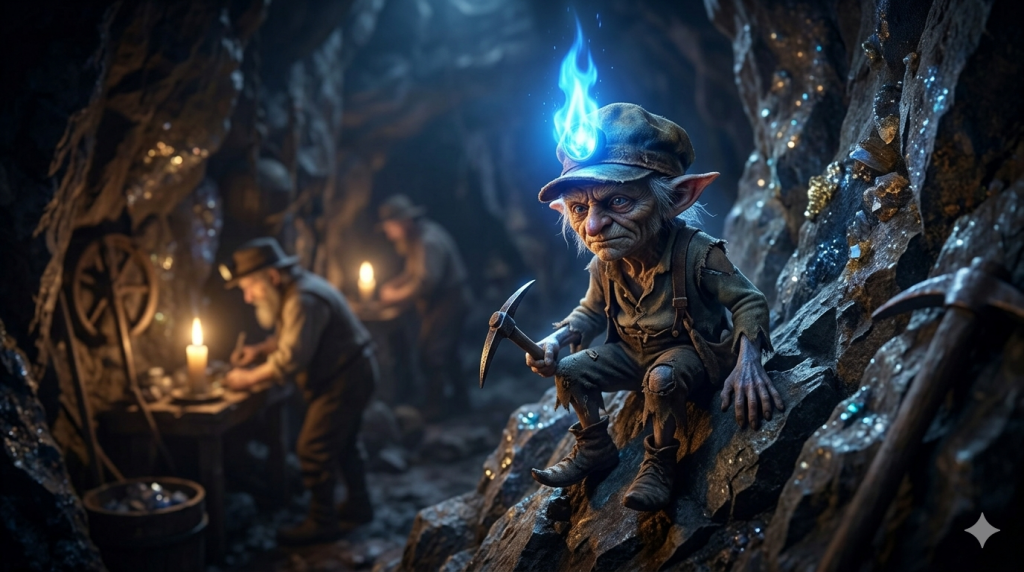
A light-blue flame flickers into existence somewhere in the darkness of the tunnel. It moves with purpose, settling on a full coal tub. Then the tub begins to move, rolling toward the shaft under its own power as though pushed by the strongest pair of hands in the pit. Nobody is behind it. Nobody needs to be.
A Spirit Built From the Realities of Mining Life
The folklore of British mining is a world unto itself, shaped by the specific terrors and daily realities of working deep underground in the dark, where the air could kill you before you ever heard a sound, where the ground above could close over your head without a moment’s warning, and where the only light came from the flame you carried with you. Out of that world came a family of mine spirits as distinct and specific as the industry that produced them, and the Bluecap stands at the centre of that tradition.
Unlike most creatures of British folklore, the Bluecap was not feared. It was, if properly treated, valued. It was a worker, and it asked for a worker’s wages, and the relationship it had with the miners of the northern coalfields was built on a principle of strict mutual respect and fair exchange rather than the usual dynamic of supernatural terror.
The Bluecap is described consistently across the sources that document it as appearing as a small, flickering blue flame. Not a figure. Not a face. Simply a flame, hovering in the air and moving with the specific intentionality of something that knows where it is going. When the flame settled on a coal tub, the tub moved. When it hovered over a section of wall, there was good ore behind it. And when the fortnightly wages left in the corner of the mine were short by even a farthing, the work stopped.
The Colliery at Shilbottle
The most thoroughly documented account of a Bluecap at work comes from Shilbottle Colliery, a coal mine near Alnwick in Northumberland, where the spirit apparently made itself a reliable and long-standing feature of working life throughout a substantial portion of the nineteenth century.
A writer in the Colliery Guardian on 23 May 1863 described what the miners at Shilbottle witnessed in terms that leave very little to the imagination: “Sometimes the miners would perceive a light-blue flame flicker through the air and settle on a full coal-tub, which immediately moved towards the rolly-way as though impelled by the sturdiest sinews in the working.”
The rolly-way was the underground rail system along which the coal tubs ran toward the pit shaft. The Bluecap was serving the role of a putter, a specific mining job title for someone who pushed or hauled the laden coal tubs along the underground rails from the working face toward the shaft. It was hard physical labour, one of the essential unglamorous functions that kept a colliery operating, and the Bluecap performed it with, by all accounts, a strength considerably beyond what any human putter could manage.
The Shilbottle Bluecap was also known locally as the Shilbottle Blue Bonnet, and the terms were used interchangeably by the miners who worked alongside it. It did not confine itself to a single area of the colliery but moved freely between sections of the mine, applying its efforts wherever they were most needed, in the way that a skilled and conscientious casual worker might cover different parts of a site on different shifts.
A Spirit With Exacting Standards of Fairness
What sets the Bluecap apart from almost every other helpful spirit in British folklore is the precision of its financial expectations.
Every fortnight, the miners left wages in a corner of the mine. Not an offering, not a gift, not a propitiation: wages. The same wages that a human putter of average ability would expect to receive for the same work. The Bluecap rated its own labour honestly and expected to be compensated honestly in return.
The consequences of getting this wrong were immediate and unambiguous. Pay a farthing too little, and the Bluecap rejected the entire amount, leaving the money where it was and withdrawing its services until the debt was properly settled. Pay a farthing too much, and it left the excess where it had found it, taking only what it was owed, not a penny more.
This is an extraordinary detail in the folklore of a supernatural being. Most creatures in the British tradition that form any kind of working relationship with humans operate on vaguer terms: keep the house clean for the brownie, leave milk for the fairies, avoid offending the knockers. The Bluecap demanded wage parity. It knew what the going rate was for a putter’s work, and it held to that rate with a precision that would have impressed a union negotiator.
Katharine Briggs, the twentieth century folklorist who documented the Bluecap in her 1976 Dictionary of Fairies, noted that this emphasis on fair payment rather than gifts or propitiation gave the Bluecap a character quite distinct from most other helpful supernatural beings. It was not seeking appeasement. It was seeking justice, the simple, specific justice of a day’s work honestly paid for.
The Blue Flame and What It Actually Was
The Bluecap’s defining characteristic, the small blue flame by which it manifested itself, is where the folklore and the physical reality of underground mining come into a genuinely fascinating conversation with each other.
Coal mines are saturated with methane gas, known to miners as firedamp, which seeps out of coal seams constantly and accumulates in pockets throughout the tunnels and workings. Firedamp is invisible. It has no smell. The only way to detect it, in an era before modern gas monitoring equipment, was the behaviour of the flames that miners carried with them: their candles or oil lamps would burn differently in the presence of gas, flickering and changing colour toward the blue end of the spectrum in a way that an experienced miner could read as a warning sign.
The Davy lamp, invented by Sir Humphry Davy in 1815 specifically in response to the series of catastrophic mine explosions that had been killing miners across Northumberland and Durham for decades, exploited exactly this property of flame in the presence of gas. The lamp’s design included a safety mesh that enclosed the flame, and the presence of firedamp caused a distinctive blue halo to appear around the enclosed flame, allowing miners to detect dangerous gas concentrations before they could cause an explosion.
The 1812 Felling Colliery disaster had killed 92 miners in a single explosion. Between 1786 and 1815, major explosions in Northumberland and Durham alone claimed 558 lives. These were not abstract statistics to the men who worked in those mines. They were colleagues, neighbours, fathers, sons. The blue flame was the difference between coming home and not coming home, and the miners who saw blue flames in the mine gave them meaning that went well beyond simple physics.
A pocket of methane burning off quietly in a corner, producing a small, steady blue flame that appeared to move with the air currents in the tunnel, would have been precisely the thing that both terrified and fascinated a miner in the pre-Davy-lamp era. The transformation of that flame into a helpful spirit, one that not only failed to kill you but actively helped with the heaviest work in the pit, is one of the most psychologically coherent pieces of folklore transformation in the British tradition. The miners took the thing they feared most, the blue flame in the dark, and made it into something that was on their side.
Relations and Cousins
The Bluecap did not exist in isolation but as part of a wider family of mine spirits found across the coalfields and metal mines of Britain, each adapted to the specific character of its region and its industry.
The Knockers, sometimes called Knackers, were mine spirits found throughout the tin and copper mines of Cornwall and Wales, named for the tapping and knocking sounds they made in the walls of the mine. Unlike the Bluecap, the Knockers were not helpful in any simple sense: they were unpredictable, capable of leading miners toward rich ore seams but also toward danger, requiring careful management and specific propitiations including a portion of a miner’s food left underground for them each day. The sounds they made were real enough in a practical sense: the groaning and cracking of rock under pressure is a constant companion in any deep mine, and experienced miners learned to read those sounds as warnings of structural instability.
The Welsh Coblynau occupied similar territory to the Knockers, gnome-like in appearance by tradition and cheerful in temperament, signalling the presence of rich ore deposits by knocking in the walls. Cornish miners who emigrated to the copper mines of North America in the nineteenth century took their Knocker traditions with them, where the spirits became known as Tommy-Knockers in the mining communities of Michigan, Colorado, and California, an example of folklore travelling with the labour force and taking root in new ground.
The German Kobold, the root word that eventually gave English its word goblin, began its folkloric life as a mine spirit very similar to the Bluecap in its general function, a being that inhabited mines and could be either helpful or dangerous depending on how it was treated. The Kobold evolved over centuries in German tradition into something closer to a household spirit, losing its specific mining association, but its origin in the underground places where miners worked every day is visible in the mineral cobalt, named after these spirits because it was believed to be a curse left by malevolent Kobolds in ore that looked promising but yielded nothing valuable when smelted.
If you want more like this, the Tales of Myth and Magic newsletter delivers new creatures, legends, and forgotten folklore straight to your inbox.
No fixed schedule. No noise. Just the stories, when they are ready.
Sign up here →A Spirit That Faded With the Industry
The Bluecap’s active presence in mining folklore appears to have declined significantly during the latter half of the nineteenth century, a period that coincides with the increasing mechanisation of the coal industry and the gradual introduction of scientific approaches to mine safety.
The Davy lamp, in particular, changed the relationship between miners and the blue flame that had given the Bluecap its name and its physical form. Once miners understood that a blue halo around a lamp flame indicated firedamp rather than a supernatural presence, and once they had a tool specifically designed to manage that risk, the interpretive framework that turned blue flames into a working spirit became less necessary. The physical phenomenon that had grounded the belief in something real and observable remained, but its meaning shifted from supernatural to scientific.
The last documented accounts of active belief in the Bluecap at Shilbottle date to the 1890s. The 1890 Monthly Chronicle of North-Country Lore and Legend recorded the Bluecap in terms that already had the quality of documenting something fading rather than something current, the kind of careful preservation that suggests the belief was already slipping from living tradition into documented memory.
Shilbottle Colliery itself closed in 1982, when the mine was finally exhausted. The village of Shilbottle in Northumberland still exists, the community it once supported substantially changed by the end of the industry that defined it. The Bluecap, if it was working the rolly-way when the last shift ended, would have found its wages uncollected and its services no longer required.
What the Bluecap Tells Us About Mining Communities
The Bluecap is a small story in the grand catalogue of British folklore, a creature documented in one specific region, associated with one specific industry, and faded from active belief within living memory of the sources that recorded it. But what it tells us about the communities that believed in it is not small at all.
Coal mining in the north of England was work that killed people regularly, suddenly, and without warning. The men who went underground every morning understood the specific nature of the risks they were taking in a way that most of us never have to understand risk. Out of that understanding came a tradition of relationships with the supernatural presences of the mine that were built on the same values that sustained the surface communities: fairness, mutual respect, the understanding that hard work deserved honest recompense.
The Bluecap did not ask to be worshipped. It did not demand elaborate rituals or specific propitiations that required a specialist to administer. It asked for the going rate for a putter’s wages, left in the corner every fortnight. That specificity, the insistence on exactly the right amount, neither more nor less, captures something important about the communities it came from: people who understood the value of labour from the inside out, who knew to the farthing what a hard shift underground was worth, and who created a supernatural helper that operated by the same rules they lived by.
A spirit that does an honest day’s work for an honest day’s pay, in the darkest and most dangerous workplace in England, is its own kind of remarkable.
Never miss a myth
Thank you for being here. The site is brand new and every subscriber genuinely means something to me. If you're here, you care about this stuff as much as I do - and that's all the reason I need to keep going. New stories, videos and dark folklore from around the world, straight to your inbox. No algorithm. Just the stories, when they're ready.