Somewhere on a dark road in the west of Ireland, a rider appears from the mist. He is moving fast, and he is carrying something. Look closely and you will see that what he carries under his arm is his own head, its eyes scanning the darkness with a grin stretched wide across its face. If it turns toward you, and if it speaks your name, your time has already run out.
A Rider Without Peer in Irish Folklore
Irish folklore is not short of terrifying figures. The banshee wails outside the windows of the dying. The each uisce, the water horse, lures riders to their deaths beneath dark loughs. The changelings steal the living and leave hollow things behind. But among all of them, the Dullahan occupies a position that is uniquely, specifically dreadful, because it does not warn, it does not substitute, it does not deceive. It simply arrives. And when it arrives, someone dies.
The name itself is rooted in the Irish language. Dullahan or dulachán derives from Irish terms meaning roughly dark man or dark one, a name that reaches toward something ancient and deliberately obscure rather than something that can be clearly defined and therefore, perhaps, defended against. It is also known in some traditions as the Gan Ceann, meaning literally without a head, the descriptor doing the minimum necessary work to identify something that ordinary language struggles to contain.
The Dullahan is classified in Irish tradition as one of the unseelie court of the fairy realm, a designation that separates it firmly from the benign or merely mischievous end of Irish supernatural belief and places it among those beings that are actively malevolent, operating by rules entirely their own rather than by anything a human might reasonably anticipate or appeal to.
What the Dullahan Looks Like
The physical description of the Dullahan is consistent enough across different traditions and different sources to suggest it was genuinely held as a specific image rather than a vague category of fear.
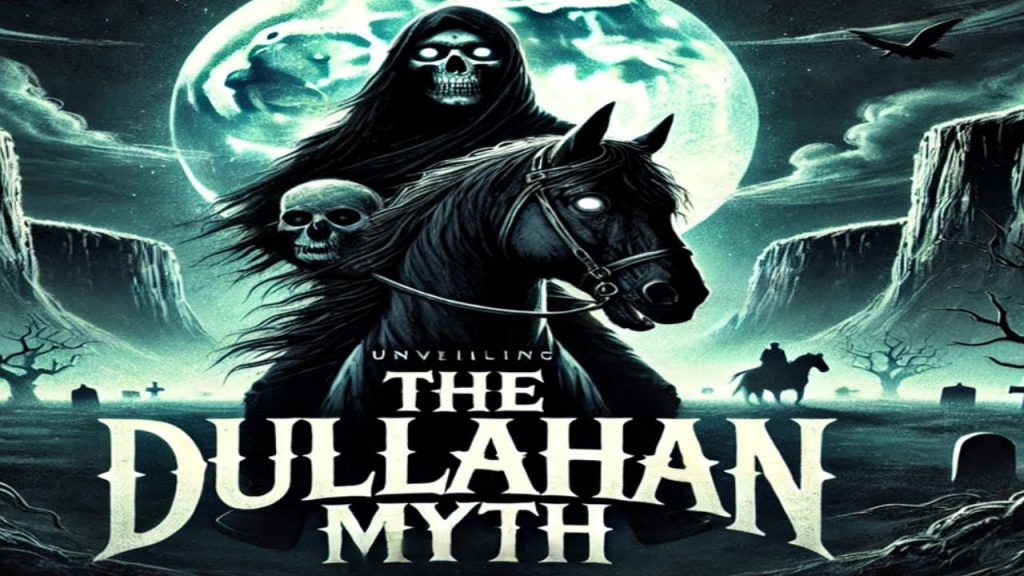
The rider is headless, the neck ending in a raw stump above the shoulders. The severed head is carried, sometimes tucked under one arm and sometimes held aloft, and it is described in terms that sit somewhere between grotesque and darkly comic: the face wearing a wide, fixed grin that stretches to the ears, the eyes small and constantly moving, scanning the landscape with restless attention. Some accounts describe the head glowing faintly in the darkness, functioning as its own lantern on moonless nights.
The horse, or horses, are black, and they are fast in the way that supernatural things are fast, covering distances that should be impossible in the time available, the sound of hooves arriving long after the rider should already be upon you. In some tellings the Dullahan rides a single enormous black horse with a head disproportionately elongated, its flaming eyes and cropped ears giving it an appearance as wrong as its rider. In other regional traditions the rider becomes a headless coachman driving the Cóiste Bodhar, the silent coach, drawn by six black horses whose speed is such that the friction of their passage has been known to set the hedges on the roads they travel along briefly alight.
The coach itself, in those tellings, is decorated in the specific imagery of death: lanterns made from human skulls, wheel axles fashioned from human bones, the coffin-black of its lacquer catching no light it did not need. It travels so fast that the locks of houses and gates along its route open of their own accord as it passes.
The weapon the Dullahan carries is a whip made from a human spine.
A God Stripped of His Sacrifices
The theological genealogy of the Dullahan reaches back behind Christianity into a considerably darker landscape of Irish religious practice, though this connection requires care to describe accurately, since the chain of association involves several distinct figures across several distinct eras.
The most ancient figure in the lineage is Cromm Crúaich, a pagan god mentioned in the twelfth century Book of Leinster and appearing as Cenn Cruach in the Tripartite Life of Saint Patrick, a hagiography that may date as far back as the ninth century. According to these Christian sources, Cromm Crúaich was the chief idol of pre-Christian Ireland, worshipped on Mag Slécht, the Plain of Adoration, in what is now County Cavan. The idol at its centre was said to be of gold, surrounded by twelve others of stone. To Cromm Crúaich the first-born of every family and every livestock were sacrificed each Samhain in exchange for the god’s favour and a bountiful harvest. The Oxford Dictionary of Celtic Mythology notes that the description of Cromm Crúaich as a cruel idol demanding human sacrifice may partly echo biblical accounts of Tophet and Moloch, meaning the portrait is not a neutral one, but the references are old enough and specific enough in their geography to suggest something genuinely real about the worship practised there.
Cromm Crúaich later became Crom Dubh in Irish oral tradition, a darker and more personalised figure described as a pagan chieftain or deity who demanded decapitation as the specific form of his sacrifices. When Saint Patrick arrived in Ireland, according to the traditions surrounding this transition, Crom Dubh’s power was broken, his sacrifices denied, his worship ended. What could not easily be resolved was what happened to a god stripped of the thing that sustained him.
The answer Irish folklore settled on was the Dullahan. Denied his sacrifices, Crom Dubh took to the roads himself, collecting the souls he was owed by riding out and calling the names of those fated to die, carrying his own head in the place of the decapitated victims no longer brought to him. This is not a universally accepted etymology, and at least one serious folklore scholar has noted that the direct Crom Dubh connection, while widely repeated, is sparsely documented in primary sources and may owe more to creative elaboration than to genuine continuous tradition. But the connection between the Dullahan’s decapitated form and the decapitation rituals of pre-Christian Irish worship is structurally coherent enough to have convinced a significant portion of those who have studied both.
The Name That Ends You
The Dullahan’s method is specific and final. It rides in silence for the most part, scanning the landscape with those restless eyes until it reaches its destination. When it stops, it speaks. It speaks a single name, the name of the person whose time has come, and the speaking of that name is the act of death itself. There is no warning that the Dullahan is coming for you specifically, no negotiation once it arrives, no possibility of appeal.
Unlike the banshee, whose wailing gives the family of the dying some forewarning, however anguished, the Dullahan offers nothing of the kind. By the time you hear your name, the decision has been made in whatever place these decisions are made. The Dullahan is not a portent. It is the delivery mechanism.
Anyone who witnesses the Dullahan and is not its intended target risks being blinded or having a basin of blood thrown in their face, a detail from Thomas Crofton Croker’s 1825 collection Fairy Legends and Traditions of the South of Ireland, one of the earliest published sources to deal with the Dullahan in any detail. Croker, whose work was so well regarded that the Brothers Grimm translated it into German, was among the first to systematically gather these stories from oral tradition in the south of Ireland, and his account remains one of the foundational documentary references for the legend.
The only reliable protection is gold. Gold in any form, a pin, a coin, a piece of jewellery, kept on the person, is said to cause the Dullahan to retreat. The reasoning is not explained in most tellings, simply stated as fact in the way that folk remedies often are: this works. No further justification is offered. Whether this connects to broader Celtic associations between gold and divine or protective power, or to something more specific about the relationship between the Dullahan and whatever lies behind it, the tradition does not clarify.
A Figure That Travelled
The Dullahan did not stay in Ireland. Its specific combination of headlessness, a horse, and the function of death herald proved compelling enough to cross into other folkloric traditions, and the question of how far that crossing extended has occupied scholars of comparative folklore for generations.
In German tradition, a headless horseman blows a horn to warn huntsmen away from a road where death will befall them that day. In the Grimm brothers’ collection, headless riders appear in variants that share enough DNA with the Irish figure to suggest either shared influence or parallel development from similar underlying anxieties about death’s arrival in darkness on horseback.
The most famous transformation of the Dullahan in the wider world is Washington Irving’s headless horseman in The Legend of Sleepy Hollow, published in 1820. Irving himself moved in literary circles that had direct contact with Irish folklore traditions, and the question of whether his Hessian soldier, who lost his head to a cannonball during the American Revolution and now hurls pumpkins at terrified schoolmasters, owes a direct debt to the Irish figure or simply drew from the same wider European headless rider tradition has never been entirely settled.
What can be said is that the Dullahan predates Irving’s story by centuries, that Croker’s collection, published five years after Sleepy Hollow, was already drawing on folklore that clearly predated the publication itself, and that the image of a headless rider calling out names in the dark is sufficiently different from a ghost soldier throwing pumpkins that the two stories, whatever their relationship, have taken their shared template in very different directions.
If you want more like this, the Tales of Myth and Magic newsletter delivers new creatures, legends, and forgotten folklore straight to your inbox.
No fixed schedule. No noise. Just the stories, when they are ready.
Sign up here →What the Head Means
There is a dimension to the Dullahan that goes beyond the surface horror of a man without a head on a fast horse in the dark, and it connects to something specific about how the Celts understood the human body.
For the pre-Christian Celts, the head was not simply another body part. It was understood as the seat of the soul, the location of identity, power, and the essential self, more than any other physical feature. The severed head in Celtic tradition carried enormous and persistent symbolic weight: heads were displayed as war trophies not simply as evidence of killing but as claims on the power and identity of the defeated, the belief being that something of the person remained concentrated in the head even after death. Skulls were preserved, venerated, and sometimes believed to retain the ability to speak.
A figure that carries its own head is, in this context, something stranger and more meaningful than simply a man who has had a terrible accident. It is a being whose soul, whose power, whose essential identity, exists separately from its body, mobile and watchful and not diminished by the separation. The Dullahan’s head, scanning the dark roads of Ireland with its permanent grin, is not simply grotesque decoration. It is the seat of whatever power allows this thing to know your name and find you in the dark.
Never miss a myth
Thank you for being here. The site is brand new and every subscriber genuinely means something to me. If you're here, you care about this stuff as much as I do - and that's all the reason I need to keep going. New stories, videos and dark folklore from around the world, straight to your inbox. No algorithm. Just the stories, when they're ready.