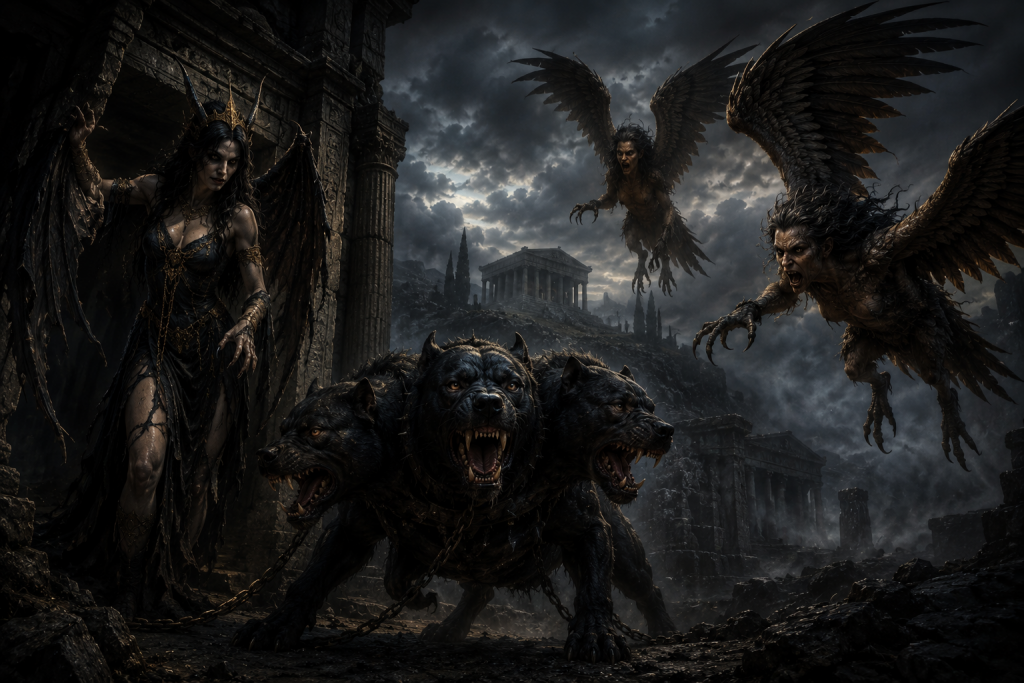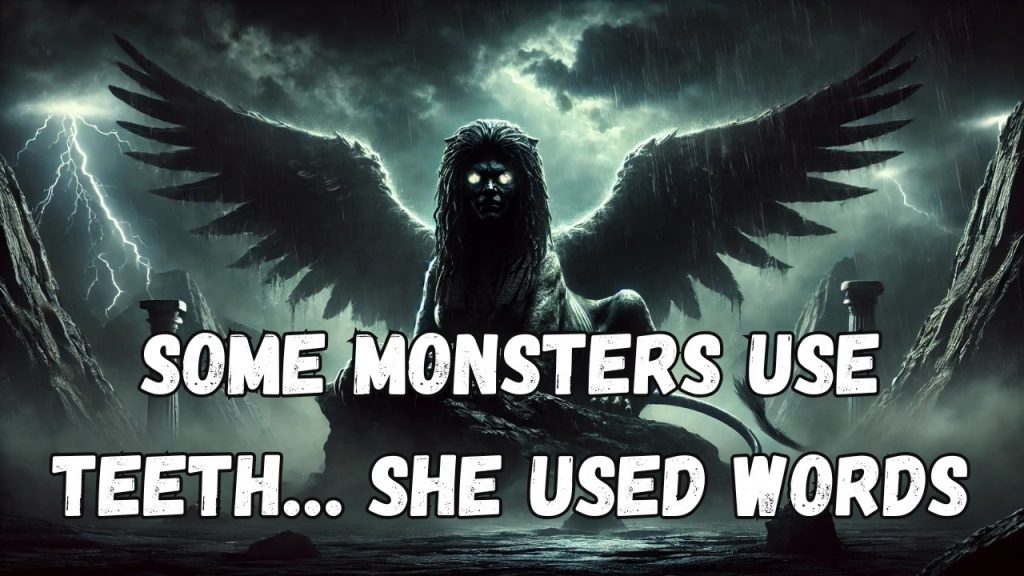
A creature with the face of a woman, the body of a lion, and the wings of an eagle sat on a rock outside the gates of Thebes. She asked every traveller the same question. Answer correctly and you could pass. Answer wrongly, and she would tear you apart where you stood. For years, nobody answered correctly.
Born From Monsters, Sent by a Goddess
The Sphinx of Thebes did not arrive in Greek mythology as a guardian or a protector. She arrived as a punishment.
According to the genealogies recorded by ancient Greek writers, her parentage placed her firmly among the most monstrous bloodlines in the entire mythological tradition. Various sources name her as the daughter of Typhon, the most fearsome creature ever to challenge the Olympian gods, and Echidna, herself a hybrid of woman and serpent who bore many of Greek mythology’s most dangerous offspring. Other accounts trace her lineage instead through Orthrus, a monstrous two headed dog, making her sister to the Chimera and the Nemean Lion. Whichever genealogy you follow, the conclusion is the same: she was never meant to be ordinary, and she was never meant to be kind.
Physically, ancient sources describe her with consistent strangeness. Apollodorus gives her a woman’s face and chest combined with the body of a lion and the wings of a great bird, essentially a griffin with a human face in place of an eagle’s head. Other tellings add a serpent’s tail to the arrangement. She was, by any ancient Greek standard, a creature stitched together from pieces that did not belong together, exactly the kind of hybrid form the Greeks reserved for their most unsettling monsters.
What makes the Sphinx genuinely unusual among Greek monsters is not her appearance but her method. Most of the era’s great threats, the Hydra, the Minotaur, the Chimera, killed through raw physical force. The Sphinx killed through intellect. She did not simply attack travellers on the road to Thebes. She challenged them, and only those who failed her challenge died.
If you are interested in creatures from Greek mythology, check out this page!
A Punishment for a Terrible Crime
Why the Sphinx came to Thebes at all is a question ancient sources answer with considerably more detail, and considerably more darkness, than most modern retellings include.
The most consistent explanation places the blame on Hera, queen of the gods, acting in fury over events that had unfolded years before the Sphinx ever appeared. King Laius of Thebes, in this version of events, had once abducted and assaulted a young man named Chrysippus, the son of King Pelops, during a visit to a neighbouring kingdom. Ancient sources differ on precisely what followed: some say Chrysippus took his own life out of shame afterward, others describe a far more tangled sequence of events involving jealousy and murder within his own family. What the sources agree on is that Hera, who held particular affection for Chrysippus, was enraged not only at Laius for the crime itself but at the city of Thebes as a whole for never properly holding him accountable for it.
Her response was to send the Sphinx from the distant reaches of Ethiopia to settle outside the city and begin her campaign of terror. This punishment did not end with Laius himself. According to the broader mythological tradition surrounding the house of Thebes, Hera’s curse extended forward through his entire bloodline, setting in motion the chain of tragic events that would eventually engulf his son, a son not yet born, who would grow up to be Oedipus.
It is a considerably grimmer origin story than the version most people encounter today, where the Sphinx tends to appear simply as a mysterious obstacle on the road, with little explanation offered for why she was there at all. The ancient sources make clear that she was never random. She was divine retribution, deployed with calculated cruelty against an entire city for a crime its king had committed and never answered for.
The Riddle and Its Victims
Once installed outside Thebes, the Sphinx took up a position on a rock or mountainside, variously identified in different sources as Mount Phikion, and from there she controlled all passage into and out of the city.
Her method was consistent and, by all accounts, entirely without mercy. Every traveller who approached was stopped and presented with a single riddle, said in some versions to have been taught to her directly by the Muses, and in others to have come from Laius himself, who had once learned secret oracular knowledge passed down from Cadmus, the legendary founder of Thebes. Whatever its true origin, the riddle was this: what creature walks on four legs in the morning, two legs at noon, and three legs in the evening.
Failure carried an immediate and final price. Anyone unable to answer correctly was killed and devoured on the spot. The list of the Sphinx’s victims, according to the fragments of earlier sources that survive, was not limited to anonymous travellers either. Among those said to have died attempting to answer her were Haemon, son of the Theban regent Creon, and other named figures connected to prominent local families, suggesting the terror she inflicted reached directly into the ruling households of the city rather than remaining a distant rural threat.
The effect on Thebes itself was close to total. With the road effectively sealed and death waiting for anyone who attempted to pass without solving an apparently unsolvable puzzle, the city fell into a state of genuine crisis. Trade halted. Travel became suicidal. The desperation grew severe enough that Creon, ruling in the absence of a king, made an extraordinary offer: the throne of Thebes itself, along with the hand of the recently widowed queen, to anyone capable of ending the Sphinx’s reign.
The Stranger Who Solved It
Into this crisis walked a young man with no idea of the role he was about to play in his own destiny.
Oedipus arrived at Thebes already fleeing a prophecy, having learned from the oracle at Delphi that he was fated to kill his father and marry his mother, and having resolved, in response, never to return to the city he believed was his home. What he did not know was that he had been adopted, that his true father was Laius himself, and that he had already, unknowingly, fulfilled half the prophecy on the road to Thebes by killing a stranger who turned out to be the king.
Arriving at the city and finding it gripped by the Sphinx’s terror, Oedipus approached her directly and was given the same riddle that had killed so many before him. What walks on four legs in the morning, two legs at noon, and three legs in the evening.
Where every previous traveller had failed, Oedipus recognised something the others had missed: that the riddle was never describing a single day, but the entire span of a human life. Morning represented infancy, when a person crawls on all fours. Noon represented adulthood, walking upright on two legs. Evening represented old age, when a third leg, a walking stick, becomes necessary to bear a person’s weight. The answer, Oedipus said, was man.
He had answered correctly. According to most surviving versions of the myth, the Sphinx’s response to her own defeat was immediate and final. She threw herself from her perch to her death, her reign over the city ended in the same instant her riddle had finally been solved.
For Oedipus, the victory brought exactly the rewards Creon had promised: the throne of Thebes, and marriage to the recently widowed queen, Jocasta, who was, unbeknownst to either of them, his own mother. The prophecy that had driven Oedipus away from Corinth had, through the act of saving an entire city, delivered him directly into its fulfilment.
A Monster Different From Her Egyptian Namesake
The word sphinx and the basic concept of a creature combining human and lion features both originate not in Greece but in Egypt, and the differences between the two traditions are worth noting, since they are far more significant than the shared name suggests.
The most famous embodiment of the Egyptian tradition, the Great Sphinx of Giza, still sits on the Giza plateau near Cairo today, carved directly from the limestone bedrock and measuring roughly 240 feet long and 66 feet high. Most Egyptologists date its construction to the reign of the pharaoh Khafre, sometime around 2558 to 2532 BCE, making it part of the same vast funerary complex that includes the pyramids built for Khafre and his father Khufu. Unlike the Greek Sphinx, the Egyptian original was unambiguously male, generally understood to depict the pharaoh himself wearing royal regalia, and functioned as a guardian figure, a protector of sacred and royal space rather than a predator stalking travellers on an open road.
By the time the concept reached Greek mythology, something had shifted substantially. The Greek Sphinx became explicitly female, gained wings she never had in Egyptian iconography, and transformed from a passive, protective guardian into an active, predatory threat that hunted and killed rather than simply stood watch. Some later traditions, emerging from periods when Greek and Egyptian culture intermingled more directly, even imagined a contest between the Greek Sphinx and the Egyptian god Anubis, an attempt by later storytellers to reconcile two very different creatures that happened to share a single borrowed name.
If you want more like this, the Tales of Myth and Magic newsletter delivers new creatures, legends, and forgotten folklore straight to your inbox.
No fixed schedule. No noise. Just the stories, when they are ready.
Sign up here →A Threat Built From Intellect, Not Strength
What continues to make the Sphinx stand out among the monsters of Greek mythology, even thousands of years later, is the nature of the threat she posed.
Most Greek monsters represented physical danger that could be met with physical solutions: a sword, a shield, sufficient strength or speed to survive an encounter. The Sphinx represented something else entirely, a danger that could not be outrun or outfought, only out-thought. She has often been described by classicists as a liminal creature, existing at the boundary between categories the Greek mind relied on to make sense of the world: neither fully human nor fully animal, neither comprehensible nor entirely alien. That liminality made her uniquely threatening to a culture that prized rational understanding, because she represented exactly the kind of problem reason alone might never solve.
Oedipus’s victory over her was, in that sense, never really about cleverness for its own sake. It was a demonstration that human intellect, applied correctly, could overcome even a threat designed by a furious goddess to be unanswerable. The tragedy, of course, is that solving the Sphinx’s riddle did nothing to free Oedipus from the much larger riddle of his own identity, the one prophecy had already written long before he ever reached the gates of Thebes.
Further Reading
If this article sparked your interest, these are the books worth reading next.
The Iliad — Homer (Penguin Classics)
by Homer — the primary source for everything in this article, and still the most vivid account of the Trojan War ever written.
The Odyssey — Homer (Emily Wilson translation)
by Homer, translated by Emily Wilson — the best modern English translation, and the book that contains Odysseus’s own account of the horse.
The Trojan War: A Very Short Introduction
by Eric Cline — the clearest and most up to date account of what archaeology actually tells us about Troy and whether any of it happened.
Never miss a myth
Thank you for being here. The site is brand new and every subscriber genuinely means something to me. If you're here, you care about this stuff as much as I do - and that's all the reason I need to keep going. New stories, videos and dark folklore from around the world, straight to your inbox. No algorithm. Just the stories, when they're ready.