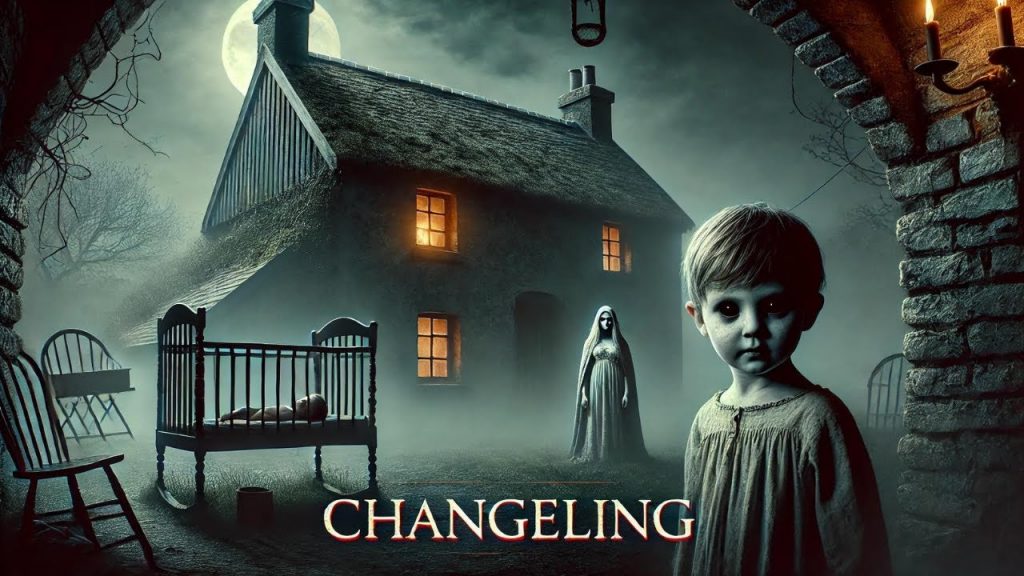
In March 1895, in Ballyvadlea in County Tipperary, a woman named Bridget Cleary was burned to death by her husband Michael. He poured lamp oil over her and set her alight while members of her own family watched. The reason he gave, and the reason those family members apparently accepted, was that the woman he was burning was not his wife. His wife had been taken by the fairies. The creature in her place was a Changeling, and the fire was the prescribed method for driving it out and forcing the fairies to return the real Bridget.
Bridget Cleary was twenty-six years old. She had been ill with bronchitis. She had been behaving in ways that her husband and family found unusual, which in retrospect almost certainly reflected the effects of her illness and possibly its treatment. She died in her kitchen. Michael Cleary was convicted of manslaughter rather than murder on the grounds that he genuinely believed what he was doing, and served fifteen years.
The case is not a medieval aberration. It happened in 1895, in a country with newspapers and courts and railways. It is the most documented and most extreme consequence of the Changeling belief in the historical record, and it is where any honest treatment of Changeling folklore has to begin, because it establishes what the tradition was capable of producing when it was genuinely believed rather than simply told as a story.
What the Tradition Actually Said
The Changeling belief holds that the fairy folk, the Sith or aos sí of Irish tradition, take human children, adults, or occasionally the newborn and replace them with a substitute. The substitute may be a fairy being in disguise, an elderly fairy given a new form, or in some accounts a piece of enchanted wood or a fairy object that merely appears to be a person. The real human is taken to the Otherworld.
The fear was not abstract. It was specific and practical, and the tradition developed equally specific and practical responses. Certain groups were understood to be at particular risk: newborns before baptism, mothers immediately after childbirth, beautiful young people, skilled craftspeople whose abilities the fairy folk coveted. The vulnerability window was understood as real and manageable: protective measures could prevent the theft if applied correctly, and the tradition preserved those measures with the seriousness accorded to necessary knowledge.
Iron was the primary protection because iron repels fairy beings in the Irish and Scottish tradition. A piece of iron placed in a cradle, a poker laid across the threshold, iron scissors hung open above a baby’s head: these were functional precautions rather than superstitious rituals to the communities that used them. Holy water and religious objects provided protection in the post-Christian version of the tradition. Keeping a fire burning in the house and never leaving a newborn unattended were practical extensions of the same logic.
The tradition was also specific about who was at risk. The fairy folk in Irish folklore are not random in their acquisitions. They take what they find beautiful, talented, or useful. A healthy, beautiful baby is more at risk than an ordinary one. A skilled musician is more at risk than someone with no particular gift. This specificity is part of what gave the tradition its particular quality of anxiety: the very qualities that made a child or an adult valued by their community also made them attractive to the fairy folk.
What the Changeling Looked Like and Why the Signs Mattered
The signs that a Changeling had been substituted were, in the tradition, the signs of something having gone wrong with a person that could not otherwise be explained. A baby who had been thriving suddenly failing to thrive. A child who had been developing normally suddenly displaying unusual behaviours. An adult who had been well suddenly becoming ill and altered in personality. A person who had been skilled suddenly losing their skill.
In every case, what the tradition was encoding was the experience of unexplained change. The Changeling belief provided a framework for understanding why people changed in ways that their families and communities could not account for. It was not a framework that originated in cruelty: it originated in the genuine human need to explain what could not otherwise be explained, in communities that lacked the medical and psychological vocabulary to describe what they were observing.
The specific signs attributed to Changelings in the tradition are consistent enough across different accounts to suggest they reflect real observations rather than purely imaginative descriptions. An insatiable appetite. Failure to grow and develop normally. Constant crying. Withdrawal from social interaction. Unusual intelligence in some areas combined with unusual deficits in others. Physical frailty accompanied by unexpected strength. These are descriptions of real phenomena, and the tradition attributed them to fairy substitution because fairy substitution was the available explanation.
The Eggshell Test and Other Methods of Identification
The tradition developed specific tests for identifying a Changeling, and these tests share a common logic: they attempt to provoke the Changeling into revealing knowledge or behaviour that is incompatible with the age it appears to be.
The most widely documented test involves brewing ale in an eggshell, or in some versions placing eggshells near the child in an unusual arrangement. The expected response is that the Changeling, unable to contain its surprise at something so absurd, will break its disguise and say something that reveals its true age. The formula varies but the typical version goes: I have seen the acorn before the oak, I have seen the egg before the hen, I have seen the first child born, but I have never seen ale brewed in an eggshell before. By demonstrating knowledge of things that happened centuries ago, the Changeling exposes that it is not a child at all but an ancient being wearing a child’s appearance.
The test is designed around the logic of the tradition: a Changeling is old, and age produces knowledge, and knowledge will eventually reveal itself when something sufficiently unexpected happens. The eggshell works as a test precisely because brewing in an eggshell is such an absurd thing to do that even a very old, very disciplined fairy being cannot see it without reacting.
Other tests included placing the suspected Changeling in a situation that would require it to demonstrate or deny abilities: asking it to play an instrument it had previously played well, testing it with tasks appropriate to its apparent age, or simply observing whether it could be surprised into a reaction that revealed more knowledge than a child should have.
What the Tradition Was Actually About
The scholarly literature on Changeling belief has developed several overlapping interpretations of what the tradition was encoding, and they are not mutually exclusive.
The most straightforward reading is that Changeling belief provided an explanation for developmental conditions that the communities involved could not otherwise account for. Autism, cerebral palsy, Down’s syndrome, failure to thrive, various genetic conditions that affect development: all of these produce the kinds of changes in a child that the Changeling tradition describes, and all of them were completely inexplicable in terms of the medical knowledge available to rural Irish and Scottish communities in the pre-modern period. The Changeling was the available explanation for why a child who had seemed normal suddenly became someone the family did not recognise.
A second reading focuses on the function the belief served for the families involved. The Changeling belief allowed a family to maintain their love for the child they remembered while explaining their difficulty connecting with the child in front of them. The real child was not gone and forgotten. They were in the Otherworld, and the creature in the cradle was an imposition rather than the true child. This distinction preserved the family’s emotional relationship with the missing child in a way that simply accepting that the child had changed permanently could not.
A third reading, developed more recently by disability historians, focuses on the harmful consequences of the belief rather than its explanatory function. The Changeling framework permitted and sometimes encouraged treatment of disabled or neurodivergent children and adults that was dangerous or fatal, on the grounds that the real person was elsewhere and the creature being treated was not fully human. The Bridget Cleary case is the most documented extreme example, but it was not isolated: historical records contain other cases of children and adults who were subjected to painful tests or dangerous treatments because their families believed they were Changelings.
These readings exist in tension with each other. The Changeling belief was simultaneously a humane attempt to understand inexplicable suffering, a psychological mechanism for preserving family love under devastating circumstances, and a framework that could sanction genuine harm. All three of these things are true at the same time, which is what makes the tradition genuinely complex rather than simply dark.
The Pan-European Tradition
The Changeling belief is not exclusively Irish. Versions of the same tradition appear across the British Isles, Scandinavia, Germany, and most of Europe, with enough consistency in the core elements to suggest either a common origin or an independent development of similar responses to similar experiences.
In Scotland the tradition is called the Taisgeal or the fairy substitution, and it connects to the broader Sith tradition of the Highlands and Islands in the same way as the Irish version connects to the Irish fairy tradition. In Scandinavia the byting or exchange child appears in Norse and later folk tradition with the same characteristics. In Germany the Wechselbalg, the exchange child, is documented from medieval records onward.
The German tradition is particularly significant because it includes a documented case from Martin Luther’s writings in the 16th century, in which Luther describes a twelve-year-old boy in Dessau who ate and drank constantly but never grew, and whom Luther identified as a Changeling. Luther recommended drowning the child. Whether this happened is not recorded, but Luther’s endorsement of the identification demonstrates that Changeling belief was not confined to rural oral tradition but extended to the highest levels of educated European thought.
Bridget Cleary and What She Tells Us
The Bridget Cleary case deserves more space than a single paragraph at the opening of an article about a folklore tradition, because it is the most important thing that tradition produced in the historical record and the thing that most cleanly demonstrates what genuine belief in a supernatural framework can lead to.
Bridget Cleary was not an obviously vulnerable person in the way that the tradition’s most common victims were: she was an adult, she was not a newborn, she was not visibly disabled or neurodivergent. She was ill. She was also, according to the accounts of those who knew her, independent, unusually assertive for a woman of her time and community, and engaged in economic activity, dressmaking and egg-selling, that gave her a degree of autonomy that her husband found uncomfortable. Whether those qualities contributed to the belief that she had been replaced is impossible to determine from the evidence, but they are worth noting.
Michael Cleary was not uneducated or socially isolated. He was a cooper, a skilled craftsman, in a community that had churches and schools and newspapers. The belief that his wife was a Changeling coexisted in his mind with everything that should have contradicted it. It coexisted in the minds of her family members who watched and did not intervene.
The case was reported across the English-speaking world and provoked enormous comment, partly because it happened at a moment when Irish folklore was being celebrated and romanticised by figures like W.B. Yeats and Lady Gregory. The distance between the romantic fairy tradition being celebrated in Dublin literary circles and the fatal consequences of that same tradition in a Tipperary farmhouse in 1895 was not a comfortable distance to contemplate, and most of the contemporary commentary tried not to.
She did not deserve what happened to her. The tradition that produced it was doing something real and human when it developed the Changeling belief as a response to inexplicable suffering. Neither of those things cancels the other out, and a treatment of the Changeling tradition that does not hold both of them in view is not treating the tradition honestly.
For more on the Irish fairy tradition, the Ireland category covers the broader range of Irish supernatural beings. The Banshee article covers the Irish death herald whose tradition also connects to specific family attachments. The Púca article covers the shapeshifting Irish fairy whose relationship to humans is defined by unpredictability rather than by the specific anxieties the Changeling tradition addresses.
Never miss a myth
Thank you for being here. The site is brand new and every subscriber genuinely means something to me. If you're here, you care about this stuff as much as I do - and that's all the reason I need to keep going. New stories, videos and dark folklore from around the world, straight to your inbox. No algorithm. Just the stories, when they're ready.