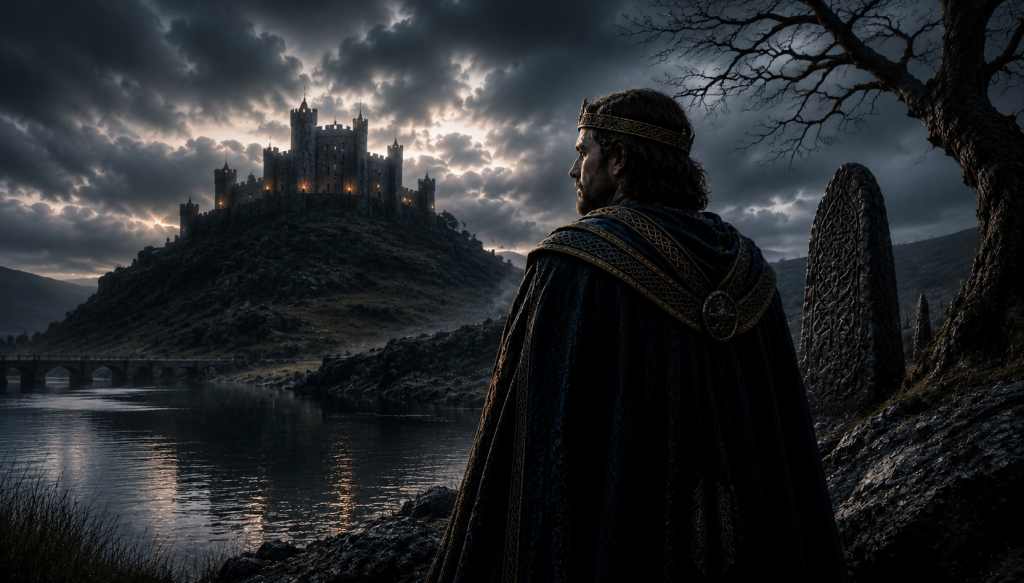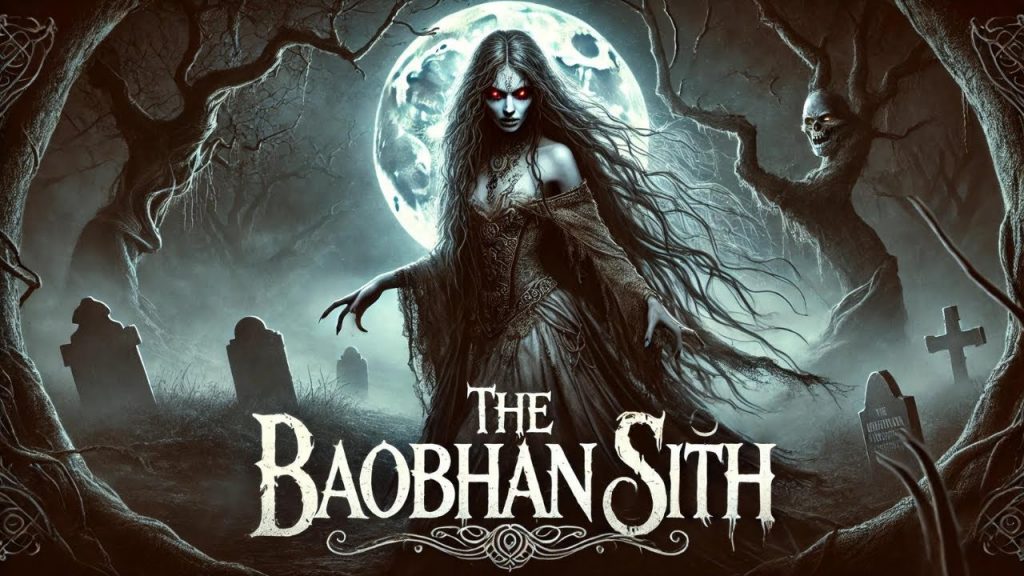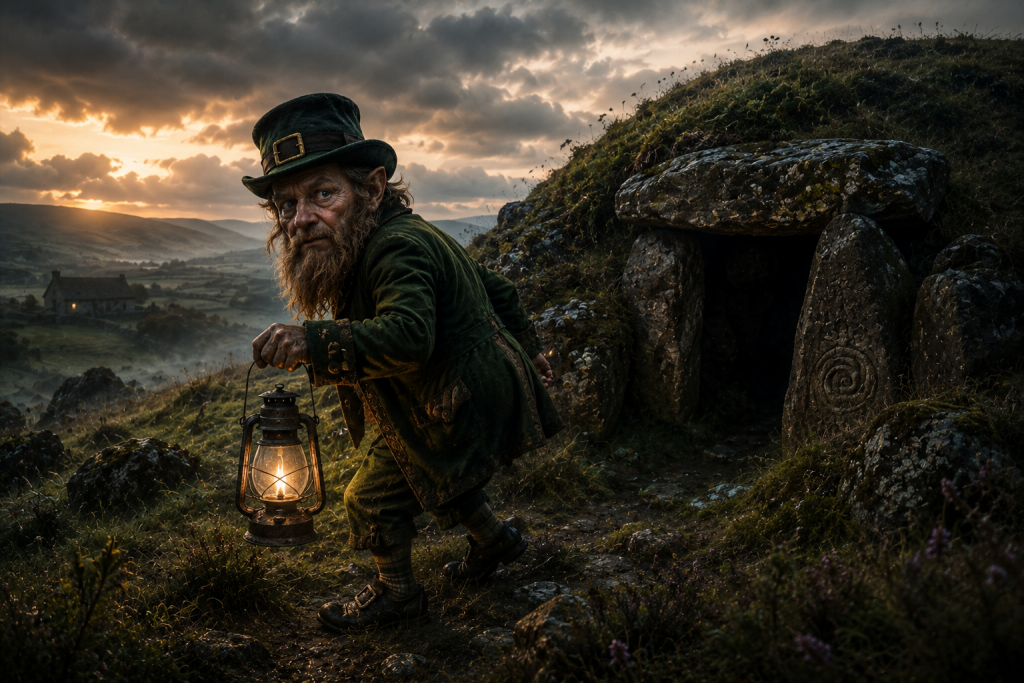
The Leprechaun on the cereal box is wearing green, grinning, and waving a shamrock. The Leprechaun in the Irish tradition is wearing red, sitting alone in a remote location, and making shoes. These two figures have the same name and almost nothing else in common, and the gap between them is one of the more interesting stories in the history of how folklore becomes popular culture.
The original Leprechaun is a solitary fairy cobbler. The first significant written account of him, in a medieval Irish text known as the Echtra Fergus mac Léti, describes a creature called a luchorpán, a small body, who is found by a pool and who possesses magical abilities. By the time the figure appears more consistently in the early modern Irish tradition, he has become specifically a shoemaker: heard before he is seen, his presence announced by the sound of a small hammer tapping on leather, working alone at his trade in hidden locations.
The cobbling is not incidental background detail. It is the mechanism of the gold. The Leprechaun makes shoes for the fairy folk, and the fairy folk pay him for his work. He accumulates wealth through legitimate labour, which is why he has a pot of gold and why that gold is his to protect. He is not a thief and he is not a hoarder in the supernatural sense: he is a craftsman who has been at his trade long enough to have become very wealthy, and who is understandably reluctant to hand his life savings to any human who happens to catch him.
The Name and What It Actually Means
The etymology of Leprechaun has been contested for a long time, and the most interesting thing about it is that the green-hatted cheerful version is not what the name originally described.
The most widely accepted derivation connects the word to the Old Irish lú, meaning small, and corp, meaning body: the small-bodied one. This is consistent with the early medieval text mentioned above and with the general pattern of Irish fairy being names that describe physical characteristics. An alternative derivation connects it to the Old Irish leath brógan, the half-shoe or shoe-maker, which would make the cobbling occupation etymologically built into the name itself rather than added later. Scholars are not agreed on which derivation is correct, and both may be partially right if the word’s history involved multiple layers of folk etymology.
What the name does not originally mean is anything about gold, trickery, rainbows, or Ireland as a brand proposition. Those associations accumulated over time, with the gold appearing in the early folklore, the rainbow in later popular culture, and the green clothing arriving relatively recently in the tradition’s long history.
The Red Coat
The green clothing that is now inseparable from the Leprechaun image appears to be a late development in the tradition, probably no earlier than the 19th century and possibly connected to the broader association of green with Irish national identity that solidified during that period. Earlier accounts of the Leprechaun consistently describe him wearing red, not green.
W.B. Yeats, collecting Irish fairy tradition in the 1880s, describes the Leprechaun as wearing a red coat with seven buttons in each row, a cocked hat, and carrying a leather apron. The red coat is the consistent element across the accounts Yeats collected, and the cocked hat is the traditional hat of a working craftsman rather than the tall green top hat of popular culture. This is a working fairy in working clothes, which is consistent with the cobbling occupation: you dress for your trade, not for a tourism brochure.
The shift from red to green happened sometime in the 19th or early 20th century and was probably driven by the same forces that were shaping Irish national identity during that period: green as the colour of Irish nationalism, of the shamrock, of the landscape, became the colour of Irishness in a way that eventually colonised even the older red-coated fairy figure. By the time the Leprechaun became an internationally recognisable symbol through American St Patrick’s Day celebrations in the early 20th century, the green version was already dominant.
The Three Wishes and Why They Are Not in the Tradition
One of the most persistent popular misconceptions about the Leprechaun is that catching one entitles you to three wishes. This does not appear in the Irish folk tradition in any consistent form. It is a contamination from the broader European wish-granting fairy tradition, particularly from German stories transmitted through collections like the Brothers Grimm, that has been incorrectly mapped onto the Irish figure.
What the Irish tradition actually says is considerably more specific and more interesting. If you catch a Leprechaun, he is compelled to reveal the location of his treasure, or to grant you one wish in exchange for his freedom, depending on the version of the story. The one wish, when it appears, is not a blank cheque but a single specific exchange: his freedom for something he can provide, which is usually knowledge of where his gold is hidden.
The important thing the tradition emphasises is not the grant but the escape. In every documented Leprechaun capture story, the creature escapes before the human can take advantage of what they have been told. The red ribbon story is the most famous example: the Leprechaun shows the captor which plant the gold is buried under, the captor marks it with a red ribbon and goes home for a shovel, and returns to find every plant in the field has been marked with a red ribbon. The treasure is unfindable. The Leprechaun is gone.
This pattern appears in multiple versions across the tradition, with different methods of misdirection but the same outcome. The Leprechaun does not lie about the treasure’s location, because he is compelled to answer truthfully. He misleads through the gap between the truth he tells and the ability of the human to act on it before he finds a way to make that action impossible. He is constrained by the rules of the encounter but works within those constraints with complete efficiency.
The Cobbling and What It Means
The Leprechaun’s occupation as a cobbler for the fairy folk is the element of the tradition that most popular accounts treat as decorative, but it is actually the key to understanding his character. He is defined by his work in a way that most fairy beings are not. The Kelpie is defined by what it does to humans. The Banshee is defined by what she knows. The Leprechaun is defined by what he makes.
This makes him unusual in the Irish fairy tradition because most Sith beings are defined by their relationship to the human world rather than by their own productive activity. The Leprechaun has an economic life that is independent of human beings: he makes shoes for customers who are not human, he earns payment from those customers, and he accumulates wealth through that labour over a very long time. His wealth is his own in a way that is different from a dragon’s hoarded gold or a fairy mound’s buried treasure. He earned it.
The sound of his hammer tapping is the traditional signal of his presence, and the tradition is consistent that the sound can be heard in remote locations where no human would be working. Following the sound is how you find him. Losing focus, even for a moment, is how he escapes: the tradition emphasises that you must not take your eyes off him or he will vanish. The cobbling sound continues even when he is in conversation with a captor, because he does not stop working just because a human has found him. He is a professional.
The Clurichaun Question
The Irish tradition contains a figure closely related to the Leprechaun called the Clurichaun, and the relationship between the two is genuinely contested among folklorists. The Clurichaun is described as a small fairy who haunts wine cellars, drinks the wine, and behaves in a disreputable manner. He is sometimes treated in the tradition as a Leprechaun who has been drinking, a version of the same figure in a different state. Others treat them as distinct beings who share superficial characteristics.
The Clurichaun’s wine cellar association and his drunken behaviour contrast sharply with the Leprechaun’s industrious cobbling, which is perhaps why the two have been treated as distinct: one is a working craftsman and one is a carouser. But the physical description and the general fairy classification are similar enough that the distinction may be regional, with different parts of Ireland calling the same figure by different names and attributing different behaviours to him.
The Clurichaun does not appear to be listed in your existing articles, which might be worth noting for future content: the wine cellar fairy is one of the less documented figures in Irish tradition and there is almost no quality coverage of him online.
What the Leprechaun Actually Is
The Leprechaun in the Irish tradition is a member of the Sith, the fairy folk, but he occupies an unusual position within that category. Most Sith beings in Irish tradition are associated with the grand, the powerful, or the dangerous: the Tuatha Dé Danann who became the fairy folk after the coming of the Gaels are divine beings reduced in status, the Banshee attaches herself to noble families, the Dullahan rides with the authority of death itself. The Leprechaun is a craftsman. He is not grand or noble or terrible. He is a skilled worker who minds his own business, guards his legitimate earnings, and outwits anyone who tries to take them.
This democratic quality is part of what makes him interesting in the context of the broader Irish fairy tradition, and it may be part of why he became such a durable figure in the oral tradition: he represents a fairy whose wealth is earned rather than inherited, whose power comes from intelligence and craft rather than from supernatural authority, and whose interactions with humans are defined by a specifically economic kind of cunning. He is the fairy you might actually meet if you went looking, and the lesson his stories teach is not about the awesome power of the supernatural but about the practical intelligence of someone who has been outwitting people who thought they were smarter than him for a very long time.
For more on the Irish fairy tradition, the Ireland category covers the broader range of Irish folk beings and mythology. The Púca article covers the shapeshifting Irish fairy whose relationship to humans is equally unpredictable. The Banshee article covers the most famous Irish fairy being and the very different tradition she represents.
Never miss a myth
Thank you for being here. The site is brand new and every subscriber genuinely means something to me. If you're here, you care about this stuff as much as I do - and that's all the reason I need to keep going. New stories, videos and dark folklore from around the world, straight to your inbox. No algorithm. Just the stories, when they're ready.