
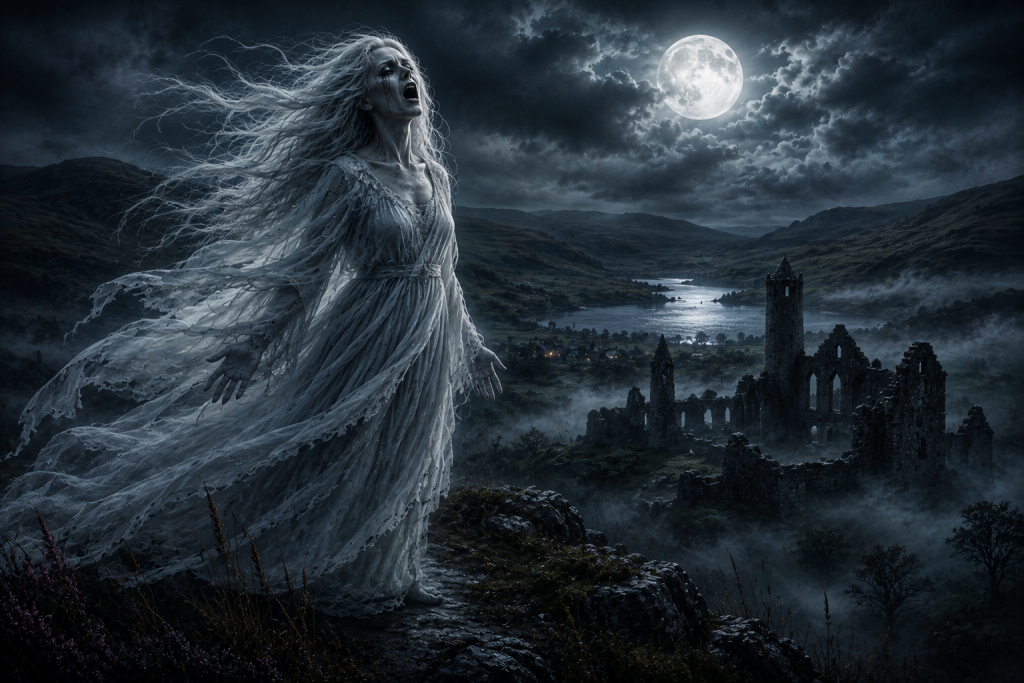
The Banshee is one of the most recognisable figures in Irish folklore and one of the most misrepresented. The popular version is a screaming ghost who appears before deaths, a supernatural alarm system with no particular connection to anyone specific. The actual tradition is considerably more precise and considerably more interesting: the Banshee is attached to specific Irish families, she is mourning rather than warning, and her cry is a personal message rather than a general announcement.
Understanding the difference between those two versions is the key to understanding what the Banshee actually is in the tradition that produced her.
The name comes from the Irish bean sídhe, woman of the fairy mound. The sídhe, pronounced shee, are the fairy mounds that appear across the Irish landscape, the ancient earthworks and burial mounds understood in Irish tradition as entrances to the Otherworld. A bean sídhe is a woman who belongs to that world, a supernatural female being connected to the hidden realm that exists alongside the human one. She is not straightforwardly a ghost. She is something older and more specific than that.
The Family Connection
The most important element of the Banshee tradition, and the one that most popular accounts either miss or reduce to a bullet list, is the family attachment. In the Irish tradition as documented by folklorists from the 17th century onward, the Banshee does not appear randomly or for all families. She appears for specific ancient Irish families, and her appearance is a deeply personal event rather than a generic supernatural occurrence.
The families associated with Banshee tradition are primarily those of the old Gaelic nobility, families whose lineages stretch back to the pre-Norman period in Ireland and whose connections to the land and to the supernatural guardianship traditions of that land are understood as inherited. The O’Brien, O’Neill, O’Connor, O’Donnell, and McCarthy families are the most frequently cited examples, though the tradition extends more broadly across families with Gaelic roots. The common pattern is ancient lineage: the Banshee’s attachment to a family reflects the depth of that family’s connection to the Irish land and to the supernatural traditions associated with it.
What this means in practice is that hearing the Banshee is a specific and personal experience. She is not crying for everyone who is about to die. She is crying for a member of her family, the family she is attached to, and her cry is the expression of genuine grief rather than the mechanical announcement of a death. The distinction matters because it changes what the Banshee is: not a supernatural information system but a mourner, a being whose attachment to a specific family is strong enough that she grieves their deaths in advance of those deaths occurring.
The Irish tradition of keening, the formal ritual wailing performed at funerals by women of the community, is the human parallel that the Banshee tradition sits alongside. The keening woman and the Banshee perform the same function at different temporal positions: one mourns after the death, the other before it. The Banshee cry is sometimes described using the same language as keening, the same vocabulary of formal grief, which suggests that she is understood as belonging to the same mourning tradition rather than to a separate category of supernatural warning.
What She Looks Like and Why It Varies
The Banshee’s appearance varies across the Irish tradition in ways that reflect the different regional traditions and the different aspects of her character that different accounts emphasise.
In some accounts she is young and beautiful, a woman in white or green with long flowing hair who is seen at a distance, crying or combing her hair near a river or a threshold. The hair-combing is a specific detail that appears frequently enough to suggest it was a fixed element of the tradition: the comb is associated with the fairy world in Irish folklore, and finding a comb is a traditional warning against picking it up because it may belong to a Banshee. In other accounts she is old, shrunken, and terrifying, a hag whose cry is more like a shriek than weeping. In some regional traditions she appears in multiple forms to different people, young to those who will live long and old to those who are about to die.
The variation across accounts is consistent with a figure who has been in active oral tradition for centuries, accumulating regional variations and individual family traditions as she passes from generation to generation. It also reflects the genuinely complex nature of the figure: a being who is both sorrowful and terrifying, who belongs to the fairy world and to a specific human family simultaneously, who mourns with genuine feeling and whose mourning is nevertheless experienced as a dread event by those who witness it.
The one consistent element across nearly all accounts is the cry itself. Whatever she looks like, the Banshee’s voice is described in terms that distinguish it from any natural sound: a wail that carries across distance, a keening that sounds like human grief amplified beyond human capacity, a sound that those who hear it recognise immediately as belonging to something outside the ordinary world. The sound, rather than the appearance, is the thing the tradition treats as definitive.
The Bean Nighe and the Scottish Connection
The Bean Nighe, the Washer at the Ford, is the Scottish parallel to the Irish Banshee and the two figures are closely enough related that they are sometimes treated as variants of the same tradition. The Bean Nighe is seen washing the bloodied clothing or grave clothes of those who are about to die, crouching at rivers and streams in the act of preparation for a death that has not yet happened. Like the Banshee, she is a herald rather than a cause: she announces what is coming without having caused it.
The differences between the two figures illuminate what is specific to each tradition. The Banshee’s attachment to specific named families is an Irish characteristic that the Bean Nighe does not share in the same way: the Scottish figure is more broadly associated with the deaths of anyone who encounters her territory at the wrong moment rather than with specific dynastic connections. The Banshee’s primary expression is sound, her cry, while the Bean Nighe’s primary expression is action, her washing. The Irish tradition emphasises the emotional content of the death announcement, the genuine grief of the mourner, while the Scottish tradition emphasises the practical preparation, the washing of the grave clothes.
Both figures derive from the same underlying tradition of female supernatural beings who have foreknowledge of death and who express that foreknowledge through mourning activities. The split between the Irish and Scottish versions reflects the development of two related but distinct folk traditions in the two Gaelic-speaking cultures either side of the North Channel.
The Bean Nighe article covers the Scottish figure in detail and is worth reading alongside this one.
The Morrigan Connection
The line from the Banshee back through the Irish tradition leads eventually to the Morrigan, the great goddess of war, death, and sovereignty who appears throughout the Ulster Cycle. The Morrigan in her older forms as a washerwoman who cleans the grave clothes of those about to die is the mythological ancestor of both the Banshee and the Bean Nighe. She appears at rivers before battles, washing the bloodied garments of warriors who have not yet been wounded, performing in divine form the same act of foreknowledge that the Banshee performs in folk tradition.
The connection suggests that the Banshee is not simply a ghost or a fairy being who evolved independently but a figure whose roots go down into the oldest layers of Irish mythological tradition: a manifestation of the female divine principle that governs the relationship between the living and the dead, attached over centuries of religious and cultural change to the specific families and the specific sonic expression of grief that the folk tradition preserved.
This does not mean that every Banshee appearance is the Morrigan in disguise or that the folk tradition is simply a degraded version of the mythological one. It means that both the mythology and the folklore are drawing on the same underlying tradition of female foreknowledge of death, and that the Banshee’s family attachment and keening cry are local and particular expressions of something much older.
The Morrigan article covers that figure in depth and makes the connection between her washing woman aspect and the later folk traditions explicit.
What Her Cry Actually Sounds Like
The tradition is more specific about the quality of the Banshee’s cry than most popular accounts convey. It is not simply a scream or a wail. It is described in the oral tradition using a vocabulary drawn from the formal mourning tradition of Irish culture, the caoineadh or keening, which was a highly developed vocal art form performed by specialist women at funerals.
The keening tradition involved specific melodic patterns, specific kinds of ornament and modulation, and a formal structure that was understood as the appropriate expression of communal grief rather than simple individual crying. The Banshee’s cry in the tradition often sounds like keening: a sustained, melodic, formally structured expression of grief rather than a chaotic scream. This is what makes it recognisable to those who hear it and what distinguishes it from ordinary sounds: not simply its volume or its strangeness but its quality as a grief sound, recognisable as mourning even before the listener understands what they are hearing.
The tradition occasionally specifies that those who hear the Banshee do not simply feel frightened. They feel the weight of the grief that the sound carries, which is a different and more specific experience than generic supernatural dread. The Banshee’s cry is understood as genuine mourning, and the people who hear it are affected by the grief it expresses as much as by the fact of what it announces.
The Diaspora Banshee
One of the more interesting developments in the Banshee tradition is what happened to it when Irish communities emigrated. In the major diaspora communities of the 19th and 20th centuries, particularly in the United States, Australia, and Britain, the Banshee tradition persisted in Irish families in a form that maintained the family attachment while adapting to the new geographic context. Banshee accounts from Irish-American communities describe the cry heard in American cities, attached to the same family names and carrying the same significance as in Ireland, operating independently of the Irish landscape that the tradition is rooted in.
This persistence of the tradition across geographic displacement is one of the more striking examples of how strongly embedded the Banshee is in the concept of Irish family identity rather than in a specific place. The Kelpie belongs to Scottish lochs in a way that cannot travel with the tradition. The Banshee belongs to Irish families in a way that travels wherever those families go, which is a different and arguably more intimate kind of supernatural attachment.
For more on the broader Irish supernatural tradition, the Ireland category covers the creatures and mythological figures of the Irish tradition. The Dullahan article covers the headless horseman who is in some ways the Banshee’s counterpart in the Irish death herald tradition, announcing death through action rather than sound.
Never miss a myth
Thank you for being here. The site is brand new and every subscriber genuinely means something to me. If you're here, you care about this stuff as much as I do - and that's all the reason I need to keep going. New stories, videos and dark folklore from around the world, straight to your inbox. No algorithm. Just the stories, when they're ready.
Pingback: The Bean-Nighe: Scotland's Washer at the Ford - Tales of Myth and Magic