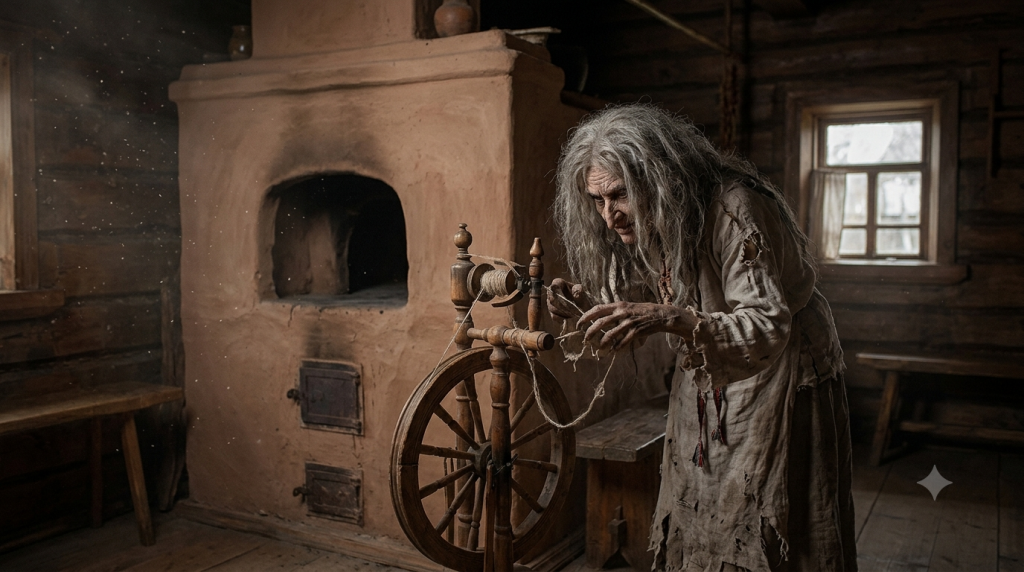
The Kikimora is the dark counterpart to the Domovoi, the household spirit of Slavic tradition whose presence means misfortune rather than protection. Where the Domovoi is a benevolent ancestor spirit who protects the family he inhabits with, the Kikimora is a malevolent female spirit whose presence in the home produces exactly the kind of low-level domestic misery that makes daily life grinding and exhausting without ever producing a single dramatic event to explain it. Children cry without cause. Chickens stop laying. Thread tangles on the spindle. Sleep is restless and filled with bad dreams. The Kikimora is responsible.
She is one of the most specifically domestic of Slavic supernatural beings, and her malevolence is expressed entirely through the disruption of domestic routines rather than through physical harm. She does not kill. She makes the household fail to function, which in a subsistence agricultural community amounts to a serious ongoing threat to survival.
How She Arrives
The Kikimora’s arrival in a household was understood to have specific causes, and understanding these causes was important because they also pointed toward remedies. A house built on cursed land, particularly land where someone had died violently or where a criminal had been buried, was at risk of acquiring a Kikimora connected to that death. A house built by a sorcerer who placed a Kikimora in the foundations during construction was similarly afflicted. In some traditions, a child who died unbaptised could become a Kikimora, connecting her to the same category of untimely or improperly concluded deaths that produced the Rusalka.
The connection between the Kikimora and the building’s foundations is particularly important. She was understood to enter the house through the threshold or through cracks in the foundation rather than through doors and windows, which made her difficult to exclude through ordinary protective measures that focused on entrances. She was already inside, in the oldest and deepest part of the structure.
What She Did
The Kikimora’s nighttime activities centred on the spinning wheel and the distaff, the primary instruments of women’s domestic work in the pre-modern Slavic world. She would spin at night, but what she produced was not useful thread — it was tangled, knotted, ruined work that had to be discarded in the morning. She would also tickle sleeping children, causing them to cry through the night, and she would sit on sleepers’ chests causing the oppressive weight that the Slavic tradition identified with supernatural visitation, the same experience attributed to the Mara of Germanic tradition.
Her presence could sometimes be detected by the sound of spinning in an empty room, or by finding the spindle tangled in the morning when it had been properly wound the night before. The specific disruption of the spinning work — women’s work, the work associated with Mokosh, the fate goddess — connects the Kikimora to a disruption of the proper order of female domestic life as much as to simple malice.
Getting Rid of Her
Removing a Kikimora from a household was the work of a specialist — a wise woman or a healer who knew the specific procedures. These varied by tradition but typically involved identifying the original cause of her presence, performing counter-rituals to address that cause, and using specific plants and substances she disliked, particularly ferns, juniper, and various bitter herbs. The threshold and the foundations of the house received particular attention, since that was where she entered and where she resided.
In some traditions the Kikimora could not be removed at all once she had established herself, and the only solution was to leave the house. This reflected the seriousness with which her presence was understood: she was not a nuisance to be managed but a genuine supernatural affliction that could make a home uninhabitable.
For more on the Slavic tradition, the Domovoi article covers the benevolent household spirit whose presence is what a household wants instead of the Kikimora. The Mokosh article covers the fate goddess of spinning whose domain the Kikimora disrupts. The Slavic Mythology hub page has every article in the cluster.
Never miss a myth
Thank you for being here. The site is brand new and every subscriber genuinely means something to me. If you're here, you care about this stuff as much as I do - and that's all the reason I need to keep going. New stories, videos and dark folklore from around the world, straight to your inbox. No algorithm. Just the stories, when they're ready.