The Impundulu is a supernatural creature from the folklore of the Zulu, Xhosa, and other southern African peoples, and it occupies an unusual position in the world vampire tradition because it is simultaneously a natural phenomenon made supernatural and a witch’s familiar. It is associated with lightning, appearing in the flash and crack of a storm, and it is bound in service to witches who inherit it through the female line, passing from mother to daughter as a servant, a protector, and a source of power.
Its vampiric nature is expressed through its relationship with the witch’s enemies. It drinks the blood of those the witch directs it against, causing wasting illness and death. It can also take human form, appearing as a beautiful young man who seduces women, and the relationship between the Impundulu and a witch’s female relatives or rivals has a specifically sexual dimension that distinguishes it from most other vampire traditions.
The Lightning Bird
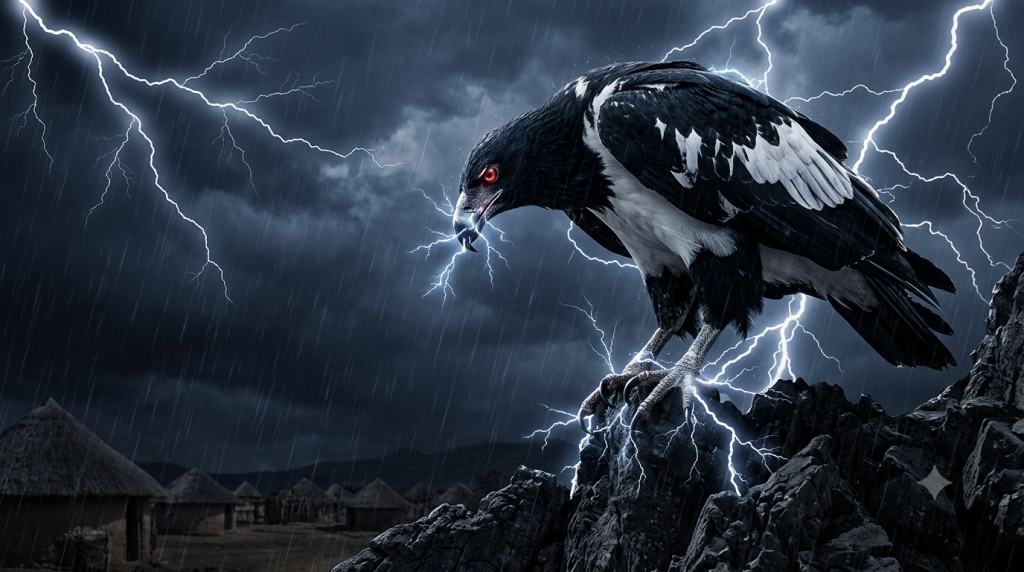
The Impundulu in its natural supernatural form is a large bird associated with lightning. When lightning strikes, the Impundulu has landed. The nest it builds underground, at the point where lightning has struck, is said to be locatable and to contain eggs that are powerful magical objects. Finding and retrieving an Impundulu egg was considered extremely dangerous but potentially very rewarding for those who dealt in supernatural power.
The bird form is described as striking rather than terrifying: black and white feathers, sometimes iridescent, with red markings. It does not look like a creature of death and disease. It looks like something extraordinary, which is consistent with its role as a powerful supernatural object that is also a servant to those who can control it.
The association between lightning and vampiric or supernatural creatures appears in several African traditions. Lightning was understood as a manifestation of supernatural power in action, and the Impundulu’s connection to it positioned the creature within the most dramatic natural force available to the southern African landscape. A storm was not simply weather. It was the Impundulu at work.
The Witch’s Familiar
The relationship between the Impundulu and the witch who controls it is one of the most developed familiar relationships in any vampire tradition. The creature is inherited rather than acquired: it passes from a dying witch to her closest female relative, usually a daughter, and the inheritance is not always welcome. The new possessor of the Impundulu inherits both its power and its demands, and the relationship between a witch and her Impundulu has elements of mutual dependency that go beyond simple master and servant.
The Impundulu in human form is described as attaching itself to the witch’s household in a manner that creates obligations and complications. It requires feeding, attention, and management. A witch who failed to properly control her Impundulu could find it turning on members of her own family rather than on the enemies she directed it against. The power it provided came with genuine risk.
The Human Form and Its Dangers
The Impundulu’s ability to appear as a handsome young man is one of its most feared aspects in the tradition, because this form allowed it to cause harm through seduction rather than direct attack. Women who became involved with a man who was actually an Impundulu would find themselves bound to it in a relationship they could not easily escape, their health declining as the creature fed on them while they believed themselves to be in a normal human relationship.
The diagnosis of Impundulu involvement was the work of a traditional healer, an inyanga or sangoma, who could identify the supernatural cause of a young woman’s unexplained decline and prescribe the treatments necessary to break the creature’s hold. These treatments combined herbal medicine with ritual practice in a way that addressed both the physical symptoms and the supernatural cause simultaneously.
The Impundulu Today
The Impundulu remains a living tradition in parts of South Africa, not simply a historical folklore curiosity. Traditional healers continue to diagnose Impundulu involvement in cases of unexplained illness, and the creature appears in contemporary South African literature, film, and television as a recognisable supernatural figure with cultural weight. Its presence in modern South African culture reflects the depth of its roots in the communities that maintain the tradition.
For more on the vampire traditions of the world, the Adze article covers the West African vampire firefly of the Ewe people. The Aswang article covers the Filipino shapeshifting vampire with its own witch familiar connections. The Vampires: The Ancient Origins article covers the broader history of vampire belief across cultures.
Never miss a myth
Thank you for being here. The site is brand new and every subscriber genuinely means something to me. If you're here, you care about this stuff as much as I do - and that's all the reason I need to keep going. New stories, videos and dark folklore from around the world, straight to your inbox. No algorithm. Just the stories, when they're ready.