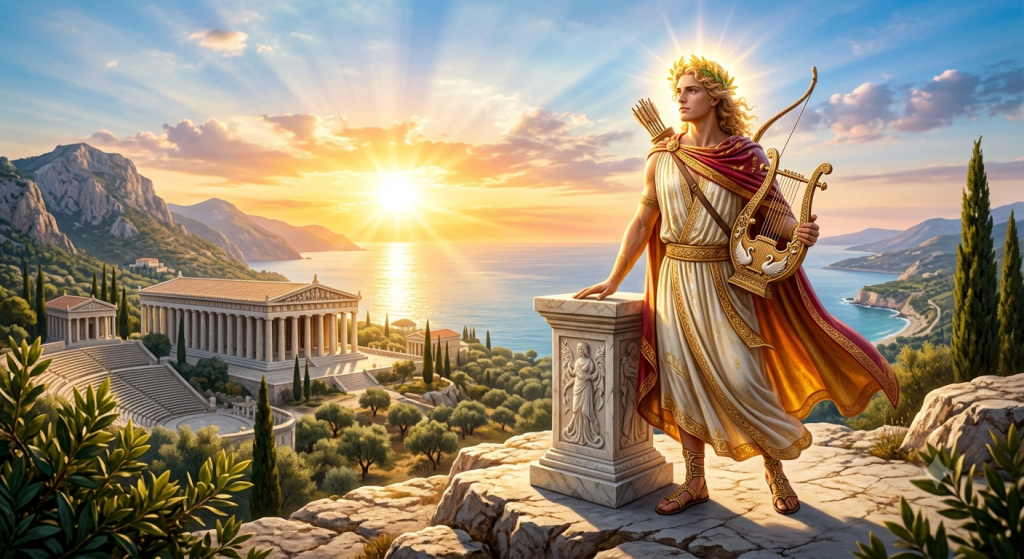
Apollo is the most multifaceted of the Olympian gods and in many ways the most Greek. He governs the sun, music, poetry, archery, prophecy, healing, and plague. He is the god of rational clarity and civilised order, the god whose Oracle at Delphi was consulted by kings and cities for centuries, the god whose lyre produces the music of the spheres. He is also the god who sent the plague that opens the Iliad, who killed the Cyclopes in revenge for his son’s death, who flayed the satyr Marsyas alive for claiming to play better than him, and whose romantic pursuits were almost uniformly unsuccessful.
The combination is characteristic of how Greek mythology understood divinity: not as moral perfection but as concentrated power, with excellence and danger inseparable in the same figure. Apollo is the most beautiful of the gods and one of the most dangerous to offend, which is a genuinely Greek theological position rather than a contradiction requiring resolution.
The Birth on Delos
Apollo was born on the island of Delos with his twin sister Artemis, children of Zeus and the Titaness Leto. Hera, outraged by Zeus’s affair with Leto, forbade the earth from providing any ground where Leto could give birth. Every land refused her until she reached Delos, a floating island not attached to the sea floor and therefore technically not earth, which agreed to receive her. Apollo was born on Delos, and the island became his most sacred site, one of the great religious centres of the ancient Greek world.
The infant Apollo’s first act was to demand a lyre and a bow, and his second was to go to Delphi and kill the great serpent Python that guarded the site. Python was sacred to Gaia, the earth goddess, and its killing was a significant act: Apollo was claiming the most important prophetic site in Greece for himself, displacing an older chthonic tradition with his own solar and rational one. He purified himself for the killing at Tempe and established the Pythian Games at Delphi in the serpent’s honour, which became one of the four great Panhellenic games alongside the Olympics.
The Oracle at Delphi
The Oracle at Delphi was the most important religious institution in the ancient Greek world and the primary mechanism through which Apollo communicated with humanity. Cities consulted it before founding colonies. Kings consulted it before going to war. Individuals consulted it about marriage, business, and the future. The Oracle’s answers were given through the Pythia, a priestess who entered a trance state and spoke Apollo’s words, which were then interpreted and transcribed by priests.
The Oracle’s answers were famously ambiguous, and the tradition includes numerous examples of those who misread them suffering the consequences. Croesus of Lydia was told that if he crossed the Halys River a great empire would fall. He crossed and was defeated by Persia: the empire that fell was his own. Oedipus’s father was told his son would kill him and tried to prevent it, setting in motion the sequence of events that fulfilled the prophecy. The Oracle did not lie. It told the truth in a form that required correct interpretation, and the failure of interpretation was the consultants’ problem rather than the Oracle’s.
Music and the Contests
Apollo’s mastery of music is presented in the tradition not as a pleasant characteristic but as a defining attribute of his divine nature, and the stories around it reflect the Greek understanding of artistic excellence as something that carries real stakes. When the satyr Marsyas found the aulos, the double flute that Athena had invented and discarded, he became skilled enough at playing it to challenge Apollo to a musical contest. The judges declared Apollo the winner. Apollo flayed Marsyas alive.
The punishment is extreme by any standard, and the tradition records it without apparent discomfort. The gods do not lose competitions gracefully. More specifically, the challenge to Apollo’s musical supremacy was understood as a challenge to the divine order he represented, and his response was proportionate to that understanding rather than to the human sense of what a music contest should cost the loser.
The contest with Pan follows a similar pattern. Pan claimed his pipes were better than Apollo’s lyre. The mountain god Tmolus judged the contest and awarded it to Apollo. King Midas, who was present, said he preferred Pan’s music. Apollo transformed his ears into donkey’s ears. The god of rational clarity and musical perfection did not take aesthetic disagreement well.
The Pursuit of Daphne
Apollo’s romantic mythology is largely a catalogue of rejection and its consequences. The most famous episode is his pursuit of Daphne, the daughter of the river god Peneus, which began when Eros shot Apollo with a golden arrow that inspired love and shot Daphne with a lead arrow that inspired revulsion. Apollo pursued. Daphne ran. When Apollo was about to catch her she prayed to her father for help, and Peneus transformed her into a laurel tree. Apollo embraced the tree and declared the laurel his sacred plant, which is why victors at the Pythian Games were crowned with laurel rather than the olive or pine used at other games.
The story is from Ovid rather than earlier Greek sources and carries the characteristically Roman tone of Ovid’s mythological writing, but the tradition of Apollo’s unsuccessful romantic pursuits is consistent across multiple sources. Cassandra, given the gift of prophecy by Apollo and then cursed never to be believed when she refused his advances. Hyacinthus, killed accidentally by a discus Apollo threw, transformed into the flower that bears his name. Coronis, who was unfaithful to Apollo while pregnant with his son Asclepius: Apollo had her killed and then felt immediate remorse and rescued the unborn child from her funeral pyre.
The Sun and the Chariot
Apollo’s association with the sun in Greek mythology is complicated by the earlier existence of Helios as the sun deity. In the earliest tradition Helios is the sun itself, driving his chariot across the sky each day, while Apollo is the god of solar light and its effects, a distinction that later tradition collapsed into an identification of the two. By the classical period Apollo was widely understood as the sun god, and the fusion of Helios and Apollo produced the figure familiar from later ancient sources and from the Renaissance tradition that revived him.
The story of Phaethon, who borrowed Helios’s sun chariot and lost control of it, setting the earth on fire until Zeus struck him down with a thunderbolt, belongs to the Helios tradition rather than to Apollo’s mythology proper, but it circulates in connection with Apollo in popular accounts because of the identification of the two figures. The distinction matters for understanding the earlier tradition but the fusion is too long-established to ignore in any account of how Apollo was actually understood across Greek and Roman antiquity.
Further Reading
If this article sparked your interest, these are the books worth reading next.
The Iliad — Homer (Penguin Classics)
by Homer — the primary source for everything in this article, and still the most vivid account of the Trojan War ever written.
The Odyssey — Homer (Emily Wilson translation)
by Homer, translated by Emily Wilson — the best modern English translation, and the book that contains Odysseus’s own account of the horse.
The Trojan War: A Very Short Introduction
by Eric Cline — the clearest and most up to date account of what archaeology actually tells us about Troy and whether any of it happened.
For more on the Greek tradition, the Artemis article covers the twin sister whose hunting domain complements Apollo’s solar one. The Zeus article covers the father whose affair with Leto produced the twin gods of Delos. The Greek Mythology hub page has every article in the cluster.
Never miss a myth
Thank you for being here. The site is brand new and every subscriber genuinely means something to me. If you're here, you care about this stuff as much as I do - and that's all the reason I need to keep going. New stories, videos and dark folklore from around the world, straight to your inbox. No algorithm. Just the stories, when they're ready.