There are monsters, and then there is the Chimera. A creature so grotesque, so fundamentally wrong in its very construction, that the Greeks used its name to mean something impossible, a fantasy too terrible and too strange to be real. And yet, in the world of ancient myth, it was very real indeed. It breathed fire across the hills of Lycia, it slaughtered livestock and warriors alike, and it took one of the greatest heroes of the ancient world to bring it down.
The Chimera was not simply a dangerous animal. It was an affront to the natural order, a thing that should not exist, stitched together from creatures that had no business sharing a single body. That wrongness was entirely the point.
What Was the Chimera?
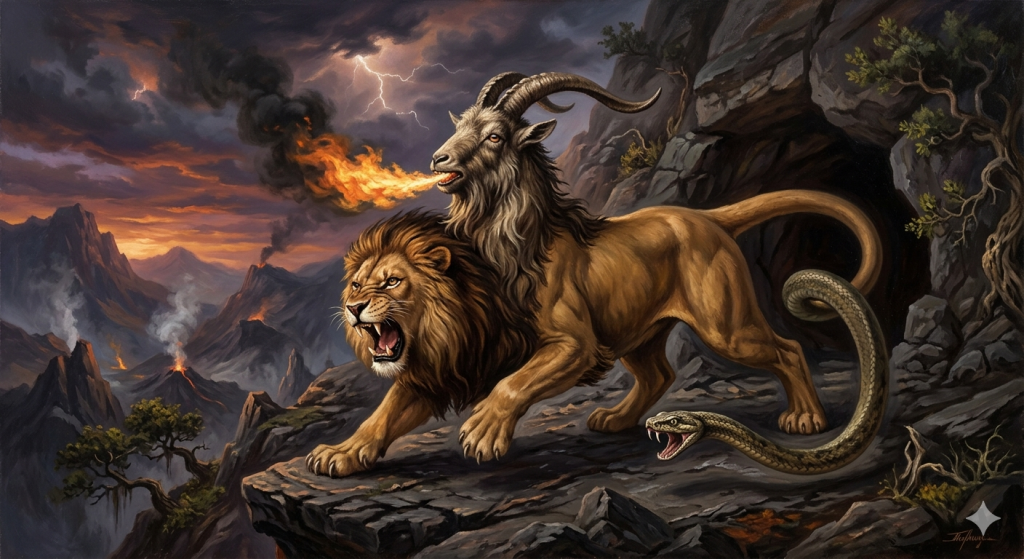
The Chimera was a fire-breathing monster composed of parts from multiple animals. The most commonly cited description, drawn from Homer’s Iliad, describes a creature with the head of a lion, the body of a goat, and the tail of a serpent. Hesiod, writing in his Theogony, adds that it breathed raging fire and had three heads, one of each animal, though later depictions vary considerably on the exact arrangement.
The word chimaira in ancient Greek simply meant “she-goat,” specifically a female goat in its first year. How a young goat’s name came to describe one of mythology’s most fearsome monsters is a question that has occupied scholars for centuries. The creature’s goat body, prominent in most ancient descriptions, is the likely connection, though the name carries an irony that feels almost deliberate. Something so monstrous sheltering behind such a mundane word.
Latin writers later adopted the creature as Chimaera, and from there it entered the European tradition as a byword for any impossible or absurd combination. In modern scientific language, a chimera is an organism carrying two or more genetically distinct sets of cells, a fitting legacy for a myth built entirely around the blending of what should be separate.
If you like Greek Mythology, check out more here!
Blood and Parentage: A Family of Nightmares
The Chimera did not appear from nowhere. Greek mythology was meticulous about genealogy, even for monsters, and the Chimera’s family tree reads like a catalogue of ancient terror.
Her parents were Typhon and Echidna. Typhon was the most fearsome of all the monsters who ever challenged the gods, a being of such catastrophic power that the Olympians themselves fled from him in terror. He was vast, fire-breathing, and almost destroyed Zeus before being defeated and imprisoned beneath Mount Etna. Echidna was his mate, a creature half-woman and half-serpent, described by Hesiod as divine, deathless, and living forever in a cave beneath the earth.
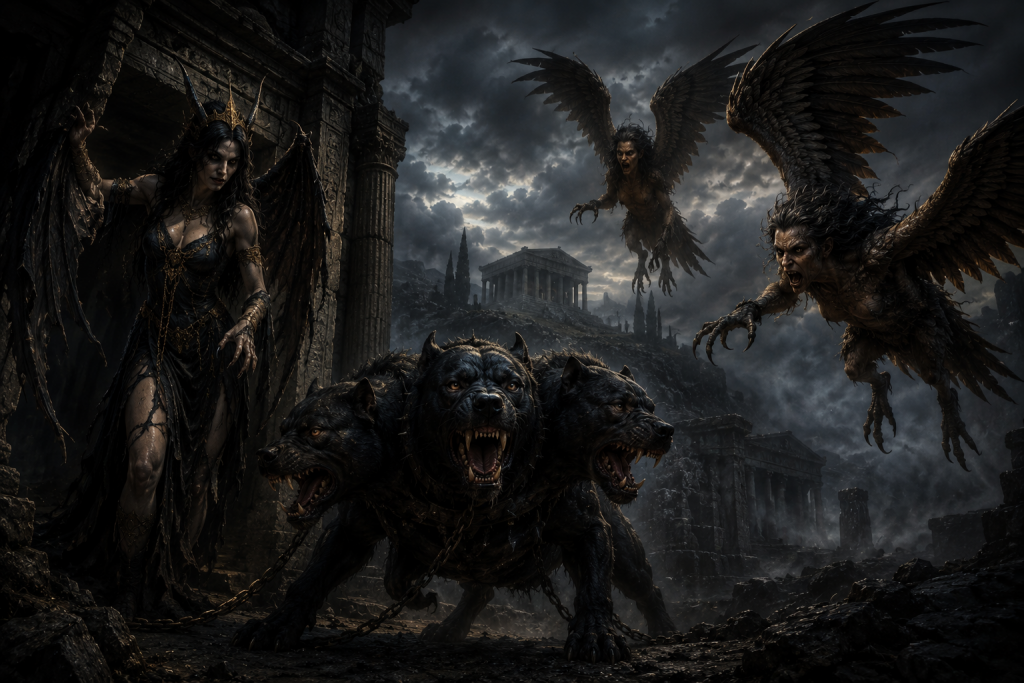
From this union came an extraordinary litter of horrors. The Chimera’s siblings included Cerberus, the three-headed hound guarding the Underworld; the Lernaean Hydra, the many-headed water serpent killed by Heracles; the Nemean Lion, whose hide was impervious to weapons; and Orthus, the two-headed dog. Depending on which ancient source you follow, the Sphinx and the Caucasian Eagle may also number among her kin.
The Chimera was, in other words, born into a dynasty of monsters. This was not an accident of nature. It was a lineage.
The Land of the Chimera: Lycia
Ancient sources were consistent in placing the Chimera in Lycia, a region on the southern coast of what is now Turkey. It is striking how geographically specific the Greeks were about a creature that could not have existed, and the region carries traces of the myth to this day.
Near the ancient Lycian site of Olympos, on the slopes of a mountainside called Yanartaş, natural gas seeping through the rock has burned continuously for thousands of years. The Greeks knew it, and later travellers have reported the flames for centuries. This place was called the Chimaera in antiquity, and ancient Lycian sailors used it as a landmark for navigation at night.
It is possible, and many scholars consider it likely, that these permanent flames fed directly into the myth. A hillside that burns without apparent cause, visible from the sea, breathing fire from the earth itself, is exactly the kind of phenomenon that demands explanation. The Greeks provided one.
The ancient city of Telmessos, also in Lycia, minted coins in later centuries bearing the Chimera’s image, suggesting that the creature was genuinely woven into the regional identity of the area rather than being purely a pan-Hellenic invention imposed from outside.
Bellerophon: The Hero Who Killed It
Every monster needs a hero, and the Chimera’s was Bellerophon, one of the great figures of early Greek mythology and a man whose story contains considerably more tragedy than triumph.
Bellerophon was a prince of Corinth, handsome and gifted, who came to the court of King Iobates of Lycia carrying a sealed letter. The letter had been written by Iobates’ son-in-law Proetus, and its contents were a death sentence. Bellerophon had rejected the advances of Proetus’ wife, who had then accused him of assault. Unable to kill a guest directly without violating the sacred laws of hospitality, Proetus had instead sent him to Lycia with a message asking Iobates to do the deed.
Iobates, bound by the same laws, could not simply execute Bellerophon either. Instead, he sent him on a series of missions designed to guarantee his death. Killing the Chimera was the first.
Bellerophon did not go to this task alone or unarmed. The key to his success was Pegasus, the winged horse born from the blood of the Gorgon Medusa. Bellerophon had tamed Pegasus with a golden bridle given to him by the goddess Athena, and it was from the air, beyond the reach of the Chimera’s claws and fire, that he was able to fight.
The method of the Chimera’s killing is described in ancient sources with a detail that has fascinated scholars ever since. Bellerophon reportedly fixed a lump of lead to the tip of his spear. Flying above the monster, he drove the spear into its mouth. The Chimera’s own fire-breath melted the lead, which poured down its throat and killed it from within.
It is a story that feels almost mechanical in its cleverness, using the monster’s own nature as the instrument of its destruction.
If you want more like this, the Tales of Myth and Magic newsletter delivers new creatures, legends, and forgotten folklore straight to your inbox.
No fixed schedule. No noise. Just the stories, when they are ready.
Sign up here →After the Chimera: Bellerophon’s Fall
The killing of the Chimera did not end Bellerophon’s story, and what came after serves as a reminder that Greek mythology rarely rewards its heroes without also punishing their pride.
After surviving everything Iobates threw at him, including wars against the Solymi people and the Amazons, Bellerophon was eventually given the king’s daughter in marriage and treated as a great man of Lycia. For a time, everything was well.
Then Bellerophon decided to ride Pegasus to Olympus itself. The reasons ancient sources give vary, but the presumption is consistent. A mortal man attempting to ascend to the home of the gods uninvited was the purest form of hubris the Greeks could imagine.
Zeus sent a gadfly to sting Pegasus. The horse reared, and Bellerophon was thrown. He fell back to earth, surviving but lamed and blinded, wandering the land alone and avoided by all until his death. Pegasus continued to Olympus without him.
The man who killed the Chimera ended his days in disgrace and solitude. Greek mythology was rarely interested in uncomplicated victories.
The Chimera in Art and the Ancient Imagination
The Chimera appeared throughout ancient art from an early period. One of the most celebrated depictions is the Chimera of Arezzo, an Etruscan bronze statue dating to around the fifth century BC, discovered in Italy in 1553. It shows a lion with a goat head rising from its back and a serpent for a tail, and it remains one of the finest surviving examples of ancient metalwork.
The creature also appeared on painted pottery, architectural friezes, and coins. The consistency of its representation across different cultures and centuries, Etruscan, Greek, and later Roman, suggests it lodged itself very firmly in the ancient imagination and stayed there.
Roman writers inherited the creature and deployed it freely. Virgil placed a Chimera among the monsters gathered at the entrance to the Underworld in the Aeneid, though here it appears somewhat reduced in status, one nightmare among many rather than the singular terror it had been for the Greeks.
Further Reading
If this article sparked your interest, these are the books worth reading next.
The Iliad — Homer (Penguin Classics)
by Homer — the primary source for everything in this article, and still the most vivid account of the Trojan War ever written.
The Odyssey — Homer (Emily Wilson translation)
by Homer, translated by Emily Wilson — the best modern English translation, and the book that contains Odysseus’s own account of the horse.
The Trojan War: A Very Short Introduction
by Eric Cline — the clearest and most up to date account of what archaeology actually tells us about Troy and whether any of it happened.
Never miss a myth
Thank you for being here. The site is brand new and every subscriber genuinely means something to me. If you're here, you care about this stuff as much as I do - and that's all the reason I need to keep going. New stories, videos and dark folklore from around the world, straight to your inbox. No algorithm. Just the stories, when they're ready.