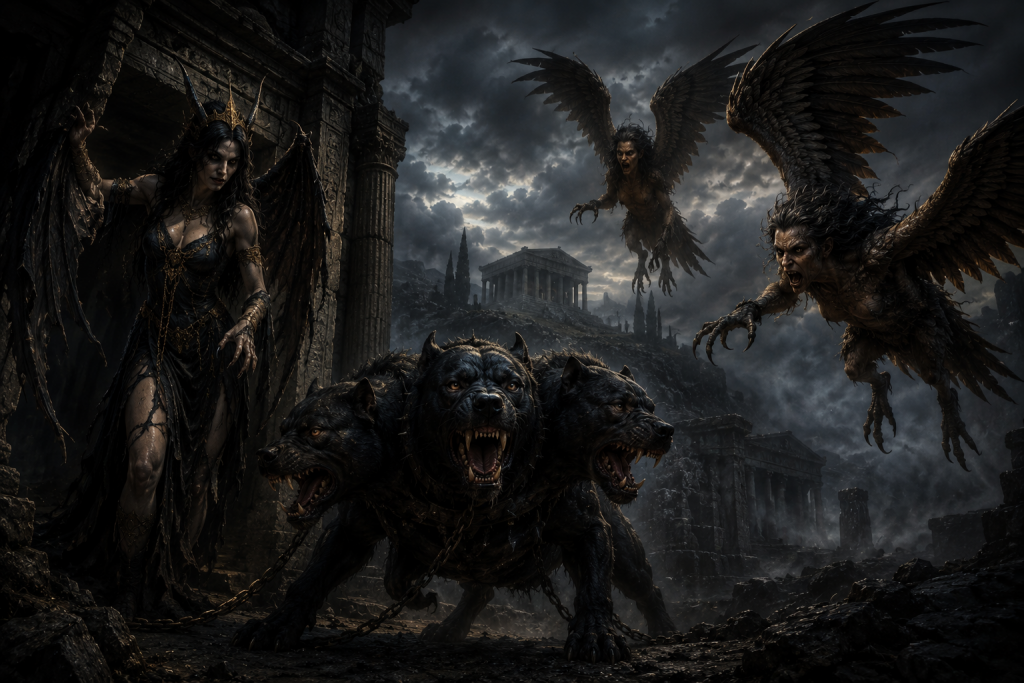
Cut off one head and two grow back. Cut off two and four replace them. The swamps of Lerna smelled of something that killed men before they ever drew close enough to fight. And in the depths of the lake below, something older than the city of Argos was waiting.
Born to Kill a Hero
The Lernaean Hydra was not a creature that simply happened to exist. It was raised with a specific purpose, by a goddess with a very specific grudge.
Hera, queen of the Olympian gods, despised Heracles from the moment of his birth. He was the son of Zeus and a mortal woman, one of countless infidelities that Hera endured with mounting fury, and she made it her personal mission to ensure his life was as short and as painful as possible. When Heracles was driven temporarily mad by Hera’s own divine interference and killed his wife and children in the resulting delirium, the subsequent penance imposed on him, twelve labours undertaken in service to the cowardly King Eurystheus of Mycenae, was itself shaped by her. The first labour sent him against the Nemean Lion. The second was designed to finish him.
Hera had raised the Hydra, the serpent of Lerna, from childhood specifically for this moment. Its parentage was, by any measure, impeccable in the worst possible way. According to Hesiod’s Theogony, the oldest surviving source for the myth, the Hydra was the offspring of Typhon and Echidna, the same monstrous pairing that produced the Nemean Lion, the Chimera, and Cerberus, the three-headed hound of Hades. It was sibling to some of the most feared creatures in the entire Greek mythological tradition, and it had been specifically nurtured into something its mother intended to be the end of the greatest hero who had ever lived.
If you are interested in creatures from Greek Mythology, check out this page for more!
The Swamps of Lerna
The Hydra’s home was the lake and marshlands of Lerna, in the Argolid region of the eastern Peloponnese, and the location mattered as much as the creature itself.
Lerna was not simply a convenient piece of wet ground. Archaeology has established it as a sacred site older even than the Mycenaean city of Argos, which makes it one of the most ancient places of religious significance in the entire Greek world. It was the site of the myth of the Danaids, fifty daughters of a king who murdered their husbands on their wedding nights and were condemned in the afterlife to spend eternity trying to fill a leaking vessel with water. More significantly still, Lerna was believed to be one of the entrances to the Underworld itself, a point where the boundary between the living world and the realm of Hades grew thin enough to pass through.
The Hydra was the guardian of that entrance.
This gave the creature a role that went well beyond simply terrorising the surrounding countryside, though it did that too, emerging from the spring of Amymone to ravage nearby villages, kill livestock, and contaminate the freshwater sources that communities depended on. Its breath was poisonous. Its blood was virulent. Ancient sources describe its tracks alone being deadly, the ground it passed over marked by something that could kill a man who had never even seen the creature. Heracles, approaching the swamp for the first time, covered his mouth and nose with cloth to keep the fumes from the water from killing him before he ever reached the fight.
This was not a monster to be encountered carelessly. It was something that had made an entire region essentially uninhabitable, guarding a gateway to death from a place that was already, in the Greek understanding of the world, soaked through with the presence of the dead.
How Many Heads
Ancient sources disagree on almost every specific detail of the Hydra’s appearance, which is itself telling. The creature seems to have grown in the telling across different centuries and different writers, as if even the myth acknowledged that pinning down something so monstrous to precise numbers was somehow beside the point.
Hesiod, writing in the eighth century BC, does not specify a number of heads at all. The poet Alcaeus, roughly a century later, describes nine, a number that became the most widely accepted standard across subsequent tellings. Simonides, writing in the early fifth century BC, increased this to fifty. Some later sources count as many as one hundred.
What every version agrees on is the central, defining feature: the regeneration. Cut off one head and two grew back in its place. This was not a beast that could simply be outlasted or overwhelmed by force of arms. Every strike that should have brought it closer to death made it stronger, multiplied it, turned the hero’s own aggression against him. It was, as the classicists Ruck and Staples observed, a creature whose reaction to decapitation was essentially botanical, growing back from damage the way a plant regrows from pruning, an expression of the absolute hopelessness of conventional approaches to the problem.
There was one additional complication. One of the Hydra’s heads was immortal. It could not be destroyed by any ordinary means. Even if every other head was removed and prevented from regenerating, this central head would survive.
The Second Labour
Heracles arrived at Lerna in the company of his nephew Iolaus, who drove the chariot that carried them to the edge of the swamp. He fired flaming arrows into the Hydra’s cave, the spring of Amymone, to draw the creature out into the open where it could be fought. It came.
What followed began badly. Heracles attacked with sword or club depending on which source you follow, and for each head he removed, two more erupted from the wound. Hera, watching and calculating that this might not be enough, sent a giant crab from the depths of the lake to attack Heracles from below while he was occupied with the heads above, a second threat designed to unbalance the fight at the critical moment. Heracles crushed the crab under his heel and kept fighting, but the regeneration was making the task impossible.
It was Iolaus who found the solution, either through his own reasoning or prompted by an idea from Athena depending on which version of the myth you read. Fire. Not to kill the heads themselves, but to cauterise the neck stumps the instant each head was removed, sealing the wound before the regeneration could begin. Iolaus prepared torches or firebrands while Heracles cut, and the combination worked. Head removed, stump sealed, no regeneration possible.
When every head but the immortal one had been dealt with, Heracles faced the final problem. He could not destroy the immortal head outright. What he could do was remove it and contain it. He used a golden sword given to him by Athena for precisely this purpose, cut the last head from the body, and placed it still writhing, still alive, under a great rock on the sacred road between Lerna and Elaius, where it remained, imprisoned rather than dead, sealed from doing further harm by the weight of stone above it.
A Victory That Was Not Counted
Eurystheus, looking for any reason to deny Heracles credit, refused to count the Hydra as a completed labour. His reasoning was that Iolaus had assisted, making the victory tainted in his view. Heracles, who had done the vast majority of the fighting, had no choice but to accept the judgement, and two additional labours were added to his original ten as a result, inflating the count to the canonical twelve.
The pettiness of this decision is entirely in keeping with how Eurystheus functions throughout the myth cycle as a deliberate foil to Heracles, a small man given temporary power over a great one, using that power as vindictively as possible. Hera, however, had her own response to the defeat of the creature she had raised specifically to kill the hero. She honoured both the Hydra and the crab that had fought alongside it by placing them in the sky as the constellations Hydra and Cancer, a permanent celestial memorial to the monsters who had come closest to ending Heracles before he completed his penance.
The constellation Hydra remains the largest constellation in the night sky by area, a fitting memorial for a creature that kept growing every time part of it was removed.
The Poison That Kept Killing
The Hydra did not stop affecting events after its death. In some ways the most dangerous thing about it was what came afterwards.
Heracles collected the Hydra’s blood when the battle was over and used it to poison his arrows, creating weapons of such virulence that wounds inflicted by them were entirely incurable. This proved useful in the short term: he used the poisoned arrows to kill the Stymphalian Birds, the giant Geryon, and the centaur Nessus during the labours and adventures that followed.
The centaur Nessus, dying from a Hydra-poisoned arrow, took his revenge from beyond his own death. He told Heracles’s wife Deianeira that his blood, mixed with olive oil, would function as a love charm that would keep Heracles faithful to her forever. When Deianeira later feared losing Heracles to another woman, she soaked a tunic in this mixture and sent it to him as a gift. The moment Heracles put on the tunic, the Hydra’s poison, which had been in the centaur’s blood, began to burn through his skin. The agony was such that Heracles built his own funeral pyre on Mount Oeta and asked to be placed on it alive.
The Hydra, killed in the second of his twelve labours, ultimately provided the means of his death. The creature had been raised to destroy him, failed in its immediate purpose, and then waited in his own weapons for decades until it found its way back.
Both Strabo and Pausanias, writing centuries after the myth was established, recorded that the stench of the river Anigrus in Elis, which made all fish in the river inedible, was popularly attributed to the Hydra’s poison, washed into the water from the arrows Heracles had used on the centaur. The legend of the Hydra’s contaminating presence had attached itself to a real, unpleasant river and was still being repeated as a live explanation for a genuine natural phenomenon in the Roman era.
If you want more like this, the Tales of Myth and Magic newsletter delivers new creatures, legends, and forgotten folklore straight to your inbox.
No fixed schedule. No noise. Just the stories, when they are ready.
Sign up here →The Real Lerna
The site of Lerna is real, in the Peloponnese near the modern village of Myli in the Argolid. Archaeological excavation carried out in the twentieth century revealed that it had been continuously occupied and venerated from the Neolithic period onward, the sacred character of the site reaching back far further than the myths attached to it.
One of the most significant finds at Lerna was the House of the Tiles, a large early Bronze Age building dating to roughly 2500 BC, one of the earliest monumental structures yet discovered in the Greek world. The site was used as a cemetery during the Mycenaean age and appears to have been abandoned around 1250 BC, a date that falls within the broader era of the catastrophic Bronze Age collapse that ended Mycenaean civilisation.
The springs of Lerna itself were genuinely remarkable, described by ancient writers as seemingly bottomless, which fed the belief that they connected downward to the realm of the dead. The actual depth of the freshwater springs in the area contributed to this impression in entirely practical terms, the water dark and deep in a way that made the idea of an Underworld entrance feel less like invention and more like simple observation.
Whether the Hydra myth grew from something specific that happened at Lerna, a battle, a disease outbreak, a natural disaster associated with the marshlands and their toxic gases, is a question scholars have never fully resolved. What is clear is that Lerna was a real place of genuine ancient importance, venerated long before anyone wrote the story down, and that the Hydra served as the mythological explanation for why such an ancient and sacred site was also, by all accounts, deeply dangerous.
Further Reading
If this article sparked your interest, these are the books worth reading next.
The Iliad — Homer (Penguin Classics)
by Homer — the primary source for everything in this article, and still the most vivid account of the Trojan War ever written.
The Odyssey — Homer (Emily Wilson translation)
by Homer, translated by Emily Wilson — the best modern English translation, and the book that contains Odysseus’s own account of the horse.
The Trojan War: A Very Short Introduction
by Eric Cline — the clearest and most up to date account of what archaeology actually tells us about Troy and whether any of it happened.
Never miss a myth
Thank you for being here. The site is brand new and every subscriber genuinely means something to me. If you're here, you care about this stuff as much as I do - and that's all the reason I need to keep going. New stories, videos and dark folklore from around the world, straight to your inbox. No algorithm. Just the stories, when they're ready.