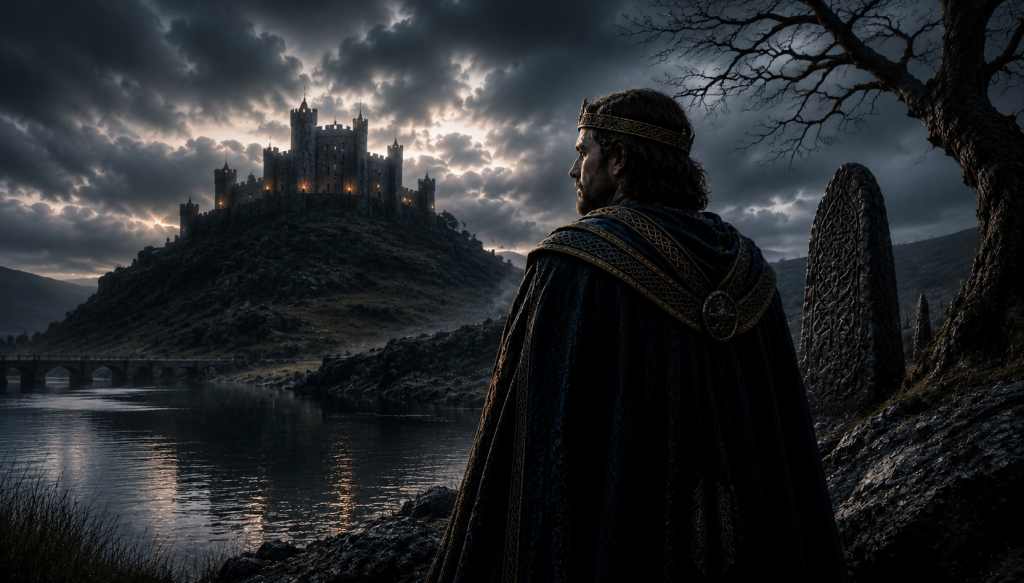
In 1880, an American diplomat named Wirt Sikes published British Goblins: Welsh Folk-lore, Fairy Mythology, Legends and Traditions, a collection of Welsh supernatural belief assembled during his years as United States Consul in Cardiff. It remains one of the most important documentary sources for Welsh folklore, and his account of the Coblynau is the most detailed in any primary source.
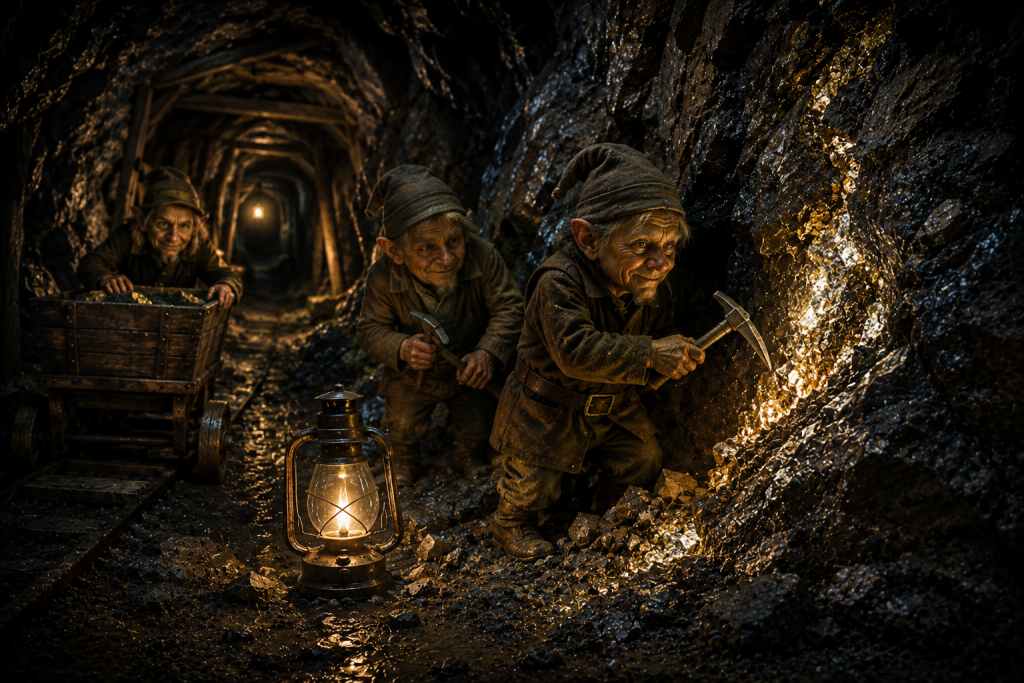
Sikes describes small beings about half the height of a man, dressed in the working clothes of miners, who inhabit the underground workings of Welsh mines and metalworks. They mimic the actions of miners: drilling, blasting, working the windlass, loading ore. They do not do this work productively, in the sense that nothing results from their labour in the physical world. They are performing the work of mining in the underground spaces, maintaining some kind of supernatural parallel to the work happening above them, and in doing so they produce sounds: the knocking, tapping, and hammering that miners heard in the rocks around them and attributed to the Coblynau.
Whether those sounds were supernatural or geological was not, in the tradition, an either-or question. The Coblynau knocked. The knocking told you things. What it told you mattered more than where it came from.
Who They Were and What They Were Called
The name Coblynau, pronounced cob-lin-eye, is the Welsh plural of coblyn, a word that is related to the English goblin and the German Kobold through a common Germanic root that refers to small supernatural beings associated with enclosed or underground spaces. The connection is genuine: the Coblynau belong to a family of European mine spirits that includes the Cornish Knockers and the German Bergmännlein, and the similarities across these traditions are close enough to suggest either common origin or parallel development in response to the shared experience of underground mining.
They are not evil in any conventional sense. Sikes is consistent on this point: the Coblynau are mischievous rather than malevolent, occasionally annoying but not genuinely dangerous. They hide tools. They lead miners in wrong directions. They create confusing echoes. But they do not harm people directly, and the tradition distinguishes them clearly from the more dangerous underground beings that appear in other European traditions. They are beings of the mine rather than beings opposed to the miners, and their mischief is the mischief of something that lives in the space you are working in rather than of something that wants you gone.
Sikes records that they were approximately half the size of a man, with disproportionately large heads and a general appearance of having been underground for a very long time: weathered, dusty, and wearing the working clothes of the mining tradition they inhabit. Their tools were miniature versions of real mining equipment. They worked in the mine the way miners worked in the mine, which is the quality that made them both recognisable and uncanny.
The Knocking and What It Meant
The sounds that miners heard underground and attributed to the Coblynau were not random or uniform. The tradition was specific about what different kinds of knocking meant, and those meanings were taken seriously enough to act on.
Knocking heard near a specific section of rock was understood as a sign that ore was present in that section. The Coblynau were working the richest seams, which was why their sounds indicated where valuable material lay. Miners who followed the knocking and dug accordingly sometimes found ore, which reinforced the tradition and gave it practical authority in mining communities. Whether the knocking was produced by the Coblynau or by the natural sounds of geological stress in ore-bearing rock formations is a question the tradition did not need to ask: the knock indicated ore, acting on the indication found ore, and the tradition was validated by results.
The knocking also served as a warning in some accounts. Sounds heard in a particular direction before a roof fall or a collapse were retrospectively understood as the Coblynau indicating danger, and the tradition developed the belief that attentive miners who listened to the underground sounds had better survival rates than those who ignored them. This is not superstition in any simple sense: the sounds produced by rock under stress before a collapse are real, and communities that developed a cultural framework for attending to those sounds and responding to them were encoding genuine safety knowledge in a supernatural form.
This is a pattern that appears across the mine spirit traditions of Europe: the Cornish Knockers, the German Kobold, the Scandinavian mine spirits all share the characteristic of knocking to indicate ore or danger. The consistency across independent traditions suggests that the knocking spirits were a common response to the common experience of underground acoustic phenomena in mining communities, a way of making the sounds of the rock legible and actionable rather than simply frightening.
The Danger of Mockery
The Coblynau tradition is unusual among British supernatural beings in having a specific and documented prohibition against mockery. The tradition held firmly that miners who imitated the sounds of the Coblynau, mimicked their knocking, or laughed at the belief in their existence were putting themselves at risk. The consequences attributed to mockery were not supernatural punishment in a dramatic sense: they were the loss of the Coblynau’s guidance, the cessation of the helpful knocking, and a general increase in bad luck underground.
This prohibition is practically significant. A belief system in which mockery is specifically punished is a belief system that protects itself against the obvious challenge that the sounds might simply be geological. Anyone who pointed this out too forcefully, or who demonstrated it by imitating the sounds, was transgressing against a community norm that had the force of genuine religious prohibition. The tradition defended its own authority by making scepticism socially and supernaturally costly.
The same dynamic appears in other mine spirit traditions. The Cornish Knockers were similarly defended against mockery. The German Kobold traditions had specific rules about how to treat the beings appropriately and what happened when those rules were violated. Underground communities that depended on collective knowledge and collective attention for survival had strong reasons to enforce the cultural practices that carried that knowledge, including the supernatural framework in which those practices were embedded.
The Cornish Connection
The Cornish Knockers, known as Knackers or simply the Knockers, are the closest parallel to the Coblynau in the British tradition, and the connection between the two is genuine enough to be worth examining properly.
Cornwall and Wales share both a Celtic linguistic heritage and a long tradition of metalworking and mining. The Cornish tin and copper mining tradition is among the oldest in Europe, predating the Roman period by centuries, and the supernatural traditions associated with it are correspondingly ancient. The Knockers in Cornwall served the same function as the Coblynau in Wales: they knocked to indicate ore, warned of danger, and could be offended by disrespectful behaviour.
When Cornish miners emigrated to work the copper mines of the American Upper Peninsula in the 19th century, they brought the Knockers with them. The tradition was transplanted to Michigan and Wisconsin, where it persisted in mining communities that had no contact with the original Cornish landscape. American miners of non-Cornish origin eventually adopted the belief as well, because the Knockers served the same practical function in American copper mines that they had served in Cornish tin mines: they made the underground sounds legible and gave miners a framework for responding to them. The tradition survived transplantation because it was useful, not simply because it was believed.
The Coblynau did not travel in the same way because Welsh mining did not produce the same patterns of emigration to mining communities abroad. But their function in Wales was the same, and the parallel development or shared origin of these two traditions in closely related Celtic cultures is the clearest evidence that the mine spirit belief was doing something real in the communities that held it.
What They Actually Were
The question of what the Coblynau actually were in the geological and psychological reality behind the tradition has a more interesting answer than either pure superstition or simple explanation.
Underground mines produce sounds. Rock under stress creaks and pops. Water moving through fissures produces sounds. Ore-bearing formations respond differently to geological pressure than the surrounding rock, and experienced miners could genuinely learn to distinguish the acoustic signatures of different rock types and conditions. The tradition of mine spirits who knock to indicate ore is a supernatural encoding of that acoustic knowledge: the sounds are real, the information they contain is real, and the supernatural framework is a way of preserving and transmitting the knowledge of how to interpret them.
What the Coblynau add to this is an agent: the sounds are not random geological events but communications from beings who know where the ore is and who choose to share that knowledge with miners who treat them correctly. This agentive framework is more motivating than a purely geological one because it implies a relationship rather than simply a skill. The miner who listens to the Coblynau is maintaining a relationship with the underground world, not just practising a technical competence. The relationship has social and moral dimensions that the technical skill alone does not have, and those dimensions are what give the tradition its persistence across generations of miners who had perfectly good reasons to be sceptical of supernatural explanations.
For more on the supernatural tradition of Wales, the Wales category covers the broader range of Welsh folklore and mythology. The Afanc article covers Wales’s lake monster in the same depth. For a comparison with English mine folklore, the England category includes the Bluecap of the northern English coalfields, the Coblynau’s closest English counterpart.
Never miss a myth
Thank you for being here. The site is brand new and every subscriber genuinely means something to me. If you're here, you care about this stuff as much as I do - and that's all the reason I need to keep going. New stories, videos and dark folklore from around the world, straight to your inbox. No algorithm. Just the stories, when they're ready.