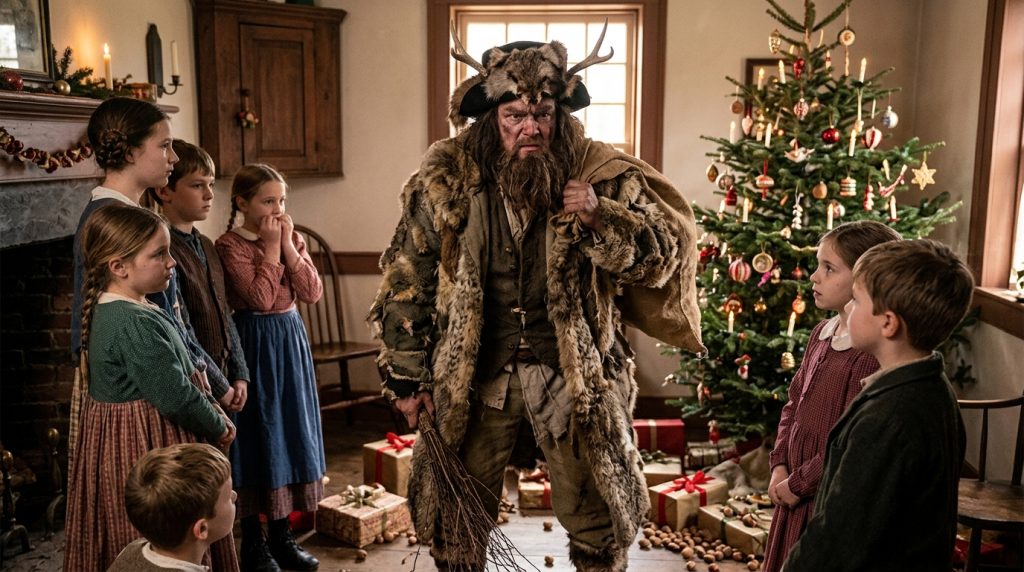
Belsnickel is a Christmas figure from the Palatinate region of southwestern Germany whose tradition was brought to Pennsylvania by German immigrants in the eighteenth and nineteenth centuries, where it became one of the distinctive elements of Pennsylvania Dutch Christmas culture. He is a solitary figure — no Saint Nicholas accompaniment, no saintly partner — who visits children in the weeks before Christmas dressed in furs, carrying a switch in one hand and sweets and nuts in the other, and distributing one or the other depending on his assessment of the child’s behaviour during the year.
The name Belsnickel is derived from Pelznickel, fur Nicholas, which connects him directly to the Saint Nicholas tradition through the element of his fur clothing while giving him an entirely different character from the benevolent bishop. He is ragged, unpredictable, rough in manner, and his visit is an event that children approach with genuine anxiety rather than excitement. The sweets are real. The switch is real. Which one you receive depends on how well you have behaved, and Belsnickel is understood to have genuine knowledge of your conduct.
The Visit
Belsnickel’s visit in the Pennsylvania Dutch tradition typically occurs in the weeks before Christmas rather than on a specific named date. He appears at the door or window, sometimes without prior warning, sometimes heralded by the sound of his switch rapping on the house. He questions the children about their behaviour. He may test them — asking them to recite prayers or perform small tasks — before making his distribution decision.
The distribution method is specific to the Belsnickel tradition and gives it a theatrical quality that purely threat-based Christmas figures lack. He scatters the sweets and nuts on the floor. The children scramble for them. And while they are scrambling, he switches at their hands and backs. The sweets are real but claiming them costs something. Even a good child who receives Belsnickel’s treats receives them in conditions that are deliberately uncomfortable, which is the tradition’s way of maintaining the moral seriousness of the Christmas reckoning even for those who have behaved well.
Belsnickel and Krampus
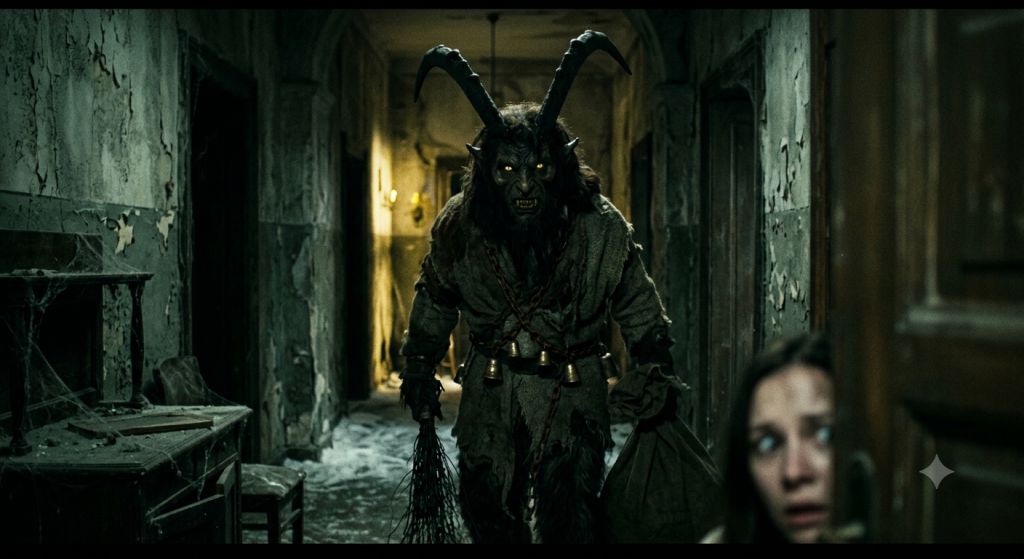
Belsnickel and Krampus serve similar functions in their respective regional traditions — the threatening Christmas visitor who disciplines naughty children — but differ significantly in character. Krampus is a demon, a figure of genuine supernatural horror associated with the devil and the underworld. Belsnickel is a human figure, rough and threatening but not supernatural in the same way: he is a man in furs rather than a beast from hell, which gives him a different emotional register. He is scary in the way that an unpredictable authority figure is scary, rather than in the way that a monster is scary.
This difference in register reflects the different cultural contexts of the two traditions. The Alpine Krampus tradition developed in a context where the supernatural companion of Saint Nicholas was understood as genuinely demonic, drawing on theological frameworks that gave the devil and his minions real power. The Palatinate Belsnickel tradition is more secular in its threat, more human in its character, more theatrical in its distribution ritual.
Belsnickel in America
The Pennsylvania Dutch Belsnickel tradition was documented extensively by nineteenth century American folklorists who found it one of the most distinctive elements of German-American Christmas culture. It declined significantly in the early twentieth century as German-American communities assimilated and the nationally dominant Santa Claus tradition displaced regional variants. It has since experienced a modest revival, partly through academic interest in Pennsylvania Dutch culture and partly through the broader American interest in dark Christmas traditions that has made Krampus internationally famous.
Further Reading
If this article sparked your interest, these are the books worth reading next.
The Dark Side of Christmas
The dark figures, the threatening traditions, and the midwinter beliefs that the commercial Christmas has largely erased. Essential reading for anyone who wants to understand what the season actually was before it became what it is now.
Krampus: The Devil of Christmas
by Monte Beauchamp — a visually extraordinary collection of vintage Krampus greeting cards with historical context. The best introduction to the Krampus tradition’s visual culture.
The Battle for Christmas
by Stephen Nissenbaum — a genuinely excellent history of how Christmas became what it is, from its contested early modern origins through the Victorian reinvention that produced the holiday we now celebrate.
For more on the Christmas folklore tradition, the Krampus article covers the Alpine figure whose tradition parallels Belsnickel’s. The Real Saint Nicholas article covers the historical bishop whose name Belsnickel carries. The Christmas hub page has every article in the cluster.
Never miss a myth
Thank you for being here. The site is brand new and every subscriber genuinely means something to me. If you're here, you care about this stuff as much as I do - and that's all the reason I need to keep going. New stories, videos and dark folklore from around the world, straight to your inbox. No algorithm. Just the stories, when they're ready.