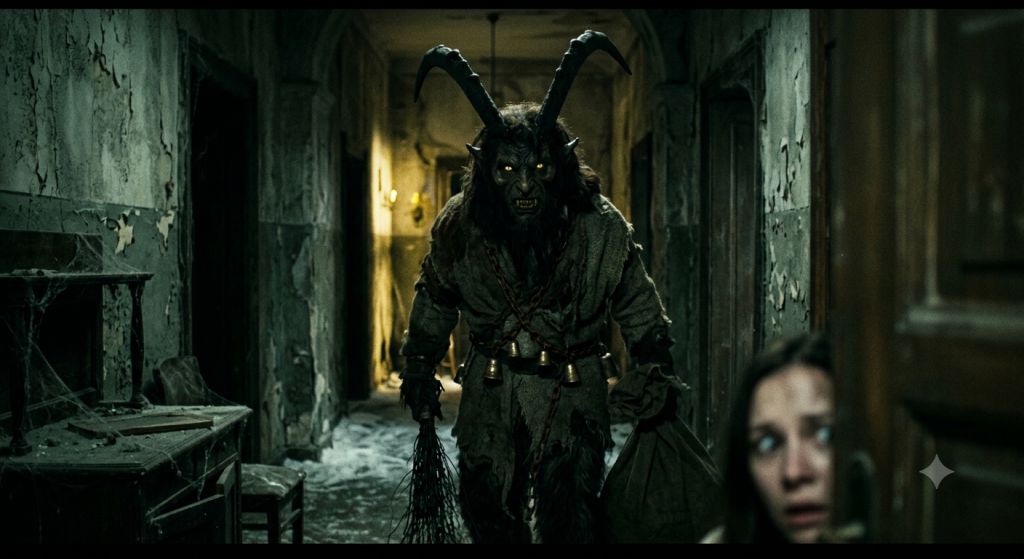
Perchta is a supernatural figure from the Alpine tradition of Austria, Bavaria, and Switzerland whose activities are concentrated in the twelve days of Christmas between the 25th of December and Epiphany on the 6th of January, and she is among the most genuinely frightening figures in European Christmas folklore. She is not frightening in the theatrical way of Krampus, whose demonic appearance and chain-rattling runs are designed to be frightening in a controlled, festive context. She is frightening in the way that a precise and implacable moral judge is frightening: she knows exactly what you have done during the year, she has specific and non-negotiable standards, and the consequences of failing to meet those standards are specific, physical, and documented with a consistency across independent sources that makes them impossible to dismiss as literary exaggeration.
The consequence is disembowelment. Perchta cuts open the stomach of the person who has failed her standards, removes the organs, fills the cavity with straw, stones, or rubbish, and sews the whole thing back up with a ploughshare as a needle and an iron chain as thread. She uses a dull knife or a blunt scythe rather than a sharp instrument, which makes the process slower and less clean than it would otherwise be. This detail appears in multiple independent accounts from different parts of the Alpine region across several centuries, which means it is not the invention of a single storyteller looking for dramatic effect. It is a genuine element of the tradition, consistently documented, and it places Perchta in a category of European supernatural figures whose methods of punishment are specific enough to function as genuine deterrents rather than vague threats.
Understanding Perchta properly requires understanding both the specific Alpine culture that produced her and the extraordinarily ancient tradition of supernatural female figures governing fate, spinning, and the domestic order that she belongs to. She is not simply a Christmas witch. She is the expression of a theological tradition considerably older than Christianity, absorbed into the Christian calendar without being fully transformed by it, and still active in the Alpine folk imagination in forms recognisable to anyone who has read the medieval sources.
The Medieval Sources
Perchta appears in medieval German sources from the thirteenth century onward, and the specific character of those sources tells you something important about her status. She is not documented primarily in the hagiographic literature that records the Church’s encounters with folk belief: she appears in glossaries, in penitential literature, and in the records of Church councils that addressed the continuing problem of pre-Christian seasonal practices in Alpine communities. The fact that Church authorities were concerned enough about Perchta to condemn her in council records confirms that she was a genuine focus of folk religious practice rather than simply a literary invention.
The twelfth century German theologian and mystic Hildegard of Bingen does not mention Perchta directly, but her descriptions of the female supernatural figures associated with fate and the spinning of destiny provide important context for understanding the tradition that Perchta belongs to. The late medieval German sources that do mention Perchta by name describe her consistently as a figure associated with the Epiphany period, with spinning, and with the inspection of domestic order in ways that establish the core of the tradition that subsequent centuries elaborated.
The most detailed early modern accounts come from the Alpine regions themselves, particularly from the records of the Perchtenlauf traditions in Austria and Bavaria and from the ethnographic collections of the nineteenth century that preserved oral traditions that had been maintained across the preceding centuries. The folklorist Jacob Grimm, whose Deutsche Mythologie of 1835 remains one of the most important sources for Germanic supernatural tradition, provides a detailed account of Perchta that draws on multiple independent sources and establishes her as a figure of genuine antiquity and genuine complexity.
Grimm’s account is particularly valuable because he identifies Perchta’s connection to the pre-Christian Germanic tradition of supernatural female figures governing fate and the domestic order, placing her in a genealogy that includes Holda or Holle of the northern Germanic tradition, the Norns of Norse mythology, and ultimately the Indo-European tradition of female fate figures whose spinning of thread represents the determination of human destiny. This genealogy does not make Perchta simply a variant of these other figures: she has specific characteristics that distinguish her from all of them. But it places her in a tradition old enough that her Christmas activities are the latest expression of a religious impulse that has been present in the European world for millennia.
The Two Perchtas
The Perchta tradition in the Alpine sources consistently describes two distinct aspects of the same figure, and the relationship between these two aspects is one of the most interesting elements of the tradition. The Beautiful Perchta and the Ugly Perchta are not two different beings: they are the two faces of a single supernatural figure whose appearance at any given moment is determined by the moral condition of the person encountering her.
The Beautiful Perchta appears to those who have fulfilled their obligations during the year. She is described as a tall, stately woman dressed in white, sometimes with a goose foot or a swan foot visible beneath the hem of her robes. This goose or swan foot is one of the most consistently documented details of her appearance and one of the most interesting: it marks her as belonging to a specific category of supernatural female figures in the Germanic tradition who are identified by a non-human foot that their clothing conceals. The Swan Maiden tradition, the various Germanic stories of women who turn into birds or who have bird characteristics hidden beneath human appearance, shares this motif, and its presence in the Perchta tradition connects her to a very old current of Germanic supernatural belief about shape-shifting female figures who inhabit the boundary between the human world and the wild world.
The Beautiful Perchta brings good fortune to the households she is pleased with. She blesses the spinning, ensures a good harvest for the coming year, and leaves small gifts for the children who have behaved well and the women who have finished their work. In some regional traditions she leaves a coin in the shoe of those she approves of, which is a detail that connects her gift-giving to the broader European tradition of the supernatural figure who rewards the deserving with money left in footwear.
The Ugly Perchta appears to those who have not met her standards. She is described as old, bent, with an enormous iron nose or an iron beak rather than a human nose, with tangled grey hair and ragged clothing. The iron nose or beak is one of the most consistently documented details of her threatening aspect and one of the most specifically Alpine: the iron implements associated with her threatening activities, including the blunt knife used for disembowelling and the iron chain used for sewing the victim back up, appear across multiple independent accounts and suggest a specific tradition of iron as the material of supernatural punishment in the Alpine context.
The moral determinism of the two-aspect structure is theologically precise. Perchta does not choose arbitrarily between her beautiful and ugly faces. Her appearance is determined entirely by what she finds when she inspects the household. The person who encounters the Beautiful Perchta has earned that encounter. The person who encounters the Ugly Perchta has also earned it, in the opposite direction. There is no element of chance or caprice in the tradition: Perchta is not a figure who might harm you if she happens to be in a bad mood. She is a figure who will harm you if you have given her specific grounds to do so, and who will reward you if you have not.
The Spinning Domain and Its Significance
Perchta’s specific domain is spinning and the textile work that was the primary domestic labour of women in the pre-industrial Alpine world, and her inspection of spinning during the twelve days of Christmas is the element of her tradition most consistently documented across all the sources. The woman who has completed her spinning before the Christmas season, who has emptied her distaff and cleaned her spinning implements and put them away properly, is safe from Perchta’s punishment. The woman who has left her spinning unfinished or who has been idle during the year faces the disembowelment that is Perchta’s specific penalty for domestic failure.
The specific connection between spinning and Perchta’s powers places her in the Indo-European tradition of female supernatural figures who govern spinning as a metaphor for fate. The Norse Norns spin the threads of human destiny at the foot of Yggdrasil. The Greek Moirai spin, measure, and cut the thread of each human life. The Slavic Rozhanitsy spin the fate of each child at birth. Mokosh, the Slavic fate goddess, governs spinning and inspects it at specific times of year. Frau Holle of the broader Germanic tradition governs spinning in ways closely parallel to Perchta, and the two figures are related closely enough that some scholars have argued they represent regional variants of the same original figure.
In each of these traditions the act of spinning is not simply a practical activity. It is the human equivalent of the supernatural spinning of fate: the woman at the spindle is participating in a cosmic activity, and her diligence or idleness at the spindle has implications beyond the practical question of whether she has enough thread for the household’s needs. The spinning that Perchta inspects is therefore not simply a measure of domestic productivity: it is a measure of the woman’s participation in the cosmic order that Perchta represents and enforces.
The specific timing of the inspection, during the twelve days of Christmas, is significant in this context. The twelve days were understood across the Alpine and Germanic tradition as a period of suspension: the ordinary agricultural and domestic routines were interrupted, the supernatural was particularly active, and the normal rules of time and productivity did not apply in the way they did during the rest of the year. The suspension of normal spinning during the twelve days was itself part of the tradition: Perchta did not expect spinning during the twelve days, but she expected all spinning to have been completed before they began. The twelve days were not a period of work but a period of reckoning with what had been done and left undone during the year that was ending.
The Disembowelment: Why the Tradition Is So Specific
The specific nature of Perchta’s punishment for those who fail her inspection deserves careful attention, because the specificity of the disembowelment tradition is one of the most unusual elements of the European Christmas supernatural tradition and one that raises genuine questions about where it comes from and what function it served.
The disembowelment appears in its fullest form in the Austrian and Bavarian traditions, where it is described with a consistency and a specificity that rules out literary embellishment as the primary explanation. Multiple independent accounts from different areas and different periods describe the same punishment: the stomach is cut open, the organs are removed, the cavity is filled with rubbish (straw, stones, broken pottery, or simply dirt), and the victim is sewn back up with the specific instruments of iron needle and iron chain. The victim does not die immediately: they survive with the rubbish inside them, in a condition that combines the physical discomfort of violated anatomy with the specific humiliation of being filled with worthless material.
The filling with straw and rubbish is the element that distinguishes Perchta’s punishment from simple evisceration and gives it its specific moral content. The person who has been idle during the year is filled with the material equivalent of idleness: worthless stuff, the substance of wasted time made physical and inserted into the body that should have been productive. The punishment is not simply violence but a specific moral commentary expressed through the body of the offender. The lazy person becomes literally full of worthless material, which is what Perchta’s tradition implies they already were figuratively.
The dull knife or blunt scythe used for the disembowelment is another specific detail with a specific function. A sharp knife would make the process quick and relatively clean. A dull knife makes it slow, painful, and difficult, which extends the suffering and emphasises the thoroughness of the punishment. The choice of instrument is a moral choice as well as a practical one: the laziness of the offender is met with the specific unpleasantness of a blunt blade, rather than with the mercy of a clean cut.
The origin of the disembowelment tradition is not entirely clear, and various explanations have been proposed. The most compelling connects it to the pre-Christian Alpine tradition of sacrificial practices associated with the midwinter season, in which the renewal of the world at the year’s turning required the destruction of something old and the replacement of its contents with new material. The body filled with rubbish and then sewn back up is, in this reading, a distorted survival of a sacrificial logic in which the destruction and refilling of a container was a ritual act with cosmological significance. Whether this explanation is correct is impossible to verify, but the specific character of the punishment, which is more elaborate than simple killing and more ritualistic than simple torture, suggests that it has origins in something more than simple folk sadism.
The Perchtenlauf and the Masked Processions
The Perchtenlauf, the running of the Perchten, is the ritual procession tradition associated with Perchta in the Alpine regions, and it is one of the most visually spectacular folk traditions in Europe. The runs take place during the twelve days of Christmas, particularly in the nights around the New Year, and involve participants wearing elaborate carved masks and fur or feather costumes representing the Schönperchten (beautiful Perchten) and the Schiachperchten (ugly Perchten), who process through Alpine villages making enormous noise with bells, chains, and other noise-making implements.
The masks used in the Perchtenlauf are genuinely extraordinary objects. Unlike the relatively standardised Krampus masks, which share a common template even as they vary in detail, the Perchten masks represent an extraordinary range of characters and creatures, from figures of almost ethereal beauty to creatures of genuine grotesqueness. Each mask is individually carved, typically from the wood of local trees, and the carving of a Perchten mask is understood as a skilled craft that combines artistic ability with a knowledge of the tradition’s visual conventions. The best masks are objects of considerable aesthetic quality and considerable monetary value.
The function of the Perchtenlauf in the tradition is understood as the driving away of winter spirits and the evil influences of the old year, making way for the new year’s positive forces. The Schönperchten bring good luck and fertility; the Schiachperchten drive away negative supernatural forces through their frightening appearance and the noise they create. The run is therefore simultaneously a protective ritual and a community celebration, combining genuine supernatural function with the carnival atmosphere that characterises the major Alpine seasonal traditions.
The Church’s relationship with the Perchtenlauf has been consistently hostile. The masks, the noise, the costumes, and the general atmosphere of the run were all understood by ecclesiastical authorities as incompatible with the Christian character of the Christmas season, and multiple Church councils and episcopal decrees from the medieval period onward attempted to suppress the tradition. The attempts were no more successful than the Church’s attempts to suppress Krampus: the Perchtenlauf tradition survived through the entire period of ecclesiastical opposition and continues in Alpine communities today with considerable vitality.
The Relationship to Frau Holle
The relationship between Perchta and Frau Holle, the Germanic winter goddess of the northern tradition, is one of the most discussed questions in the scholarship on Alpine and Germanic supernatural tradition, and it is worth addressing directly because it illuminates something important about the depth and reach of the tradition that both figures belong to.
The similarities between Perchta and Frau Holle are extensive. Both are female supernatural figures associated with the midwinter period. Both govern spinning and inspect the spinning of the women in their domain at specific times of year. Both have a beautiful aspect and an ugly aspect whose appearance is determined by the moral condition of the person they encounter. Both are associated with the Wild Hunt or with nocturnal processions of supernatural beings. Both have connections to the dead and to the fate of unbaptised children. And both belong to the same broad tradition of Indo-European female supernatural figures governing fate, spinning, and the domestic order.
Jacob Grimm argued in Deutsche Mythologie that Perchta and Frau Holle were regional variants of the same original figure, a position that has influenced much subsequent scholarship. The alternative view, held by more recent scholars, is that the two figures represent parallel developments from a shared Indo-European tradition rather than direct variants of each other. The distinction matters because it affects how you understand the regional specificity of each figure: if Perchta is simply the Alpine name for Frau Holle, then her specific Alpine characteristics are superficial variations on a single underlying tradition; if she is a parallel development, then her specific characteristics reflect something genuinely different about the Alpine context that produced her.
The disembowelment tradition, which is specific to Perchta and has no clear equivalent in the Frau Holle tradition, is the strongest evidence for the parallel development view: it is too specific and too consistently documented to be a superficial local variation, and its absence from the Frau Holle tradition suggests that Perchta has characteristics that cannot be explained simply as Alpine variants of the northern figure. The two figures are related, deeply so, but they are not the same figure in different regional dress.
Perchta in the Contemporary Alpine World
Perchta remains a figure of genuine significance in the contemporary Alpine world, though her significance operates differently in different contexts. In the communities where the Perchtenlauf tradition is most active, particularly in the Salzburg and Tyrol regions of Austria, she is understood as the presiding figure of a living folk tradition that connects the community to its pre-Christian past and that has genuine cultural value precisely because of its age and its continuity. The Perchtenlauf in these communities is not a heritage performance staged for tourists: it is an active community ritual that the participants take seriously as a form of seasonal observance.
In the broader Alpine world, Perchta functions more as a cultural reference point than as a figure of active folk belief. She appears in Christmas markets, in seasonal illustrated books, and in the dark Christmas content that has proliferated on the internet in the early twenty-first century. The international appetite for dark Christmas figures that drove the global Krampus revival has brought Perchta to the attention of audiences outside the Alpine region, and she appears with increasing frequency in the same dark Christmas content ecosystems that have made Krampus internationally famous.
The international reception of Perchta has been, if anything, more interested in her disembowelling tradition than in the spinning and domestic order aspects that are central to her Alpine meaning. The disembowelment is the element that translates most easily across cultural boundaries, because it requires no knowledge of the specific Alpine domestic economy of spinning and textile production to understand as threatening. The spinning domain requires context; the dull knife does not. This selective translation of the tradition is characteristic of how folk figures travel across cultural boundaries: the most dramatic and most easily comprehensible elements survive the translation, while the elements that require cultural knowledge to understand are left behind.
For more on the Christmas folklore tradition, the Krampus article covers the Alpine devil whose tradition overlaps with Perchta’s in the same communities and the same seasonal period. The Frau Holle article covers the Germanic winter goddess whose spinning domain and midwinter inspection parallel Perchta’s and whose relationship to her is one of the most interesting questions in Germanic supernatural tradition. The Wild Hunt at Christmas article covers the broader midwinter tradition of supernatural beings active during the twelve days. The Christmas hub page has every article in the cluster.
Never miss a myth
Thank you for being here. The site is brand new and every subscriber genuinely means something to me. If you're here, you care about this stuff as much as I do - and that's all the reason I need to keep going. New stories, videos and dark folklore from around the world, straight to your inbox. No algorithm. Just the stories, when they're ready.