The Headless Horseman of Sleepy Hollow is one of the most enduring Halloween figures in American culture, a galloping supernatural terror whose image has become inseparable from the season. He appears in Washington Irving’s 1820 short story The Legend of Sleepy Hollow, where he is identified as the ghost of a Hessian soldier whose head was shot off by a cannonball during the Revolutionary War and who rides through the night hurling his head at those he encounters. He terrorises the schoolteacher Ichabod Crane, and whether he is a genuine supernatural being or a human impostor playing a prank is left deliberately ambiguous by Irving.
The Headless Horseman is often presented as a figure from American folk tradition, a ghost story that circulated in the Hudson Valley before Irving wrote it down. The reality is more complex: Irving was a literary writer who used the conventions of European headless rider traditions to create a specifically American ghost story, setting it in a specific American landscape and giving it a specific American historical context. The result is a literary creation with genuine folkloric roots that has itself become a piece of American folklore.
Irving’s Sources
Washington Irving was a well-read man who was familiar with the European headless rider traditions that preceded his story. The Dullahan of Irish tradition, the headless rider who carries his own head and whose appearance signals imminent death, is the closest parallel to Irving’s Horseman and the most likely direct influence. Irving had access to collections of Irish and Scottish folklore, and the headless rider with a carrying head rather than a lost head is specifically Irish in character.
German folklore also contributed to Irving’s conception, particularly the tradition of the Wild Hunt and its association with headless or otherwise incomplete supernatural riders. Irving spent time in Germany and was deeply interested in German romantic folklore, which fed into the supernatural atmosphere of Sleepy Hollow as much as any specific headless rider legend.
The Dullahan Connection
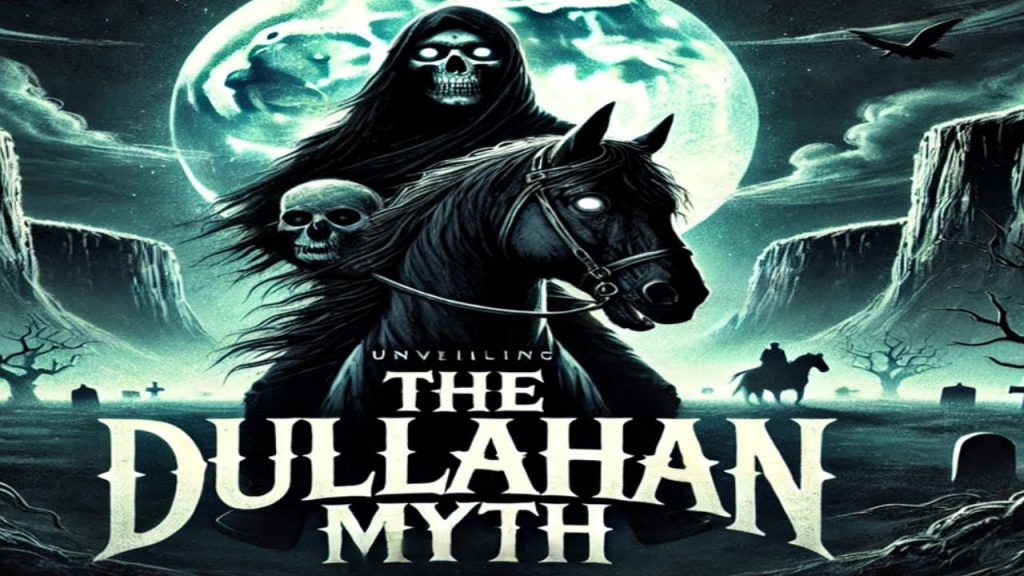
The Irish Dullahan is the most significant folkloric ancestor of Irving’s Horseman. He rides a black horse, carries his own head under his arm or holds it aloft, and uses a spine as a whip. He is a death omen rather than a prank-playing ghost, and his appearance means that someone in the vicinity is about to die. He cannot be stopped and cannot be turned away, and the only protection against him is gold, which he finds intolerable.
Where Irving’s Horseman throws his head as a weapon or a prank, suggesting the possibility of human imposture, the Dullahan uses his head as a lantern and a death announcement, his glowing face illuminating the darkness as he rides to collect the soul whose time has come. The tonal difference between the Irish death omen and the American Halloween prank reflects the different cultural contexts: Irish folk belief maintained genuine terror around the headless rider, while Irving was writing for an American audience he wanted to entertain rather than genuinely frighten.
From Story to Symbol
The Legend of Sleepy Hollow’s transition from a literary short story to an American folk figure happened remarkably quickly. By the mid-nineteenth century the Headless Horseman was already being treated as a genuine piece of American folklore rather than as a known literary creation, and by the twentieth century he had become one of the definitive symbols of Halloween in American culture through multiple adaptations, films, and illustrations.
Tim Burton’s 1999 film Sleepy Hollow gave the Horseman his most spectacular cinematic treatment and reinforced his status as a Halloween icon for a new generation. The Disney animated short of 1949, part of The Adventures of Ichabod and Mr Toad, introduced the story to post-war American children and established the visual template for the Horseman that subsequent adaptations have largely followed.
Further Reading
If this article sparked your interest, these are the books worth reading next.
Halloween: From Pagan Ritual to Party Night
by Nicholas Rogers — the best single-volume history of Halloween, tracing it from its Celtic and medieval roots through to its commercialisation as a global holiday. Properly researched and clearly written.
Trick or Treat: A History of Halloween
by Lisa Morton — a thorough and highly readable history of Halloween’s customs and traditions, from souling and guising to the modern American commercial holiday.
The Halloween Encyclopedia
by Lisa Morton — the most comprehensive reference on Halloween in print, covering every aspect of the holiday’s history, folklore, customs, and cultural expressions in detail.
For more on the seasonal folklore tradition, the Dullahan article covers the Irish headless rider whose tradition directly influenced Irving. The Origins of Samhain article covers the Celtic festival at the root of Halloween. The Halloween hub page has every article in the cluster.
Never miss a myth
Thank you for being here. The site is brand new and every subscriber genuinely means something to me. If you're here, you care about this stuff as much as I do - and that's all the reason I need to keep going. New stories, videos and dark folklore from around the world, straight to your inbox. No algorithm. Just the stories, when they're ready.