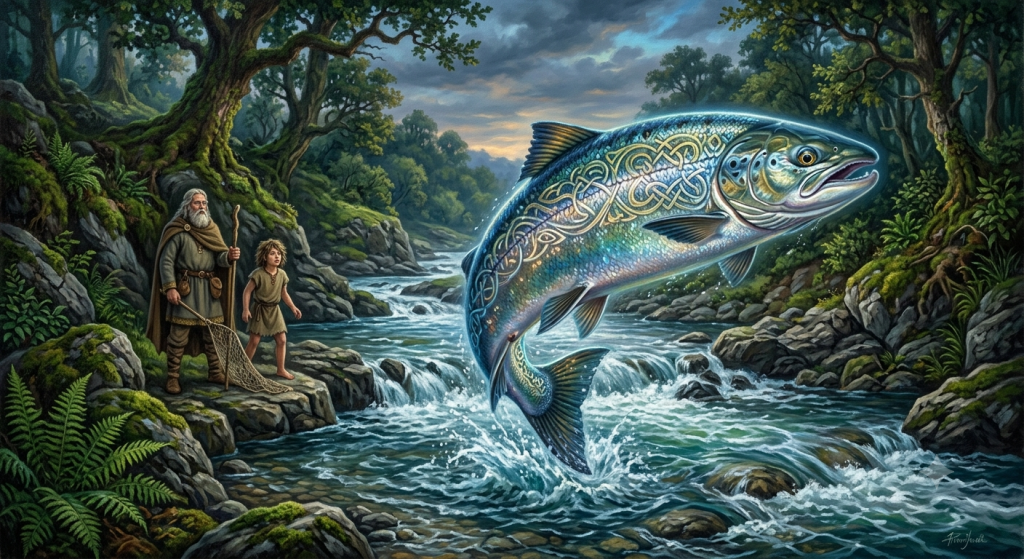
The Salmon of Knowledge is the most elegantly structured story in the Fenian Cycle, and one of the most perfectly constructed myths in the Irish tradition. Its mechanism is simple: a fish contains all the wisdom in the world, and whoever eats the first bite of it will possess that wisdom. A poet spends seven years trying to catch it. A boy is given the task of cooking it for the poet and told specifically not to eat any of it. The boy burns his thumb on the cooking fish, puts his thumb in his mouth to ease the pain, and the wisdom passes to him instead. The poet sees what has happened, understands that the prophecy has been fulfilled and that he is not the intended recipient, and accepts it.
Everything about this story is precisely calibrated. The accidental quality of the transfer is essential: Fionn does not steal the wisdom or trick his way to it. He does not even deliberately taste the fish. He burns his thumb and puts it in his mouth, as anyone would. The wisdom finds him because he is the one it was always going to find, not because he was clever enough to take it.
The Salmon and the Pool of Fec
The salmon in question lived in the Pool of Fec on the River Boyne, which the tradition also calls Tobar Segais, the Well of Wisdom. This is the same well that appears elsewhere in Irish mythology as the source of cosmic wisdom: the hazel trees that grow above it drop their nuts into the water, the salmon eat the nuts, and whoever eats the salmon gains the knowledge contained in the hazelnuts, which is all the wisdom and poetry and knowledge in the world compressed into a single edible form.
The hazel is the tree of wisdom in Celtic tradition, appearing in this role across multiple strands of Irish and Welsh mythology, and the image of cosmic wisdom as something that falls from a tree into water and is absorbed by a fish is one of the most distinctively Celtic cosmological ideas in the entire tradition. Wisdom in this framework is not abstract. It is a substance, located in specific trees above a specific well, absorbed by a specific fish, transferable through eating. The physicality of it is the point.
The poet Finegas had been attempting to catch this salmon for seven years when the young Fionn came to him as a student. The seven years of patient pursuit, the specific duration associated with magical endeavour in Irish tradition, establish that the salmon was genuinely difficult to catch and that Finegas had genuinely earned the opportunity when it finally came.
The Cooking and the Thumb
When Finegas finally caught the salmon, he gave it to Fionn to cook and told him explicitly that he must not eat any of it. The instruction carries the weight of everything Finegas has spent seven years working toward. Fionn cooked the fish carefully and did not eat any of it.
A blister rose on the salmon’s skin as it cooked. Fionn pressed it down with his thumb. The heat of the blister burned his thumb, and he put the thumb in his mouth to ease the pain. When he brought the cooked fish to Finegas, the poet looked at him and saw that his eyes had changed. He asked whether Fionn had eaten any of the salmon. Fionn said he had not, but explained about the thumb.
Finegas understood. He told Fionn to eat the rest of the salmon, because the prophecy said that a man named Fionn would receive the wisdom, and Fionn was his name, and the prophecy had been fulfilled in the only way it could have been fulfilled. He gave up seven years of effort and the thing he had spent them working toward without apparent bitterness. This is one of the most graceful moments in the Irish tradition: an old man recognising that something he had worked for belongs to someone else, and giving it over without attempting to contest what the prophecy has already decided.
What the Wisdom Gave Fionn
After eating the salmon, Fionn could access the wisdom it contained by placing his thumb in his mouth. This thumb-sucking gesture, the imbas or inspired knowledge accessed through the thumb, became one of his defining characteristics and distinguishes his wisdom from the wisdom of other heroes: it is not cleverness or strategic thinking but a direct pipeline to cosmic knowledge, accessed through a physical gesture connected to the original moment of the transfer.
The thumb also connects Fionn to the broader Celtic tradition of inspired wisdom accessed through the body rather than through intellectual effort. The thumb that burned on the salmon, that was instinctively put in the mouth, that transmitted wisdom through pain: this is wisdom as something the body receives rather than something the mind achieves. It arrives sideways, through accident and through the automatic response to discomfort, rather than through deliberate pursuit.
This is characteristic of how Irish mythology treats the transmission of cosmic knowledge. Finegas pursued the salmon through seven years of deliberate effort and did not receive its wisdom. Fionn burned his thumb and put it in his mouth and received everything Finegas had been working toward. The tradition is not saying that effort is worthless. It is saying that certain kinds of knowledge have their own logic about who receives them and how, and that this logic does not always correspond to who worked hardest for it.
The Salmon Today
The salmon remains the animal most associated with wisdom in Irish and broader Celtic cultural tradition, and the image of the Salmon of Knowledge appears regularly in contemporary Irish art, jewellery, and public sculpture. The River Boyne, where the Pool of Fec was located, runs through a landscape that is already mythologically saturated: the Brú na Bóinne complex at Newgrange is nearby, the whole river valley thick with the associations of Irish mythology’s most important sites.
The story is also one of the most cited in discussions of how knowledge and wisdom are understood differently in different cultural traditions. The Salmon of Knowledge does not reward the cleverest or the most persistent. It rewards the person it was always going to reach, through a mechanism that is indistinguishable from accident. This is a genuinely different model of how cosmic wisdom works from the Greek tradition’s emphasis on rational inquiry or the Norse tradition’s emphasis on deliberate sacrifice, and it is characteristically Irish in its insistence that the most important things arrive sideways rather than directly.
Further Reading
If this article sparked your interest, these are the books worth reading next.
The Mabinogion
The foundational collection of Welsh mythology — the primary source for the Arthurian tradition, the four branches of Welsh legend, and the stories that sit at the heart of the Celtic world.
Celtic Myths and Legends
by Peter Berresford Ellis — the best single-volume introduction to the full range of Celtic mythology, covering Irish, Welsh, Scottish, Gaulish, and Breton traditions properly.
The Táin: Translated from the Old Irish Epic Táin Bó Cúailnge
The great Irish epic — Cu Chulainn, Queen Medb, and the Cattle Raid of Cooley. The closest thing the Celtic world produced to the Iliad, and considerably stranger.
For more on the Fenian tradition, the Fionn Mac Cumhaill article covers the full life and mythology of the warrior-poet whose wisdom began with a burned thumb. The Oisín and Tír na nÓg article covers the story of Fionn’s son and the land of eternal youth. The Ireland category has every article in the Irish mythology and folklore cluster.
Never miss a myth
Thank you for being here. The site is brand new and every subscriber genuinely means something to me. If you're here, you care about this stuff as much as I do - and that's all the reason I need to keep going. New stories, videos and dark folklore from around the world, straight to your inbox. No algorithm. Just the stories, when they're ready.