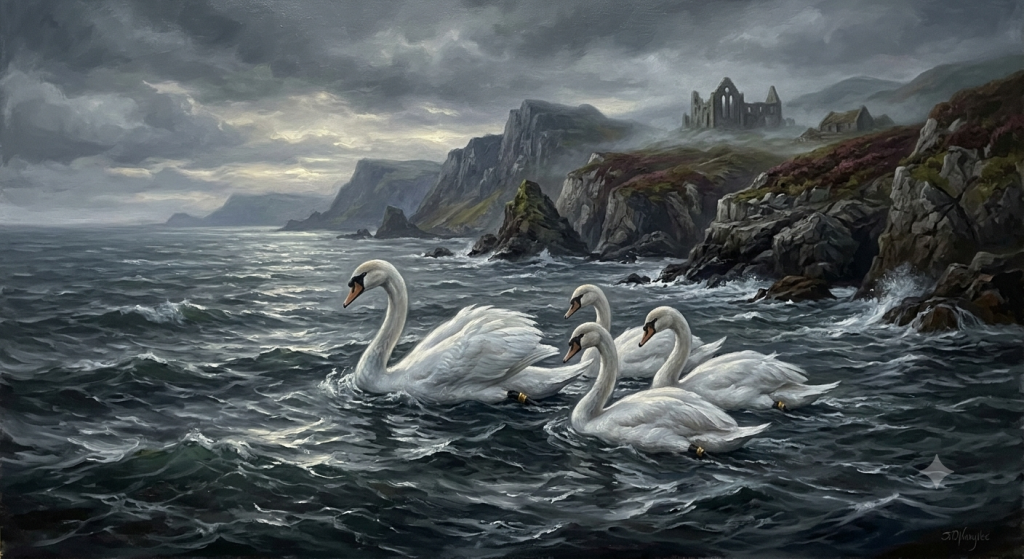
The Children of Lir is one of the Three Sorrows of Irish mythology, and it is the one that has stayed most persistently in Irish cultural consciousness across the centuries. The image of four white swans on the water, calling out in human voices, singing music so beautiful that those who heard it fell into a peaceful sleep, is one of the most enduring in Irish storytelling, and it appears on street signs and public sculptures and children’s book covers throughout Ireland today in a way that speaks to how thoroughly the story has embedded itself in the national imagination.
It is a story about patience under suffering so extreme it defies ordinary comprehension. Nine hundred years as swans. Three periods of exile on three bodies of water, each more exposed and more punishing than the last. A stepmother’s curse that nobody could lift and a father who could do nothing but watch. And at the end of nine hundred years, a release that comes too late for anything except death.
The Background: Lir and the Election
After the Tuatha Dé Danann withdrew into the sídhe mounds following their defeat by the Milesians, they held an assembly to choose a king of the Otherworld. The man chosen was Bodhbh Derg, son of the Dagda. Lir of Sídh Fionnachaidh was not chosen, and he was angry about it. He left the assembly without acknowledging the new king, which was a serious breach of protocol in the tradition’s terms.
The council wanted to go to war with Lir for the insult. Bodhbh Derg refused, and instead offered Lir his foster daughter Aobh in marriage. Lir accepted. He and Aobh had four children: Fionnuala, the eldest and the one who carries the story; Aodh; and the twins Fiachra and Conn. Aobh died in childbirth with the twins.
Bodhbh Derg gave Lir another foster daughter, Aoife, as a second wife. Aoife loved the children at first, then became consumed by jealousy of the love Lir bore them, a love so great that it seemed to leave no room for anything else. She fell into illness and lay in her sickbed for a year, her jealousy working in her until she rose from it resolved to act.
The Curse
Aoife took the four children to Lough Derravaragh in Westmeath, intending to have her attendants kill them. The attendants refused. She then tried to kill them herself and could not bring herself to do it. She used magic instead.
She struck them with a druidic wand and turned them into four white swans. Before she did, Fionnuala, the eldest, asked what form the curse would take and how long it would last. Aoife told her: three hundred years on Lough Derravaragh, three hundred years on the Straits of Moyle between Ireland and Scotland, and three hundred years on the waters of Irrus Domhnann and Inis Gluaire in the west. They would be released when a king from the north married a queen from the south and when the sound of a Christian bell was heard in Ireland.
She then added something that she had not planned to add: she gave them their human voices and the gift of making music so beautiful that those who heard it would find peace and comfort. This addition is one of the most characteristic moments in Irish mythology: the curse-giver undoes part of what she has done, not enough to undo it but enough to give the cursed something to sustain them. Whether this is mercy or guilt or simply the logic of the tradition that says suffering must carry something worth preserving, the text does not say.
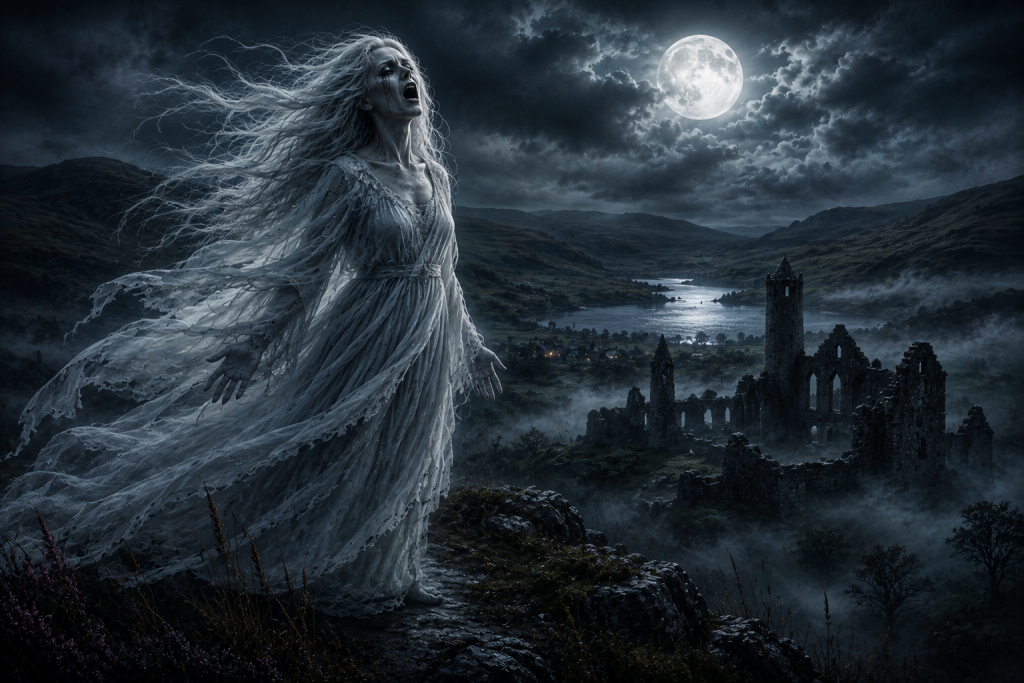
When Aoife returned without the children, Bodhbh Derg understood what she had done and used his own power to transform her into an air demon, which she remains to this day according to the tradition.
The Three Periods of Exile
The three hundred years on Lough Derravaragh are the gentlest of the three periods. Lir came to the lough when he learned what had happened and sat with his children by the water, and they could speak to him and sing to him, and the Tuatha Dé Danann came from across Ireland to be near the swans and hear their music. The music they made was so beautiful that whatever grief a person came with was eased by hearing it.
The Straits of Moyle, the turbulent water between northeastern Ireland and Scotland, were different. The tradition describes the three hundred years there in terms of physical exposure and cold that the text treats without mitigation: storms that drove the swans apart from each other, freezing water, waves that battered them against rocks. Fionnuala sheltered her brothers under her wings when she could find them, gathering them back together after each storm.
The western waters of Irrus Domhnann and Inis Gluaire were similarly exposed and cold. The Atlantic in winter off the west coast of Ireland is not gentle, and the tradition does not pretend it is. The nine hundred years are not nine hundred years of dignified suffering. They are nine hundred years of cold and storm and separation and the slow passage of time while the world changed around them.
The Release and the End
The conditions for release were fulfilled when Saint Mochaomhóg came to Inis Gluaire and built his church there, and the swans heard his bell. The Christian framing of the release is one of the most discussed elements of the story in scholarship, because it represents the Christianisation of a pre-Christian myth: the old Ireland of the Tuatha Dé Danann ending, the new Ireland of Christianity beginning, with the four swan children at the threshold between the two.
A king from Connacht came north to marry a princess of Munster, and the two conditions were met simultaneously. The swans shed their feathers and returned to human form. What emerged were not the children who had been cursed nine hundred years before. They were ancient, withered, human only in form. The saint baptised them before they died.
Fionnuala asked to be buried with her brothers as they had sheltered in life: Conn at her right hand, Fiachra at her left, and Aodh before her face. They were buried that way, and a stone was raised over them with their names in Ogham.
The story ends there. Not with triumph or with justice. With four very old people dying in the arms of a saint on a small island off the west coast of Ireland, after nine hundred years of doing nothing wrong.
Why the Story Persists
The Children of Lir has survived in Irish cultural memory with an intensity that the other Two Sorrows have not quite matched, and the reason is probably the specific nature of what it describes: innocent suffering of enormous duration, borne with patience that the tradition presents as genuinely heroic in a way that battlefield heroism is not.
Fionnuala’s care for her brothers across nine centuries of cold and storm, her sheltering of them under her wings in the Straits of Moyle, her holding of the family together across a duration that would unmake any ordinary bond, is the kind of heroism that asks nothing of the audience except recognition. It requires no special knowledge of warrior codes or sovereignty traditions. It simply requires understanding what it means to care for someone for a very long time in very difficult circumstances.
That is why there are swan sculptures outside the Custom House in Dublin and why the story appears in Irish primary school curricula and why it has been adapted into operas and ballets and children’s books across two centuries of Irish cultural production. It is the story that needs the least translation.
Further Reading
If this article sparked your interest, these are the books worth reading next.
The Mabinogion
The foundational collection of Welsh mythology — the primary source for the Arthurian tradition, the four branches of Welsh legend, and the stories that sit at the heart of the Celtic world.
Celtic Myths and Legends
by Peter Berresford Ellis — the best single-volume introduction to the full range of Celtic mythology, covering Irish, Welsh, Scottish, Gaulish, and Breton traditions properly.
The Táin: Translated from the Old Irish Epic Táin Bó Cúailnge
The great Irish epic — Cu Chulainn, Queen Medb, and the Cattle Raid of Cooley. The closest thing the Celtic world produced to the Iliad, and considerably stranger.
For more on the Irish mythology tradition, the Tuatha Dé Danann article covers the divine race to which Lir and his children belong. The Deirdre of the Sorrows article covers the first of the Three Sorrows of Irish mythology. The Ireland category has every article in the Irish mythology and folklore cluster.
Never miss a myth
Thank you for being here. The site is brand new and every subscriber genuinely means something to me. If you're here, you care about this stuff as much as I do - and that's all the reason I need to keep going. New stories, videos and dark folklore from around the world, straight to your inbox. No algorithm. Just the stories, when they're ready.