The Táin Bó Cúailnge, the Cattle Raid of Cooley, is the central text of the Ulster Cycle of Irish mythology and one of the most important works in early medieval European literature. It was composed in its earliest surviving form around the seventh or eighth century CE, drawing on older oral tradition, and it exists in two main manuscript versions: the Book of the Dun Cow from around 1100 CE and the Book of Leinster from around 1160 CE, each with significant differences in emphasis and detail.
The comparison most commonly made is with Homer. The Táin is Ireland’s Iliad: a vast heroic narrative centred on a prolonged military campaign, built around the figure of a supreme warrior whose abilities are beyond those of any other combatant, concerned with questions of honour, loyalty, obligation, and the relationship between individual excellence and collective enterprise. The comparison flatters neither work by reducing either to an analogy of the other, but it gives a sense of the scale and the ambition of the Irish text.
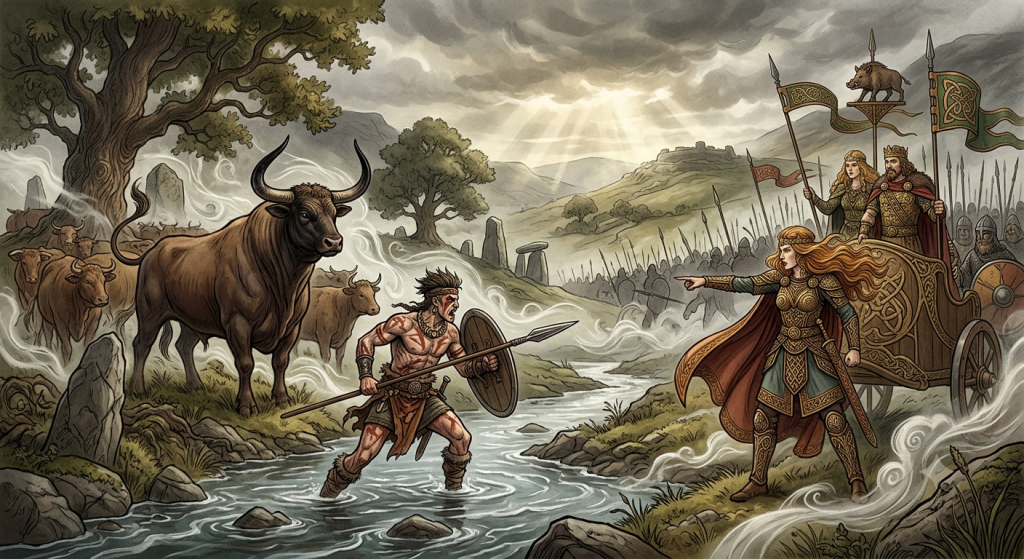
The story is straightforward at the level of plot. Queen Medb of Connacht launches an invasion of Ulster to seize the Donn Cúailnge, the Brown Bull of Cooley. The men of Ulster are incapacitated by a curse that makes them weak as women in labour whenever Ulster faces its greatest military threat. Only Cú Chulainn, the greatest warrior in Ireland, is exempt from the curse because of his divine ancestry. He defends Ulster alone, fighting Medb’s champions in single combat, holding the army back until the Ulstermen recover. The Ulstermen eventually recover, the two armies meet in full battle, and Medb withdraws with the bull. The bull and Ailill’s bull fight each other and both die.
At this level it is a straightforward heroic narrative. At every other level it is considerably more interesting than that.
The Curse of Macha
The curse that incapacitates the men of Ulster, called the Noínden Ulad or the Debility of the Ulstermen, has its own origin story that is told separately from the Táin but is essential to understanding it. Macha, a woman of supernatural origin, was forced by her husband to race against the king’s horses while pregnant, because the king had boasted of her speed. She won the race and gave birth at the finish line, but she cursed the men of Ulster before she did: for nine generations, they said, at the time of their greatest need, they would suffer the same weakness she had suffered, the weakness of a woman in the pangs of childbirth.
The curse is one of the most pointed pieces of mythological social commentary in Irish tradition. The men of Ulster are incapacitated precisely by the experience that women go through as a matter of course, and this incapacitation occurs when they are needed most. The king who caused it through his boasting, who treated his wife as a competitive asset rather than as a person, brings this vulnerability on his entire kingdom. Cú Chulainn is exempt because his father is the god Lugh, which means his divine ancestry places him outside the ordinary human condition that the curse targets.
Cú Chulainn’s Single Combat
The central sustained narrative of the Táin is Cú Chulainn’s series of single combats against Medb’s champions. Irish heroic convention required that a single warrior could challenge an army to send its best fighter rather than advance en masse, and Medb’s army is obligated by this convention to send champions one by one while Cú Chulainn is available to fight them.
The combats that result are some of the most vivid writing in early Irish literature. They are not simply accounts of fighting. Each champion has their own character, their own relationship to Cú Chulainn, their own tragic weight. The most devastating is the combat with Fer Diad, Cú Chulainn’s closest friend and foster brother, whom Medb induces to fight against Ulster through a combination of bribery, flattery, and the threat of satirical damage to his honour. The two men fight for three days at a ford, going back and forth, each night sending each other healing herbs and food across the water, each morning returning to the combat. On the fourth day Cú Chulainn uses the Gáe Bulg, his most terrible weapon, and kills Fer Diad. His lament over the body is one of the most moving passages in the text.
The Ríastrad
In the most intense moments of combat, Cú Chulainn undergoes the ríastrad, the warp spasm or battle frenzy, one of the most extraordinary descriptions of supernatural transformation in any mythology. His body contorts into a shape that is no longer quite human. One eye sinks into his skull and the other protrudes on his cheek. His internal organs can be seen moving through his skin. His hair stands on end, each hair tipped with a spark of fire. A pillar of dark blood rises from the crown of his head and becomes a cloud around him.
The ríastrad is not simply a battle enhancement. It is a complete transformation of the warrior into something other than human, something that can no longer be fought by ordinary means. The tradition presents it as simultaneously his greatest power and his most dangerous condition: in the ríastrad, Cú Chulainn cannot distinguish friend from foe, and the Ulstermen sometimes have to use other means to bring him back to himself.
The Women of the Táin
The Táin is frequently discussed as a text about male heroism, and Cú Chulainn’s combats are certainly its dramatic centre. But the text’s female characters are among its most fully realised, and the choices the narrative makes around them reward attention.
Medb, as discussed in her own article, is the driving force of the entire narrative and is treated by the text as a fully capable military and political leader whose decisions are taken seriously even when they lead to bad outcomes. Emer, Cú Chulainn’s wife, is largely absent from the main narrative but present in the surrounding tradition as a figure of fierce loyalty and considerable intelligence. Aífe, the warrior woman who is Cú Chulainn’s lover in Scotland and the mother of his son Connla, haunts the background of the Ulster Cycle in ways that eventually produce one of its most tragic episodes.
The Morrigan appears twice in the Táin. She first approaches Cú Chulainn at a ford and offers him her love and her help. He refuses both, saying he has no time for a woman’s company during a campaign. She responds by attacking him in animal form, a heifer, then an eel, then a wolf, each time hindering him during a combat and each time being wounded by him in return. She then comes to him as an old woman milking a cow with three teats, and each time he blesses her she is healed of one of the wounds he gave her. The exchange is the Morrigan at her most complex: offering genuine help that is refused, retaliating with interference, then receiving inadvertent healing from the person who wounded her.
The Ending That Deflates Everything
The Táin ends in a way that refuses to give the narrative the triumphant conclusion heroic convention might lead the reader to expect. The Ulstermen recover from their curse, meet Medb’s forces in battle, and the campaign effectively ends. Medb withdraws with the Donn Cúailnge. But the Donn Cúailnge and the Finnbennach, Ailill’s White-Horned Bull, meet and fight, and they fight each other to mutual destruction across the landscape of Ireland, the Brown Bull carrying the White Bull’s pieces on his horns as he returns west, then dying himself at a place called Druim Tairb, the Ridge of the Bull.
Everything the war was fought for is gone. Both bulls are dead. The war was, in the most direct material sense, pointless. The tradition records this without editorial comment, which is itself a form of comment. The heroism of Cú Chulainn’s defence, the scale of Medb’s campaign, the tragedy of Fer Diad’s death, the cost to both armies: none of it produced an outcome that justified the cost. The Táin is one of the earliest works in European literature to end this way, with the explicit deflation of the heroic enterprise it has been celebrating for hundreds of pages.
Further Reading
If this article sparked your interest, these are the books worth reading next.
The Mabinogion
The foundational collection of Welsh mythology — the primary source for the Arthurian tradition, the four branches of Welsh legend, and the stories that sit at the heart of the Celtic world.
Celtic Myths and Legends
by Peter Berresford Ellis — the best single-volume introduction to the full range of Celtic mythology, covering Irish, Welsh, Scottish, Gaulish, and Breton traditions properly.
The Táin: Translated from the Old Irish Epic Táin Bó Cúailnge
The great Irish epic — Cu Chulainn, Queen Medb, and the Cattle Raid of Cooley. The closest thing the Celtic world produced to the Iliad, and considerably stranger.
For more on the tradition, the Queen Medb article covers the ruler who launches the campaign and why her motivation is more coherent than popular retellings suggest. The Cú Chulainn article covers the warrior who defends Ulster alone and whose single combats are the narrative’s dramatic core. The Morrigan article covers the goddess whose two appearances in the Táin are among the text’s most complex episodes.
Never miss a myth
Thank you for being here. The site is brand new and every subscriber genuinely means something to me. If you're here, you care about this stuff as much as I do - and that's all the reason I need to keep going. New stories, videos and dark folklore from around the world, straight to your inbox. No algorithm. Just the stories, when they're ready.