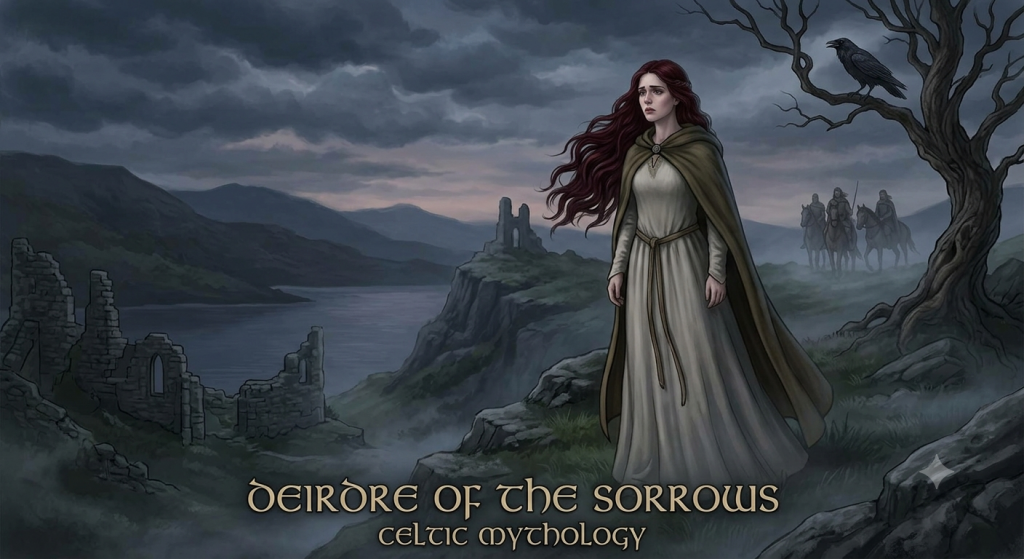
Before Deirdre was born, a druid heard her cry in her mother’s womb and prophesied that she would be the most beautiful woman in Ireland, that kings and lords would go to war over her, and that on account of her great beauty Ulster would suffer ruin. The assembled warriors of Ulster demanded she be killed before she drew breath. King Conchobar mac Nessa refused. He would keep her himself, he said, and in doing so he would prevent the prophecy from being fulfilled.
In making this decision, he set everything the druid had predicted in motion.
Deirdre of the Sorrows is one of the Three Sorrows of Irish mythology alongside the Children of Lir and the Fate of the Sons of Tuireann. It is the most literary of the three, the most carefully structured, and the one most concerned with the question of what fate actually means in a tradition where prophecy is not a warning but an announcement. Deirdre cannot escape what was said of her before her birth. Neither can anyone around her. The tragedy is not that people make wrong choices. It is that all the choices made in response to the prophecy are the choices the prophecy required.
The Childhood and the Vow
Conchobar had Deirdre raised in isolation, away from the court and away from young men, attended only by a foster mother and a druid named Leborcham, who educated her and became her closest companion. The intention was that she would grow up ignorant of any man other than the king, and would come to him as his wife at the appropriate time.
She grew up beautiful beyond description, as the druid had said she would. She also grew up intelligent, perceptive, and entirely aware of what was being done to her and why. The tradition gives her a voice and a will that the circumstances of her upbringing cannot suppress.
One winter day she saw a raven drinking the blood of a slaughtered calf on the snow, and she told Leborcham that she could love a man whose hair was as black as the raven, whose cheek was as red as the blood, and whose skin was as white as the snow. Leborcham told her that such a man existed: Naoise, one of the three sons of Uisneach, the finest warriors in Ulster.
Deirdre found Naoise and spoke to him. He knew who she was and what the prophecy said, and he tried to turn away from her. She told him that a man who turned away from a woman who approached him was a man of dishonour. He could not refuse her on those terms and remain who he was. They went away together that night, taking his brothers Ardan and Ainnle with them, and they went into exile in Scotland.
The Years in Scotland
The exile in Scotland is the middle section of the story and the one the tradition treats with the most tenderness. The texts describe Deirdre and Naoise living in the Scottish landscape with his brothers, hunting and fishing, building their life in the wild places away from courts and kings. The nature poetry attributed to Deirdre in some versions of the story, praising specific valleys and hills and rivers in Scotland, has a specificity that suggests genuine landscape knowledge behind it, whatever its ultimate literary origins.
Conchobar sent messengers to bring them back. He sent Fergus mac Róich, one of the most honourable men in Ulster, with a guarantee of safe conduct. Deirdre warned Naoise against returning. She had dreams. She read signs. She told him that the offer was false and that they would die if they returned to Ulster.
Naoise went anyway. The tradition handles his choice with care: he is not stupid, and he is not simply trusting. He is a man who cannot live forever in exile, who has honour obligations to Ulster that pull against his private happiness, who is given a guarantee by one of the most honourable men in Ireland and cannot find grounds to refuse it without insulting Fergus. He knows the risk. He goes.
The Return and What Followed
Conchobar had no intention of honouring the safe conduct. He arranged for Fergus to be detained by an obligation of hospitality that he could not refuse, separating him from the party he was supposed to be protecting. Deirdre and the sons of Uisneach arrived in Ulster without their guarantor.
Conchobar sent other warriors to kill the sons of Uisneach. In the fighting that followed, the three brothers held off every force sent against them. Eventually Conchobar used a magical weapon, or magical means, to subdue them, and the three sons of Uisneach were killed.
Deirdre was taken by Conchobar. She lived as his captive for a year, and during that year she never smiled, never ate or drank more than she needed to survive, never lifted her head from her knees. Conchobar, unable to stand her contempt, asked her who she hated most in the world. She named Conchobar and Eoghan mac Durthacht, the man who had killed Naoise. Conchobar said he would give her to Eoghan for a year.
She was put in a chariot with the two men. As the chariot moved, she leaned from it and struck her head against a rock and died.
The tradition records this without sentimentality. It is the act of a woman who has chosen the only exit available to her from a situation she has no other means of leaving. The story does not end with Conchobar’s triumph. It ends with Deirdre’s choice, which is the only choice in the entire narrative that nobody prophesied and nobody arranged for.
What the Tradition Preserves
Deirdre of the Sorrows is one of the great literary creations of early Irish literature, and the question of what the tradition intended her to mean has occupied scholars for generations. She has been read as a sovereignty figure, as a warning about the destabilising power of female beauty, as a critique of Conchobar’s possessiveness, as a celebration of love that chooses its own path over safety, and as a tragedy about the impossibility of escaping fate.
The most honest reading probably holds all of these simultaneously, because the text supports all of them. Deirdre is beautiful in ways that destroy kingdoms, which is the sovereignty goddess tradition. She is kept against her will and refuses to accept that captivity, which is a critique of Conchobar. She goes to her death rather than accept the life he offers, which is both a celebration of her love for Naoise and a statement about what dignity requires. And none of it could have happened differently, because the druid said so before she was born.
The Scots Gaelic tradition also preserves the story in a form called Derdriu, suggesting the narrative crossed the Irish Sea and took root in Scotland’s own storytelling tradition, which is appropriate for a story partly set in the Scottish landscape and partly about what happens when you try to outrun what has already been said about you.
Further Reading
If this article sparked your interest, these are the books worth reading next.
The Mabinogion
The foundational collection of Welsh mythology — the primary source for the Arthurian tradition, the four branches of Welsh legend, and the stories that sit at the heart of the Celtic world.
Celtic Myths and Legends
by Peter Berresford Ellis — the best single-volume introduction to the full range of Celtic mythology, covering Irish, Welsh, Scottish, Gaulish, and Breton traditions properly.
The Táin: Translated from the Old Irish Epic Táin Bó Cúailnge
The great Irish epic — Cu Chulainn, Queen Medb, and the Cattle Raid of Cooley. The closest thing the Celtic world produced to the Iliad, and considerably stranger.
For more on the Ulster Cycle tradition, the Cú Chulainn article covers the greatest warrior of the cycle and the tradition’s central hero. The Táin Bó Cúailnge article covers the cycle’s central epic and the campaign launched by Queen Medb. The Children of Lir article covers the second of the Three Sorrows of Irish mythology.
Never miss a myth
Thank you for being here. The site is brand new and every subscriber genuinely means something to me. If you're here, you care about this stuff as much as I do - and that's all the reason I need to keep going. New stories, videos and dark folklore from around the world, straight to your inbox. No algorithm. Just the stories, when they're ready.