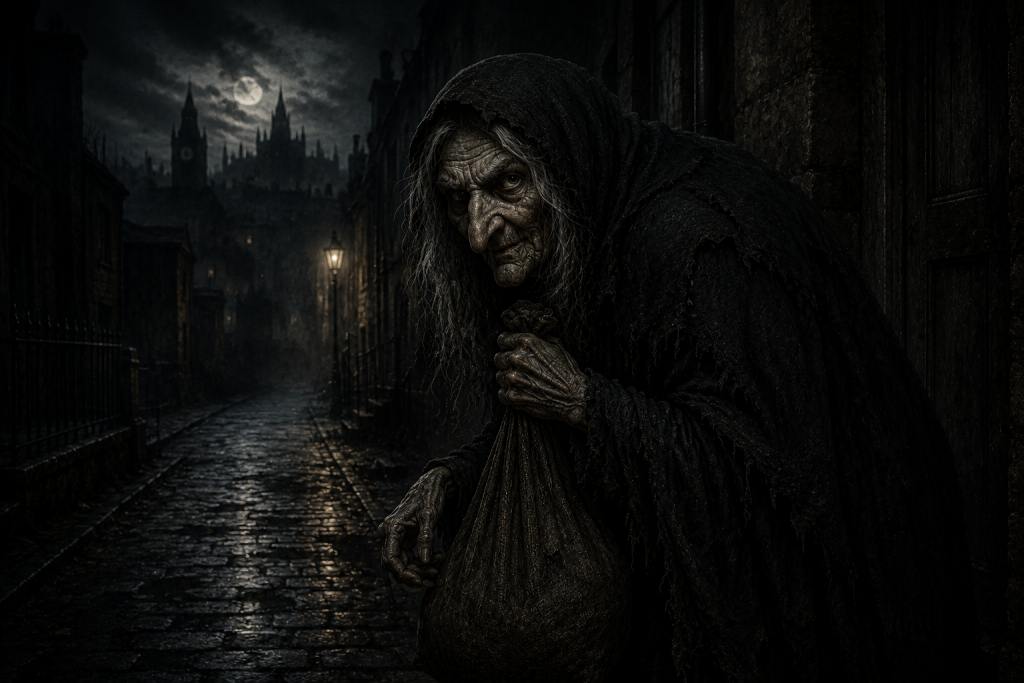

In the summer of 1727, in the small Highland town of Dornoch in Sutherland, a woman was stripped naked, smeared with tar, paraded through the streets in a barrel, and burned alive. Her name was Janet Horne, though that may not have been her real name at all, and she was the last person to be legally executed for witchcraft in Scotland.
She was elderly. She was almost certainly suffering from some form of dementia or mental illness. She reportedly held her hands out to the fire as they prepared to burn her, warming herself at the flames that were about to kill her, apparently not understanding what was happening.
The crowd watched. The sheriff had signed the warrant. The law of Scotland, which had permitted the execution of witches since 1563, was applied one final time, in a small northern town, to a confused old woman who sat warming her hands at her own funeral pyre.
Five years later, in 1736, the Witchcraft Act was repealed.
The Last Witch Trial in Scotland
The circumstances that produced Janet Horne’s execution began not with Janet herself but with her daughter, a young woman whose hands and feet were described in the accounts as deformed, the fingers and toes grown together in a way that gave her limbs an unusual appearance. In the world of the early eighteenth century Scottish Highlands, unusual physical characteristics in a child were not always understood as the product of congenital conditions. They were sometimes understood as the product of interference.
The accusation was that Janet Horne had ridden her daughter to the Devil to be shod like a horse, and that the daughter’s deformed hands and feet were the consequence of the Devil’s shoeing, the hooflike appearance of the limbs the result of what had been done to them in the service of a witch’s transportation. This is an accusation that belongs entirely to the tradition of diabolical witchcraft as it had been understood in Scotland since the North Berwick trials of 1590, the specific imagery of the witch using a family member as a supernatural mount drawn from the same cultural framework that had produced the confessions of Isobel Gowdie decades earlier.
Janet and her daughter were arrested and brought before Captain David Ross, the Sheriff-Depute of Sutherland. Both were tried. The daughter managed to escape custody and was not recaptured. Janet, elderly and apparently confused, did not escape. She was convicted.
The Name That May Not Have Been Hers
Janet Horne is almost certainly not the real name of the woman executed in Dornoch in 1727. The name appears in the accounts as a generic placeholder, Janet Horne being a common Scots term of the period for the Devil, used in the same way that other euphemisms for the Devil were used to avoid directly naming him. Giving the last Scottish witch the name of the Devil’s consort was either a deliberate piece of record-keeping symbolism or, more likely, a later editorial decision in the written accounts, a way of categorising the case that said more about how the authorities understood it than about who the woman actually was.
Her real name has not been preserved. She is remembered only as Janet Horne, which is to say she is remembered only as the thing she was accused of being, the Devil’s own, rather than as the specific human person who was stripped and paraded and burned on a summer day in Dornoch.
This erasure of her individual identity is one of the most quietly disturbing aspects of the case. Isobel Gowdie is remembered as Isobel Gowdie, a specific woman with a specific life and a specific voice in the historical record. Thomas Weir is remembered as Thomas Weir, a man whose history and character are documented. The last witch executed in Scotland is remembered by a name that was not hers, a label applied to her crime rather than to her person.
What the Law Required
The legal framework that permitted Janet Horne’s execution had been in place in Scotland since the Witchcraft Act of 1563, which made witchcraft a capital offence punishable by death. The Act had been passed in the year of Mary Queen of Scots’ return to Scotland, in a period of intense religious and political upheaval, and it had remained on the statute books through everything that followed, through the union of the crowns, through the civil wars, through the union of parliaments in 1707.
By 1727 the Act was already an anachronism. The intellectual climate of the early eighteenth century, shaped by the Enlightenment’s growing insistence on reason and evidence, had moved decisively away from the theological certainties that had made witch trials possible. In England the last execution for witchcraft had taken place in 1716. In most of Europe the age of judicial witch burning was already effectively over.
Scotland, or at least the northern reaches of it, had not entirely caught up. Captain David Ross, the sheriff who signed the warrant for Janet Horne’s execution, was either genuinely convinced of the reality of the charge or was operating within a local framework of belief that had not yet absorbed the Enlightenment’s verdict on the matter, or both. His jurisdiction was Sutherland, a remote Highland county where the intellectual currents flowing through Edinburgh and London arrived later and with less force than they did in the south.
The execution was legal. The law permitted it. The sheriff authorised it. The crowd watched it. And five years later the Parliament that had permitted it for 164 years removed the law from the statute books, making what had happened to Janet Horne not only the last execution of its kind but the one that, by its very lateness and its very strangeness, made the continuing existence of the law impossible to defend.
The Burning
The method of execution used for Janet Horne was the standard Scottish method for convicted witches, strangulation followed by burning, though some accounts suggest that in her case the burning may have preceded or replaced the strangling, that she was burned alive rather than being killed first and burned afterward.
The detail that she held out her hands to the fire as they prepared to burn her, warming herself at it as though it were simply a hearth on a cold day, appears in enough of the accounts to have become fixed in the tradition of the case. Whether it is literally accurate or whether it is a detail that attached to the story because it so perfectly expressed the pathos and the horror of what was being done, an old woman who did not understand that she was about to die warming herself at her own execution fire, is impossible to determine at this distance.
What it expresses, whether or not it happened in precisely the way described, is the specific quality of the injustice involved. Janet Horne was not a woman who had confessed to diabolical practices with the strange calm eloquence of Isobel Gowdie. She was not a man who had voluntarily destroyed his own reputation like Thomas Weir. She was, as far as the accounts suggest, a confused and elderly woman who did not fully understand the proceedings against her, who could not mount a coherent defence, and who sat warming her hands at the fire that was going to kill her because that was the only thing in the situation that made immediate sensory sense to her.
The Stone at Dornoch
There is a stone in Dornoch that marks the approximate spot where Janet Horne was burned. It is a modest memorial, a flat stone set into the ground near the site of the execution, bearing an inscription that identifies it as marking the place where the last witch in Scotland was burned in 1722.
The date on the stone is wrong. The execution took place in 1727, not 1722, a discrepancy that has been noted by historians and that speaks to the general casualness with which the case was recorded, a casualness that reflects how unremarkable the execution seemed to those who authorised and witnessed it, how thoroughly it was understood as simply the application of existing law to an existing category of offence rather than as the extraordinary thing it was.
The stone is there nonetheless. Dornoch is a small, beautiful town on the Sutherland coast, better known now as a golf destination than as the site of Scotland’s last witch burning, and the memorial stone sits in its surroundings with the slight awkwardness of something that commemorates an event the present would prefer to contextualise rather than simply remember.
If you want more like this, the Tales of Myth and Magic newsletter delivers new creatures, legends, and forgotten folklore straight to your inbox.
No fixed schedule. No noise. Just the stories, when they are ready.
Sign up here →Why 1727 Matters
The execution of Janet Horne in 1727 is significant not only as the last of its kind but as a marker of how long the legal and cultural framework that made witch executions possible persisted in Scotland even after the intellectual conditions that had produced it had changed.
The North Berwick trials of 1590 had occurred in a specific context of genuine royal fear, genuine theological anxiety, and a genuine community conviction that the Devil was active in Scottish affairs in specific and documentable ways. Isobel Gowdie’s confession in 1662 had occurred within a tradition of witch belief that was already old and deeply rooted in both the legal and the popular culture of Scotland.
By 1727 both of those contexts had substantially eroded. The educated classes in Edinburgh and London and across Europe were deeply sceptical of witch trials in ways that their predecessors had not been. The Enlightenment had provided a new framework for understanding the world that left little room for the operational Devil of the witchcraft prosecutions. The king of Britain had not personally interrogated a witch since James VI had done so in 1590.
And yet in Dornoch, in Sutherland, a sheriff signed a warrant and a woman was burned, and the law that permitted it remained on the statute books for another five years.
The gap between the intellectual climate of 1727 and the legal reality of 1727 is one of the most instructive things about the Janet Horne case. Ideas travel slowly. Laws change slowly. And in the places furthest from the centres of intellectual change, the old frameworks persist longest, applied by people who have not yet received the memo that the world has moved on, to people who have no power to resist them.
The End of an Era
The Witchcraft Act of 1736, which repealed the 1563 legislation and made the prosecution of witchcraft as a capital offence illegal in both Scotland and England, did not come with any formal acknowledgement of what had been done under the law it replaced. It did not name Janet Horne. It did not name the thousands of people, the overwhelming majority of them women, who had been executed for witchcraft in Scotland since 1563. It simply removed the law, quietly and without ceremony, as though the 164 years of executions it had authorised were something to be set aside rather than confronted.
The estimates of the total number of people executed for witchcraft in Scotland during that period vary, but the consensus among historians places the figure at somewhere between three and four thousand, a number that makes Scotland one of the most intensive sites of witch persecution in Europe relative to its population. Janet Horne was the last of those thousands, the final application of a law that had been killing people for a century and a half.
She sat warming her hands at the fire. The crowd watched. The sheriff had signed the warrant.
Five years later, the law was gone.
Her name was not Janet Horne. We do not know what her name was. She died in Dornoch in the summer of 1727, confused and cold, and she is remembered as the last, which is the only distinction the record has preserved for her.
It is not enough. It is all there is.

If you enjoyed this article, the creatures and legends of Scotland are collected in my book Tales of Myth and Magic, Volume I: Scotland — 25 tales told in full, each traced to its earliest sources, with a map, glossary, and full bibliography. Available in paperback for £11.99.
Find Out More →Further Reading
If this article sparked your interest, these are the books worth reading next.
Scottish Urban Legends: 50 Myths and True Stories
by Aaron Mullins — fifty Scottish urban legends including stories from Glasgow, Edinburgh, and the Highlands. The kind of tradition that Maggie Murphy belongs to, collected properly in one volume.
Scottish Urban Myths and Ancient Legends
by Grace Banks and Sheena Blackhall — vampires, werewolves, devil encounters, and the school playground legends of Scotland. A genuinely good collection of the stories Scots have been telling each other for generations.
The Lore of Scotland: A Guide to Scottish Legends
by Jennifer Westwood and Sophia Kingshill — the most comprehensive collection of Scottish legend in print, covering Glasgow to Shetland, exploring origins and historical basis. Endorsed by Terry Pratchett as the real macabre.
Never miss a myth
Thank you for being here. The site is brand new and every subscriber genuinely means something to me. If you're here, you care about this stuff as much as I do - and that's all the reason I need to keep going. New stories, videos and dark folklore from around the world, straight to your inbox. No algorithm. Just the stories, when they're ready.