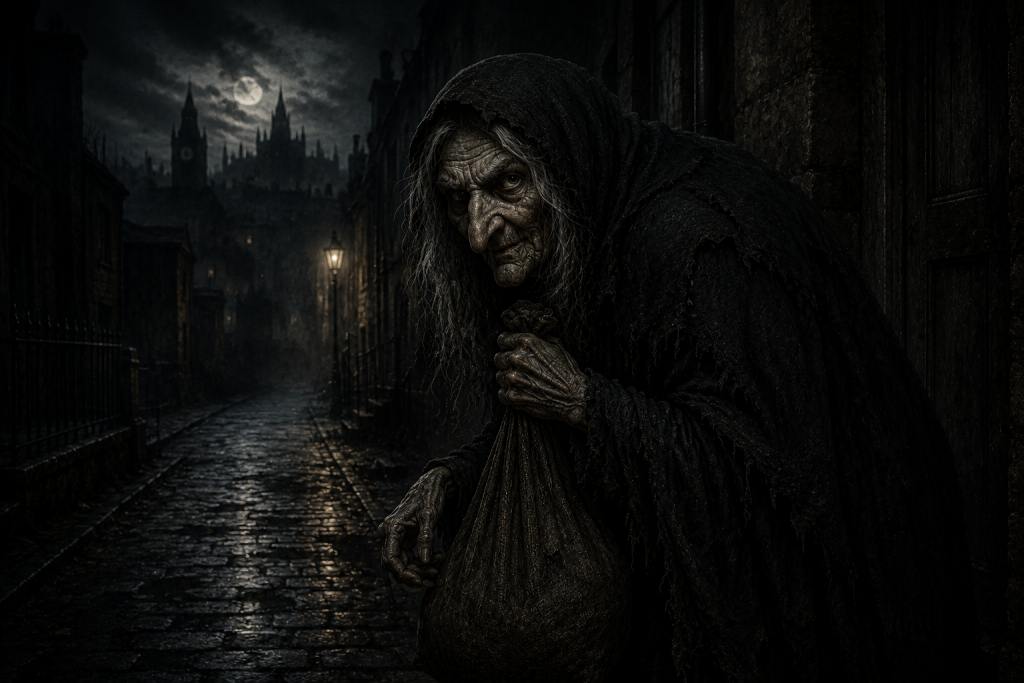

Edinburgh Castle sits on its volcanic rock above the city with the kind of presence that no amount of tourist infrastructure can fully domesticate. Beneath it, and beneath the Royal Mile that runs down from it toward Holyrood Palace, the ground holds what every old and heavily built-upon city holds: passages, vaults, sealed chambers, the accumulated underground architecture of a thousand years of construction layered on construction. Some of it is mapped. Some of it is not. And somewhere in the unmapped portion, according to one of Edinburgh’s oldest and most affectionately told ghost stories, a small boy has been lost in the dark for several hundred years, and he has never stopped playing his pipes.
The story of the Ghost Piper, sometimes called the Lone Piper or the Piper Boy, is told on nearly every ghost tour that operates on the Royal Mile, and it has been told for long enough and consistently enough that it has become part of the basic furniture of Edinburgh’s supernatural reputation. It is also, in the way of the very best ghost stories, impossible to verify and entirely beside the point whether it can be.
The Tunnel
The story begins with a discovery, the specific date of which varies depending on which version you encounter, sometime in the centuries after the castle’s construction, when workers or soldiers found an opening to a tunnel beneath the castle that nobody could account for. This was not, in itself, an unusual situation. Castles accumulate forgotten passages the way old houses accumulate forgotten rooms, the product of centuries of building and rebuilding by people who did not always leave records for those who came after.
What made this tunnel interesting was the persistent rumour, old even by the time of the discovery, that a passage existed connecting Edinburgh Castle to Holyrood Palace at the bottom of the Royal Mile, a distance of just over a mile through the heart of the city. Such a tunnel would have been of obvious strategic value, an escape route for the monarch in time of siege, a means of moving people and information between the castle and the palace without exposure to the streets above. Rumours of its existence had circulated for generations. No one had ever found it.
When the new opening was discovered, the hope was that this might finally be the legendary tunnel, the route to Holyrood that had been spoken of for so long without ever being confirmed. The problem was practical and immediate. The tunnel was narrow, too narrow for an adult to pass through comfortably, and there was no way to know how far it ran or where it led without sending someone in to find out.
The Boy Who Was Sent
The decision that followed is the part of the story that sits most uncomfortably with modern sensibilities, and the various tellings of the legend do not entirely agree on the details, though they agree on the essential shape of what happened.
A boy was chosen to go into the tunnel. In most versions of the story he was a piper, a young member of the castle’s piping tradition, in some accounts specifically attached to a military piping corps and in others simply a boy known locally for his skill with the instrument. In some of the gentler modern retellings, intended for children, he is given a name, Robbie, and a heroic, willing eagerness to take on the task. In the older and starker versions of the story, he was an orphan, chosen precisely because he was small enough to fit through the opening and because nobody of consequence would be greatly troubled if something went wrong.
He was given his pipes and sent into the tunnel with a specific instruction: play as he went, continuously, so that the men following the route above ground could track his progress by the sound carrying up through the earth. The plan, in its way, was sound. Bagpipes are loud. The drone carries. A boy playing steadily as he crawled through a passage beneath the city would produce a sound that could plausibly be followed from the surface, mapping the tunnel’s route by ear in the absence of any other way to chart it.
The men above followed the sound. It moved away from the castle, down through the high ground, tracing a route beneath the Royal Mile in the general direction that the old rumours had always claimed the tunnel ran.
And then, somewhere near the Tron Kirk, the church partway down the Royal Mile that still stands today, the music stopped.
The Search
The accounts agree that what followed was a genuine and sustained attempt to find the boy. This detail matters, because it distinguishes the story from a simple tale of casual disposal. The men above, having lost the sound, did not simply shrug and move on. They searched. They tried to follow the tunnel’s route from where the music had ceased. They dug, in some versions, attempting to break through to wherever he might be. They called down into whatever openings they could find.
Nothing was found. No trace of the boy, no sign of an accident, no indication of which direction he might have gone once the playing stopped, whether he had simply run out of breath, encountered some obstruction, fallen into an unmapped chamber, or met something in the dark that the tunnel’s narrow confines made impossible to identify or rescue him from. The tunnel itself proved difficult to trace from above with any precision, the sound having been an imprecise guide even while it lasted.
Eventually the search was abandoned. The opening to the tunnel was sealed, by most accounts deliberately bricked up by order of the city authorities, partly as a safety measure and partly, one suspects, because a tunnel that had already claimed one small boy and resisted every attempt to recover him was not a tunnel that anyone wanted to leave open as a temptation to the next curious child.
The boy was never found. The tunnel to Holyrood, if that is indeed what it was, has never been confirmed. And the piping did not entirely stop.
What People Have Heard
The core of the Ghost Piper tradition, the element that has kept the story alive across the centuries since the sealing of the tunnel, is the persistent claim that the sound of bagpipes can still be heard coming from beneath the Royal Mile and the castle grounds, particularly late at night when the ordinary daytime sounds of buskers and tourists and traffic have died away.
This is, it must be acknowledged, a claim that requires a certain amount of scepticism on a street where bagpipe music is one of the most commonly heard sounds during the day, played by buskers stationed at regular intervals along the Royal Mile for the benefit of passing tourists. The ordinary, explicable presence of bagpipe music on the Royal Mile makes the extraordinary claim, music heard from underground when no living piper is present, considerably harder to verify than it would be in a location where pipe music was not already a constant ambient feature.
And yet the specific claim persists, and persists with a consistency across multiple independent tellings that suggests something more than simple confusion with daytime buskers. What is described is not the sound of someone playing nearby, audible from street level in the ordinary way. It is sound that seems to come from below, muffled and distant in a way that daytime pipe music on the open street does not sound, heard specifically in the quiet hours when no buskers are working and the street itself is comparatively empty.
Tour guides on the Royal Mile, who spend more cumulative hours on that street after dark than almost anyone else in the city, are the most consistent source of these reports, which carries its own kind of evidential weight. These are people whose livelihood depends on knowing the difference between an authentic strange experience worth incorporating into a tour and ordinary sounds that tourists might misidentify. Their continued inclusion of the Ghost Piper in their repertoire, across decades of guides working the same streets, suggests at minimum that something about the location continues to generate the kind of experience the story describes.
A Legend Rather Than a Documented Case
It is worth being direct about something the more breathless retellings of this story tend to obscure. Unlike the Mackenzie Poltergeist at Greyfriars, which has accumulated a substantial body of contemporary documented incidents, ambulance call-outs, and recorded physical injuries, the Ghost Piper exists almost entirely as oral tradition. There is no contemporary written record of a piper boy disappearing in a tunnel beneath Edinburgh Castle. The specific date of the supposed event shifts between tellings. Some versions place the skeletal remains of the boy as having been discovered decades or centuries later during renovation work, complete with his pipes still beside him. Other, more careful accounts note that this detail of a later discovery may itself be a later embellishment to the legend rather than a documented historical event, and that no such discovery is recorded in any contemporary source.
This does not make the story without value, and it does not make the experiences reported by those who claim to have heard the piping any less genuine to the people reporting them. It does mean that the Ghost Piper belongs to a different category from some of the other haunted locations covered on this site, closer to genuine urban legend, the kind of story that grows and adapts and accumulates detail across generations of telling, than to a documented phenomenon with a traceable point of origin and a body of independently recorded incidents.
What is genuinely old and genuinely documented is the rumour of the tunnel itself, the persistent belief across centuries that some passage connected the castle to Holyrood Palace, useful for exactly the strategic purposes the legend describes. Edinburgh Castle’s long and turbulent history, including sieges, royal flights, and the general military necessities of a fortress capital, makes the existence of such a tunnel entirely plausible even if it has never been conclusively located. The legend of the piper boy may have grown up specifically to explain and dramatise this older, vaguer tradition of a hidden passage, giving a a half-remembered rumour about military architecture a human face and a human tragedy.
If you want more like this, the Tales of Myth and Magic newsletter delivers new creatures, legends, and forgotten folklore straight to your inbox.
No fixed schedule. No noise. Just the stories, when they are ready.
Sign up here →The Tron Kirk
The detail that the music stopped near the Tron Kirk is one of the more specific and geographically grounded elements of the story, and it is worth noting that the Tron Kirk still stands today, roughly midway down the Royal Mile between the castle and Holyrood Palace, a handsome seventeenth century church building that has been used for various civic purposes since it ceased to function as a place of worship.
If the legend’s geography is taken at face value, this places the point of the boy’s disappearance at roughly the midpoint of the supposed tunnel’s route, neither close enough to the castle to suggest an early failure nor close enough to Holyrood to suggest the tunnel had nearly succeeded. He was, in the story’s own terms, somewhere in the middle of an impossible journey when whatever happened to him happened.
Standing outside the Tron Kirk today, with the Royal Mile busy around you in daylight or comparatively quiet after dark, it requires very little imagination to think about what might lie beneath the pavement, in the unmapped portions of Edinburgh’s extensive underground architecture, structures and passages that the modern city has built over and forgotten in the same way that earlier centuries built over and forgot whatever came before them.

If you enjoyed this article, the creatures and legends of Scotland are collected in my book Tales of Myth and Magic, Volume I: Scotland — 25 tales told in full, each traced to its earliest sources, with a map, glossary, and full bibliography. Available in paperback for £11.99.
Find Out More →Further Reading
If this article sparked your interest, these are the books worth reading next.
Scottish Urban Legends: 50 Myths and True Stories
by Aaron Mullins — fifty Scottish urban legends including stories from Glasgow, Edinburgh, and the Highlands. The kind of tradition that Maggie Murphy belongs to, collected properly in one volume.
Scottish Urban Myths and Ancient Legends
by Grace Banks and Sheena Blackhall — vampires, werewolves, devil encounters, and the school playground legends of Scotland. A genuinely good collection of the stories Scots have been telling each other for generations.
The Lore of Scotland: A Guide to Scottish Legends
by Jennifer Westwood and Sophia Kingshill — the most comprehensive collection of Scottish legend in print, covering Glasgow to Shetland, exploring origins and historical basis. Endorsed by Terry Pratchett as the real macabre.
Never miss a myth
Thank you for being here. The site is brand new and every subscriber genuinely means something to me. If you're here, you care about this stuff as much as I do - and that's all the reason I need to keep going. New stories, videos and dark folklore from around the world, straight to your inbox. No algorithm. Just the stories, when they're ready.