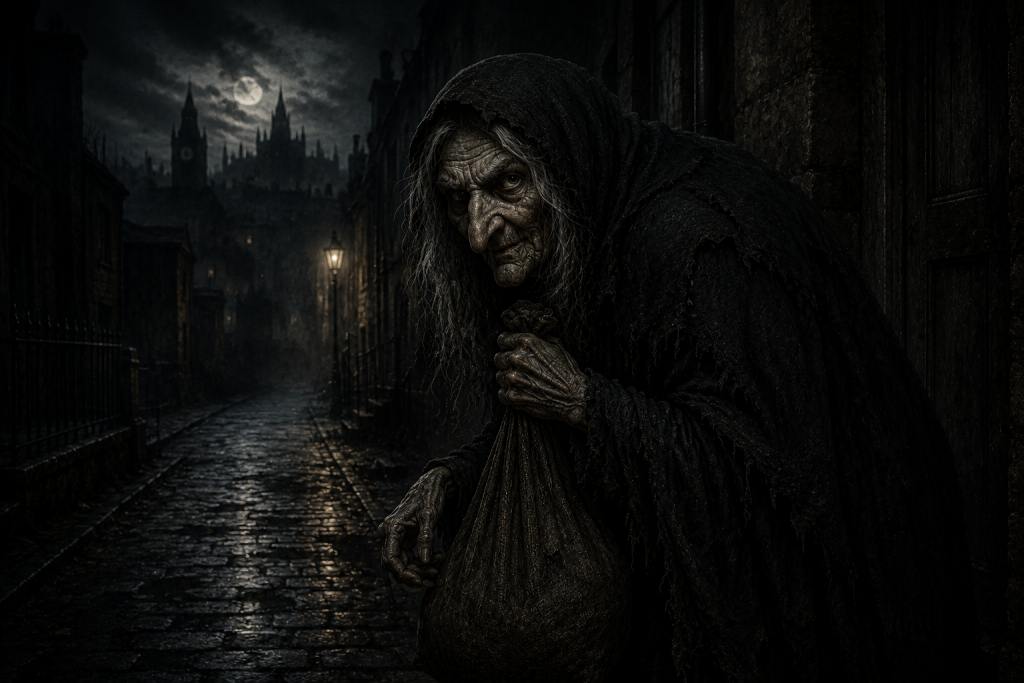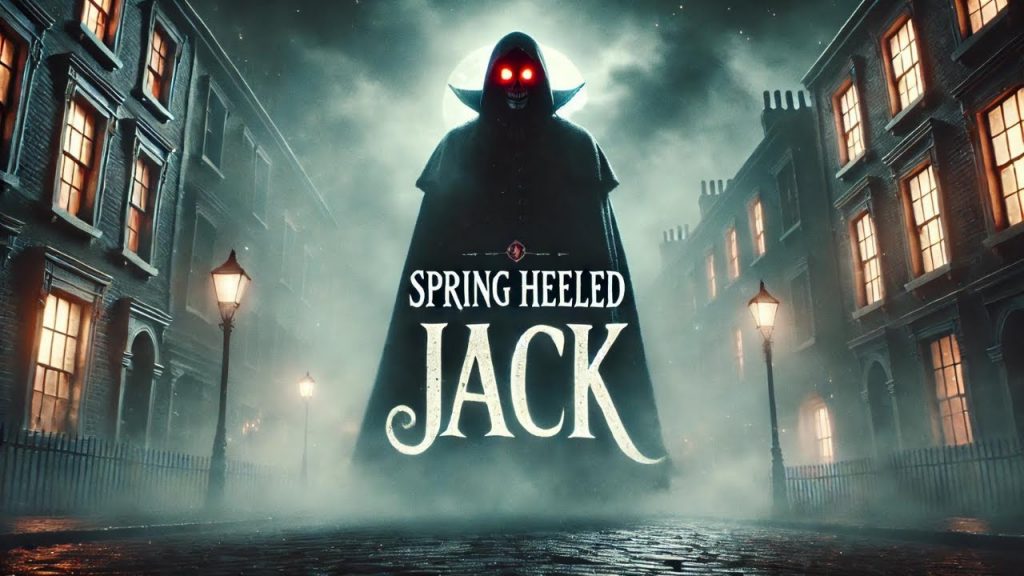
A candle flame gutters in a doorway on a February night in 1838. A man in a heavy cloak is on the step, telling a young woman that the police have caught Spring Heeled Jack in the lane and he needs light to see by. She hands him the candle. The cloak drops. Beneath it is a figure in tight white oilskin, a helmet clamped to its skull, eyes burning like red coals. It vomits blue and white flame into her face, seizes her dress, and begins to tear at her with claws she will later describe as being made of metal. She screams. Her sister drags her back inside. The figure on the steps pauses, grins, and is gone.
Something in the Dark
The story of Spring Heeled Jack is one of the strangest episodes in the history of British folklore, and what makes it stranger still is that it is not simply a story. There are police reports. There are victim testimonies taken by magistrates. There are court records. A real attack on a real young woman in a real house on a real street in east London, in February 1838, produced documented injuries and generated an investigation by Lambeth Police. The attacker was never identified. And the thing being described by credible, independent witnesses, with specific physical details that aligned across separate accounts taken in different places on different nights, was not anything that should exist.
Spring Heeled Jack does not fit neatly into any category. It is not a ghost story, because ghost stories do not leave claw marks. It is not an urban legend in the purely fictional sense, because too many of its key incidents produced documented injuries and formal investigations. It is not straightforwardly a hoax, because the sightings continued for sixty years across locations and circumstances that no single prankster, however dedicated, could plausibly account for. It is something more uncomfortable: a prolonged, real-world encounter with something that has never been satisfactorily explained.
Before the Name: The Ghost at the Gates
The phenomenon that would become Spring Heeled Jack did not begin with the name. In the early months of 1837, the first year of Queen Victoria’s reign, reports began circulating in south London of a strange entity attacking people in the streets, particularly women. The descriptions at this early stage were inconsistent and shifting: sometimes a ghost, sometimes a white bull, sometimes a large pale figure that moved in ways animals did not move. The name park ghost was applied to something that had been alarming the residents of the areas around Barnes Common and Clapham Common and Richmond.
What unified these scattered accounts was the behaviour rather than the appearance. The entity leaped. It appeared suddenly, attacked or frightened whoever it found, and vanished before anyone could do anything about it. And it seemed to find it particularly easy to cover ground in ways that suggested either extraordinary physical ability or a method of moving that conventional human anatomy could not explain.
By October 1837, the reports had coalesced into something more specific. Mary Stevens, a servant girl crossing Clapham Common on her way to work, encountered a figure that leapt at her from a dark alley, seized her, and clawed at her with hands she described as cold and clammy as those of a corpse. Her screams brought people running, but the attacker had gone. The following night, the same or a similar figure allegedly leapt in front of a carriage near the common, causing the driver to lose control. When people reached the crashed vehicle, there was no sign of whoever had caused the accident, and witnesses reported seeing something leap away over a nine-foot wall.
The Lord Mayor Takes Notice
By January 1838, the phenomenon had grown large enough to require official attention. London’s Lord Mayor, Sir John Cowan, read out a letter at a public session that described the attacks as a matter of serious concern and pointed a finger at a specific explanation: a wager among wealthy young men, one of whom was paying for the attacks to be carried out as part of a bet about how many people could be frightened within a given period.
The Lord Mayor described the letter writer’s account as suggesting the perpetrator to be a person of the highest rank, and declared his confidence that the individuals responsible would be identified and punished. He described the campaign of attacks as a pantomime display. The people in the room who had been frightened by something leaping out of the dark and scratching at them with metal claws may have found this framing less than reassuring.
The newspapers had been largely silent on the subject to this point, which had itself attracted comment. When they began to report, they treated the story with varying degrees of scepticism, and even the august Times found itself covering what was rapidly becoming a national story.
Jane Alsop and Lucy Scales
The two most thoroughly documented attacks in the Spring Heeled Jack case occurred in February 1838 and between them produced the physical description that would define the legend for decades.
On the evening of 20 February 1838, Jane Alsop heard a knock at the gate of her father’s house in Bearbinder Lane near Old Ford in east London. A man outside claimed to be a police officer who had just apprehended Spring Heeled Jack in the lane and needed a light. Alsop brought him a candle. The moment it was in his hand he threw off his cloak and revealed, in her own words later given to investigators, a most hideous and frightful appearance. The figure wore what appeared to be a large helmet. His clothing was tight-fitting and resembled white oilskin. His eyes, she said, resembled red balls of fire. And from his mouth he vomited blue and white flame directly into her face.
He then attacked her with his hands, tearing at her neck and arms with metallic claws. She managed to struggle free with the assistance of her sister, who came to the door and pulled Alsop back inside. An arrested man named Millbank was later brought before a magistrate in connection with the attack, but Alsop insisted her attacker had breathed fire, which Millbank acknowledged he could not do, and no conviction followed.
Nine days later, eighteen year old Lucy Scales was walking with her sister through Green Dragon Alley in Limehouse when a figure stepped from the shadows and spat blue flame directly into her face. She collapsed, blind and convulsing, and suffered violent seizures for several hours. A surgeon who attended her attributed her condition to extreme fright. Her sister’s account of the attacker’s appearance matched, in its significant details, what Jane Alsop had described from a different location nine days earlier: a tall figure in a cloak, eyes like fire, something that breathed flame.
These two attacks, investigated by police and recorded in testimony, are the evidential core of the Spring Heeled Jack case. The injuries were real. The accounts were given independently. The descriptions aligned. Nobody was ever convicted.
The Mad Marquis
From almost the beginning, suspicion among those who believed a human being was responsible settled on a specific candidate: Henry de La Poer Beresford, the third Marquess of Waterford, an Irish peer whose reputation for reckless, cruel, and expensive pranks had earned him the nickname the Mad Marquis.
Beresford’s record in the 1830s was genuinely alarming by any standard. He was repeatedly reported for drunken vandalism, destruction of public property, contemptuous treatment of women, and the kind of behaviour that only substantial money and aristocratic connections could insulate from serious legal consequences. He was in London during the period of the first Spring Heeled Jack attacks. A newspaper in 1838 noted that his name inspired nearly as much terror among London’s population as Jack’s own.
The theory that he was responsible gained enough currency to be formally named in print by the writer Ebenezer Cobham Brewer in 1880, though the rumour had been circulating since the attacks themselves. One account described a servant boy who escaped from an attacker claiming to have seen an elaborate crest on the assailant’s costume including a letter W, though this detail does not appear in contemporary newspaper reports and may be a later elaboration. The suggestion that Beresford had engineered some mechanical apparatus allowing him to leap higher than normal, and learned fire-breathing techniques to complete the effect, was also mooted and never confirmed.
The theory has an obvious and serious problem: Beresford married in 1842, settled in Ireland, and died in 1859. Spring Heeled Jack sightings continued for decades after his death, spreading across the country and making appearances as far as the Midlands, the south-west, Scotland, and Wales, before culminating in a final widely reported encounter in Liverpool in 1904. Whatever Beresford may or may not have done in London in 1837 and 1838, he cannot account for sixty years of sightings across the breadth of Britain.
If you want more like this, the Tales of Myth and Magic newsletter delivers new creatures, legends, and forgotten folklore straight to your inbox.
No fixed schedule. No noise. Just the stories, when they are ready.
Sign up here →Across the Country
After the initial London incidents, Spring Heeled Jack appears to have left the capital and begun a long and erratic tour of the rest of Britain, though whether the later sightings represent the same phenomenon, copycat behaviour, genuine independent encounters, or simply the inevitable diffusion of a powerful legend into new territory is impossible to determine with any confidence.
In 1847, a series of attacks in Teignmouth in Devon was eventually attributed to a local man named Captain Finch, who was convicted and sentenced, providing at least one definitive case of a named human being responsible for crimes attributed to the legend. In 1855, further sightings were reported in Devon. Throughout the 1850s and 1860s, Jack was reported in the Midlands, where his fire-breathing and claws gradually disappeared from the descriptions, leaving something less physically specific but no less alarming.
In 1877, the figure’s name was linked to a series of pranks being played on sentries at Aldershot army camp, where a pale figure was reportedly leaping over the soldiers and slapping their faces before bounding away. The following year at Colchester, a soldier managed to bayonet a figure in the leg during one such incident, and the attacker turned out to be a subaltern officer of the regiment, which settled at least that episode with a degree of prosaic satisfaction.
The most sustained mid-century reports came from the Black Country, where Spring Heeled Jack was reportedly seen leaping across rooftops, including an account of him jumping onto the roof of the Cross Inn in Dudley. In the 1880s, sightings were reported in Liverpool, where he became briefly as much of an obsession as he had been in London forty years earlier. The final major documented sighting, in Everton in 1904, described a dark leaping figure with glowing eyes that disappeared into the night before anyone could get close enough to examine what they had seen.
The Penny Dreadful and the Legend
Alongside its career as a real-world phenomenon, Spring Heeled Jack simultaneously developed an entirely separate existence as a fictional character, and the two versions of Jack fed each other in ways that made the whole phenomenon increasingly difficult to disentangle.
By 1863, a penny dreadful titled Spring-heel’d Jack: The Terror of London had given the figure a full fictional biography and a romantic, adventuring character entirely unlike the assailant described in the police reports. In the penny dreadful tradition, Jack became a masked avenger rather than a predator, a costumed hero who flouted conventional authority to see justice served. This transformation reflected the same impulse that later produced Batman: the figure of a cloaked, leaping entity who moves through the city above the law and uses fear as a tool, reimagined from a source of terror into a source of reassurance.
The fictional Spring Heeled Jack was enormously popular in the serials of the 1860s and 1870s, and his heroic penny dreadful incarnation spread beyond London into the regional press, which is part of why the later sightings in the Midlands and further north tended to shed the fire-breathing and metallic claws that had characterised the London attacks. By the time Jack reached those towns, he was already partly a character from cheap fiction, and the real person or persons behind the original London incidents, whoever they were, had no connection to the stories being told about their creation.
Parents used the figure to discipline children. Newspaper editors used him to sell papers. Theatre owners used him to fill seats. And somewhere underneath all of that, the documentary record of the actual attacks on Mary Stevens and Jane Alsop and Lucy Scales continued to sit in the archives, producing injuries that fiction could not account for and descriptions that no one has ever fully explained.
What Was Spring Heeled Jack
The honest answer is that nobody knows, and the range of possible explanations is genuinely wide.
The original 1837 and 1838 London attacks are probably best understood as the work of one or more human individuals, most likely from a wealthy background given both the Lord Mayor’s own assessment and the nature of the equipment involved. A person who could engineer a means of producing flames from their mouth, who wore equipment that enabled leaps significantly beyond normal human capacity, and who had the resources and connections to avoid prosecution for attacks that produced documented injuries and generated formal police investigations, needed both money and protection. The Marquess of Waterford remains the most plausible candidate for the early attacks, though the evidence falls well short of proof.
The later sightings, spread across sixty years and most of the country, represent a combination of copycat behaviour by other individuals inspired by the legend, genuine misidentifications of ordinary things encountered in darkness and fear, and the inevitable growth of an already powerful legend into a shape that could accommodate almost any frightening encounter with an unknown figure in the dark. The British tradition of individual pranksters in elaborate costumes, and the genuine difficulty in the nineteenth century of prosecuting crimes that crossed parish boundaries, created conditions in which a legend like Spring Heeled Jack could persist far beyond its original incidents.
Whether anything genuinely inexplicable was involved at any point is a question the available evidence cannot resolve. The burning eyes and the blue flame are the details that most resist comfortable explanation: no confirmed period technology produced these effects reliably, and yet multiple independent witnesses described them consistently enough in the original London encounters to make dismissal feel inadequate.
Spring Heeled Jack stood, as one folklorist put it, at the point where the medieval and the modern collided in Victorian England: a fire-breathing demon running through the industrial streets of the largest city in the world, described in police reports, investigated by magistrates, and reproduced in penny dreadfuls for an audience that could not decide whether it was thrilled or terrified.
The last documented sighting was in 1904. Nobody has officially reported him since.
Never miss a myth
Thank you for being here. The site is brand new and every subscriber genuinely means something to me. If you're here, you care about this stuff as much as I do - and that's all the reason I need to keep going. New stories, videos and dark folklore from around the world, straight to your inbox. No algorithm. Just the stories, when they're ready.