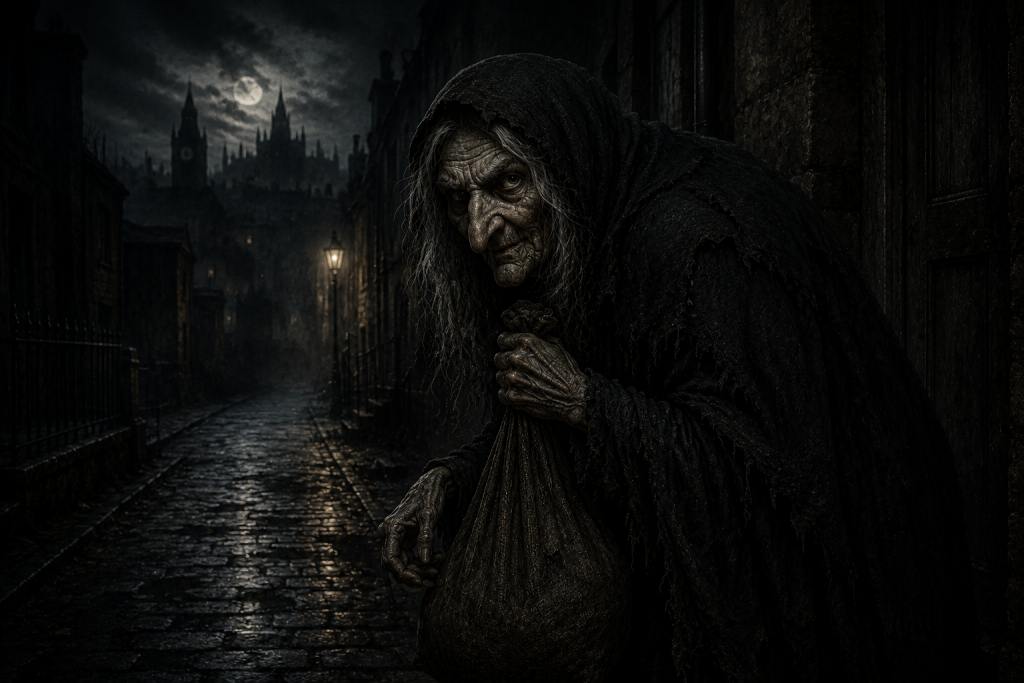

Of all the creatures that belong to the Fuath family, the broad and consistently dark category of malevolent water spirit that includes the Each-Uisge and the Caoineag, none is stranger or more genuinely difficult to picture than the Brollachan. It has no fixed shape. It has eyes, and it has a mouth, and beyond that the tradition gives you almost nothing solid to hold onto, only a dark, shifting mass that takes whatever rough outline suits the moment, encountered in the lonely places at the edge of human settlement, capable of speech but knowing, by every surviving account, exactly two words.
It is the offspring of a fuath, a child in the most literal sense the tradition allows, and like most accounts of dangerous children in folklore the world over, the genuine strangeness of the Brollachan lies not in raw power but in the unsettling mismatch between its apparent helplessness and what it is actually capable of.
What the Word Means
The name itself tells you most of what the tradition wants you to understand before any specific story begins. Brollachan, in Scottish Gaelic, translates approximately to shapeless thing or formless creature, sometimes rendered with the additional sense of senseless creature, an entity defined from the outset not by what it is but by the specific and deliberate absence of what it should be. Where almost every other being covered on this site, however strange, possesses a consistent physical description across multiple sources, the Brollachan’s only consistent description is its inconsistency.
This formlessness is explained within the tradition itself through the creature’s age. The Brollachan is understood not as an adult being that simply lacks shape as a permanent characteristic, but as a young creature, a literal child, that has not yet learned to hold a fixed form. This single detail reframes everything else about the Brollachan. It is not a monster in its mature and fully developed state. It is something closer to an infant, dangerous not despite its undeveloped nature but in some respects because of it, possessing genuine and serious power without the judgement, restraint, or settled identity that maturity might eventually bring.
Son of the Fuath at Loch Migdale
The most specific and most genuinely documented account of the Brollachan’s origin comes from oral tradition collected in Sutherland, centred on a particular mill known as Moulin na Vaugha, the Mill of the Fuath, situated along a stream off Loch Migdale on land belonging to the Dempster family’s Skibo Castle estate.
According to this tradition, recorded from Gaelic storytellers and preserved in more than one separate retelling from the same source material, a fuath, the dangerous water spirit herself, haunted this specific mill alongside her son, the Brollachan. The fuath in this particular account is described with vivid and specific physical detail, a noseless being with yellow hair, wearing a green silk dress, her own appearance disturbing enough in its wrongness, a face without its central feature, to mark her clearly as something other than human even before any malevolent act took place.
The Brollachan himself, in the versions of this story collected directly from oral sources, is described as possessing eyes and a mouth set within an otherwise genuinely shapeless mass of body, and his vocabulary, the tradition specifies with remarkable consistency, was limited to exactly two words. He could say mi-phrein, myself, and tu-phrein, yourself, and nothing else. This is one of the most specific and most genuinely strange details preserved anywhere in Scottish folklore, a supernatural being whose entire capacity for language has been reduced to the two pronouns that mark the boundary between self and other, as though the Brollachan, in its formlessness, has not yet developed the conceptual vocabulary for anything beyond the most basic possible distinction between itself and whatever it happens to be looking at.
A Creature That Imitates What It Touches
Because the Brollachan possesses no fixed form of its own, several accounts describe its most distinctive ability as a kind of passive, almost accidental mimicry, taking on the rough appearance or character of whatever person or object it comes into contact with, rather than deliberately shapeshifting in the more controlled and purposeful manner of beings like the Each-Uisge or the Boobrie.
This distinction matters. The Each-Uisge’s transformation into a fine horse or a handsome young man is a deliberate lure, a calculated strategy aimed at a specific predatory outcome. The Brollachan’s formlessness reads, by contrast, as something closer to a genuine developmental limitation, a young creature reacting to its environment rather than strategically manipulating it. It does not choose to look like you because looking like you will help it deceive you. It simply has nothing solid enough of its own to resist taking on whatever shape is nearest, in much the way an infant might mirror an adult’s expression without any conscious understanding of what that expression means or accomplishes.
This does not make the Brollachan safe. Several accounts describe it as capable of possession, entering and inhabiting a human body directly, with the possessed victim recognisable by a darkened complexion, glowing or unusually intense eyes, and violent, erratic behaviour entirely out of character for the person affected. The possession, in the darker tellings of this tradition, is not understood as sustainable for the host. The Brollachan, having taken up residence, draws on the victim’s own vital energy to sustain itself, and a possession left unaddressed for more than a few days was understood to end in the host’s death, at which point the Brollachan would simply abandon the spent body and seek out a new one.
Driving It Out
The tradition surrounding how to remove a Brollachan once it had taken possession of a person is detailed enough, and specific enough, to suggest a genuine body of folk practice rather than purely abstract storytelling, in the same way that the protective measures recorded against the Each-Uisge and the Cat Sìth reflect genuine community-level responses to a feared and seriously regarded threat.
The standard treatment involved the application of specific herbal remedies, gathered and administered according to traditional knowledge that was not always easy to come by, sometimes requiring the assistance of other magical practitioners or beings to acquire the necessary materials. It is not entirely clear, even within the tradition itself, whether the herbs were understood to work through some genuine poisoning effect on the Brollachan directly, or whether the ritual surrounding their administration, which was frequently accompanied by singing, was understood as the active element of the cure rather than the herbs alone. This ambiguity is itself characteristic of genuine folk medical tradition, where the boundary between physical remedy and ritual practice was rarely drawn as sharply as a modern reader might expect.
Once successfully driven from a host’s body, the Brollachan in its natural shapeless form was understood as genuinely dangerous in its own right, no longer constrained by occupying a human body but exposed and vulnerable simultaneously. Bright light was considered one of the most reliable methods of repelling it, and the creature was understood to fear fire specifically, with several accounts noting that despite its fundamentally shapeless nature, it remained capable of being burned, a detail that suggests the Brollachan’s formlessness was never intended by the tradition as a kind of invulnerability, only as a genuine absence of fixed physical structure.
Do Not Harm the Child
One of the most distinctive and most genuinely unusual pieces of practical guidance attached to the Brollachan tradition concerns what happens after a successful exorcism or expulsion, and it sets the Brollachan apart from almost every other dangerous creature covered on this site in a way worth dwelling on directly.
The tradition consistently and specifically warns against causing the Brollachan serious or lasting harm once it has been driven out, not on grounds of mercy or compassion toward the creature itself, but because of who its mother is. A Brollachan that has been seriously injured, the tradition holds, can draw down the wrath of its family, specifically the fuath parent whose far greater and more established power the Brollachan’s own formless and undeveloped nature does not remotely match. This is not a warning about the immediate threat the Brollachan itself poses. It is a warning about what comes looking for you afterward, considerably more dangerous and considerably less patient than its child ever was.
This detail reframes the entire Brollachan tradition in a genuinely interesting direction. The creature is not simply a monster to be defeated and forgotten. It is, within the logic of the folklore itself, somebody’s child, and the appropriate human response to encountering it is closer to the caution one might exercise around any dangerous young animal whose parent remains close by and watchful, rather than the straightforward combat or banishment appropriate to most of Scotland’s more purely adult and purely malevolent supernatural threats.
A Gentler Possibility
Set against the darker possession tradition, a smaller thread within the broader Brollachan folklore preserves a considerably gentler outcome, one that aligns the creature more closely with the household supernatural figures discussed elsewhere on this site, the Uruisg and the Glaistig, whose goodwill could be earned through correct and generous treatment.
According to this version of the tradition, a person who encountered a Brollachan in distress, perhaps lost or struggling in the wild and lonely places it favoured, and chose to offer it warmth and shelter overnight rather than driving it away or attempting to harm it, could earn the creature’s genuine gratitude. Such a person, the tradition holds, would be rewarded with safety in their future dealings with the Brollachan and, by extension, with whatever protection its more powerful fuath parent might be persuaded to extend in turn.
This gentler thread does not erase the genuinely dangerous and predatory possession tradition that exists alongside it, and the honest position is that both strands appear to have circulated within Highland Gaelic oral tradition without ever being fully reconciled into a single, consistent account. What both versions agree on is the fundamental nature of the Brollachan as young, formless, and capable of real harm despite, or perhaps because of, its immaturity, a being whose behaviour toward any given human depended substantially on how that human chose to treat it.
If you want more like this, the Tales of Myth and Magic newsletter delivers new creatures, legends, and forgotten folklore straight to your inbox.
No fixed schedule. No noise. Just the stories, when they are ready.
Sign up here →A Warning for Children, From the Mouths of Children
Several modern folklorists examining the Brollachan tradition have noted its likely function as a specific kind of cautionary tale aimed at children, and the internal logic of the story supports this reading clearly. A creature that lurks in lonely, swampy, and remote places at the edge of settled land, that is particularly associated with danger to children specifically, and that can disguise itself by taking on something of the appearance of whatever or whoever it encounters, encodes a remarkably practical set of warnings within an entertaining and memorable narrative form: do not wander too far from home into the wild and boggy ground. Do not trust unfamiliar figures encountered alone in isolated places, however ordinary or pitiable they might appear, because you cannot always be certain what you are actually looking at.
The fear of strangers encountered in remote settings, dressed up here in the specific and memorable image of a shapeless, formless thing wearing whatever shape was nearest to hand, likely served the same genuine protective function for Highland children that equivalent cautionary traditions have served across countless other cultures, a story frightening enough to be remembered and specific enough in its warnings to actually change behaviour in exactly the situations where that behaviour mattered most.
Still Told in the Old Tongue
Unlike many of the more dramatically famous creatures covered on this site, the Brollachan has rarely been formally collected or extensively documented in published folklore literature, surviving instead primarily through ongoing oral tradition concentrated in Gaelic-speaking communities of the northern Highlands, where the practice of oral storytelling has persisted with greater continuity than in many other parts of Scotland.
This relative scarcity of formal written documentation, compared to the extensive treatment given to creatures like the Each-Uisge or the Kelpie by nineteenth century folklorists working primarily in English, means the Brollachan remains, even today, a genuinely less excavated piece of Highland tradition, known with real specificity in the communities that have continued to tell its story but considerably less familiar to the wider audience that has absorbed the more famous Highland water creatures through generations of popular retelling.
Somewhere out at the edge of the settled world, in the boggy and lonely ground that the tradition has always reserved for it, something without a fixed shape of its own may still be watching, with eyes that are the only solid thing about it, knowing only the two words that mark where it ends and you begin.
Myself.
Yourself.
It may not yet know which of those words it would rather be using.

If you enjoyed this article, the creatures and legends of Scotland are collected in my book Tales of Myth and Magic, Volume I: Scotland — 25 tales told in full, each traced to its earliest sources, with a map, glossary, and full bibliography. Available in paperback for £11.99.
Find Out More →Further Reading
If this article sparked your interest, these are the books worth reading next.
Scottish Urban Legends: 50 Myths and True Stories
by Aaron Mullins — fifty Scottish urban legends including stories from Glasgow, Edinburgh, and the Highlands. The kind of tradition that Maggie Murphy belongs to, collected properly in one volume.
Scottish Urban Myths and Ancient Legends
by Grace Banks and Sheena Blackhall — vampires, werewolves, devil encounters, and the school playground legends of Scotland. A genuinely good collection of the stories Scots have been telling each other for generations.
The Lore of Scotland: A Guide to Scottish Legends
by Jennifer Westwood and Sophia Kingshill — the most comprehensive collection of Scottish legend in print, covering Glasgow to Shetland, exploring origins and historical basis. Endorsed by Terry Pratchett as the real macabre.
Never miss a myth
Thank you for being here. The site is brand new and every subscriber genuinely means something to me. If you're here, you care about this stuff as much as I do - and that's all the reason I need to keep going. New stories, videos and dark folklore from around the world, straight to your inbox. No algorithm. Just the stories, when they're ready.