Walter Traill Dennison was an Orcadian folklorist who spent the latter half of the 19th century collecting the oral traditions of the Orkney Islands from people who had grown up with them. In 1891 he published an account of the Nuckelavee that remains the most detailed description of the creature in any documentary source, and it is worth reproducing in summary because no paraphrase quite captures what Dennison recorded.
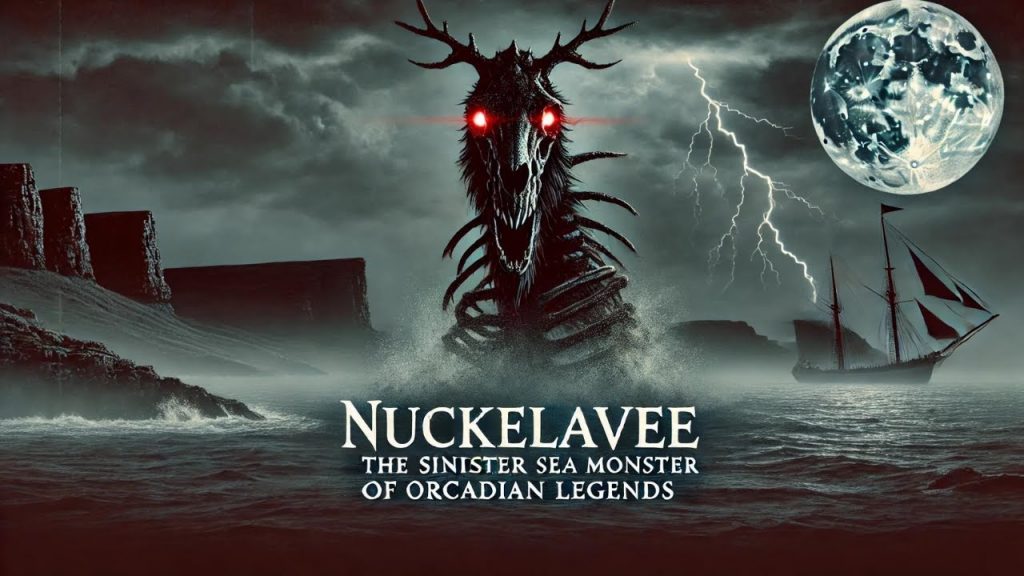
The creature that emerged from the sea and pursued a man named Tammas across the Orcadian landscape had no skin. Its entire surface was exposed: black blood moving through yellow veins, white sinews and powerful muscles in a constant writhing motion as it moved. Its head was ten times the size of a man’s. A single enormous eye burned in the centre of the head. Its mouth was wide as a whale’s. From the mouth came breath that withered crops and caused the pestilence that Orcadians called the mortasheen. The horse body it moved on was similarly exposed, similarly skinless, and from the horse’s back grew a human torso, the upper body of a man, similarly without skin, with a single arm that extended to the ground from the shoulder.
Tammas ran. He crossed a freshwater stream. The Nuckelavee stopped at the bank, unable or unwilling to cross, and Tammas survived to tell Dennison’s sources what he had seen.
The Nuckelavee is the most viscerally described supernatural creature in the British and Irish tradition, and the description is not a later elaboration. It comes from an 1891 collection of genuine oral tradition from the Orkney Islands, recorded from people who believed in what they were describing.
Where It Comes From
The Nuckelavee is specifically Orcadian rather than broadly Scottish. Orkney has its own distinct supernatural tradition that reflects the islands’ particular history: Norse settlement that predates the Scottish period by centuries, a landscape shaped by the North Atlantic rather than by Highland mountains or mainland lowlands, and communities whose relationship with the sea was not simply proximity but economic and cultural dependence. The sea fed Orkney. It also killed Orcadians regularly and unpredictably, and the supernatural tradition of the islands reflects that ambivalence.
The name Nuckelavee has been connected by some scholars to the Old Norse nykr, a water spirit, combined with other elements, though the precise etymology is contested. What is not contested is that the creature belongs to the Norsified cultural layer of Orkney rather than to the Gaelic Highland tradition that produces most Scottish supernatural beings. The Kelpie and the Each-Uisge are Gaelic creatures. The Nuckelavee belongs to an Orkney that was Norse-speaking within living memory of the people who first told stories about it.
This origin matters because it explains some of the Nuckelavee’s distinctive characteristics. The skinless appearance, while genuinely unique in the British tradition, connects to a Norse sensibility about the body and about the dead that is different from the Gaelic tradition’s approach. The creature’s breath as a source of disease connects to Norse ideas about the Otherworldly as a source of pestilence rather than simply of supernatural violence. The creature is more like something from the Norse tradition of draugar, the dangerous dead, than like anything in the Gaelic fairy tradition.
What It Does
The Nuckelavee is unusual among Scottish supernatural beings in having a specific and documented range of effects on the natural world. Most creatures in the tradition either kill specific individuals, as the Kelpie and Each-Uisge do, or cause generalised supernatural trouble, as the Trows of Shetland can. The Nuckelavee causes specific agricultural and epidemiological disasters: crop failure, the mortasheen disease that killed livestock, and illness in the human population.
The mortasheen was a real disease in Orcadian agricultural history, a wasting disease that affected horses and cattle and that the community could not prevent or treat with any reliable method. Attributing it to the Nuckelavee is not simply superstition: it is a response to a genuine and devastating phenomenon that had no available natural explanation, given a name and a cause that made it comprehensible. If the Nuckelavee brings the mortasheen, then the mortasheen is not random. It has a source, a mechanism, and potentially a set of conditions under which it occurs, all of which are more manageable than pure randomness.
The creature’s breath is the vehicle for this: Dennison’s sources described the Nuckelavee exhaling a dark, pestilential cloud that killed what it touched. This is the mechanism by which a sea creature produces inland agricultural devastation, and it is consistent enough across the tradition to suggest it was a fixed element rather than individual embellishment. The breath connects the creature to the sea winds that actually do bring disease vectors from the open Atlantic, and the tradition is encoding genuine environmental knowledge in a form that attributes causality to an agent rather than to invisible and incomprehensible processes.
The Mither o’ the Sea
The Nuckelavee is not simply a monster without context in the Orcadian tradition. It has a specific supernatural adversary: the Mither o’ the Sea, a benevolent female sea spirit who governs the ocean during the summer months and whose power holds the Nuckelavee confined to its undersea home during the warmer part of the year.
The seasonal structure of the Nuckelavee tradition is one of its most interesting aspects and one that the standard accounts rarely develop properly. The creature is primarily a winter threat. During summer, the Mither o’ the Sea is strong enough to keep it contained, and the Orcadian tradition understood this as an active ongoing struggle: the Mither fighting the Nuckelavee and the forces of winter and sea disorder throughout the summer season, losing that battle as winter approached, and regaining dominance as spring returned.
This seasonal framework is consistent with genuine environmental patterns in Orkney: winter storms bring real agricultural damage and real disease risk, and the improvement of conditions in spring and summer was genuinely associated with the sea becoming more benign. The Mither o’ the Sea and the Nuckelavee give that seasonal alternation a narrative and a set of agents, transforming the experience of Orcadian winters from something that simply happens into something that is being actively contested by supernatural forces whose temporary defeat explains the suffering.
The Mither o’ the Sea is not discussed in most accounts of the Nuckelavee because she is harder to make dramatic, but she is essential to understanding the creature’s place in the tradition. The Nuckelavee without the Mither is just a monster. The Nuckelavee as the force that the Mither spends the whole summer fighting is part of a cosmological framework that gives the seasons of the Orkney year a supernatural structure.
Fresh Water and Why It Works
The Nuckelavee’s inability to cross fresh water is the tradition’s primary protective measure, and it is worth examining why fresh water rather than anything else.
In the Gaelic tradition, iron is the primary protection against fairy beings. In the Norse tradition, various specific objects and names have protective power. The Nuckelavee’s vulnerability to fresh water is consistent with its character as a sea creature: it belongs to salt water, to the open ocean, and the transition to fresh water represents a genuine environmental boundary that the tradition has elevated into a supernatural one. A creature of the sea cannot cross a freshwater stream, in the same way that salt-water fish cannot live in fresh water.
The practicality of this protection in Orkney is worth noting. Orkney has streams. Anyone being pursued by the Nuckelavee across the Orcadian landscape had a realistic chance of reaching a stream before being caught, which is a more useful protective tradition than one that requires a specific object or a specific ritual. The tradition gives people something they can actually do: run for the nearest running fresh water. The Tammas story is essentially a demonstration of this advice working.
What It Actually Is
The question of what the Nuckelavee actually is in the tradition, whether it is a supernatural being, a disease given form, a sea spirit gone wrong, or something else, does not have a clean answer in the sources, which is itself significant. Dennison’s account treats it as a genuine creature encountered by a genuine man. The agricultural disease associations treat it as a mechanism for understanding environmental disaster. The seasonal framework of the Mither o’ the Sea treats it as a cosmological force rather than an individual being.
These three framings are not in conflict with each other in the oral tradition. They are different aspects of the same phenomenon, which is what you would expect from a tradition that developed in response to a range of different kinds of experience: personal encounters with something terrifying in the dark, the devastation of crops and livestock by disease, and the felt experience of Orkney winters as something actively hostile. The Nuckelavee is large enough to contain all of these without collapsing into any one of them, which is why it has survived as the most feared creature in the Orcadian tradition rather than being rationalised away by any single explanation.
Further Reading
If this article sparked your interest, these are the books worth reading next.
Scottish Urban Legends: 50 Myths and True Stories
by Aaron Mullins — fifty Scottish urban legends including stories from Glasgow, Edinburgh, and the Highlands. The kind of tradition that Maggie Murphy belongs to, collected properly in one volume.
Scottish Urban Myths and Ancient Legends
by Grace Banks and Sheena Blackhall — vampires, werewolves, devil encounters, and the school playground legends of Scotland. A genuinely good collection of the stories Scots have been telling each other for generations.
The Lore of Scotland: A Guide to Scottish Legends
by Jennifer Westwood and Sophia Kingshill — the most comprehensive collection of Scottish legend in print, covering Glasgow to Shetland, exploring origins and historical basis. Endorsed by Terry Pratchett as the real macabre.
For more on the water creatures of Scotland, the Kelpie article covers the most widely distributed water being in Scottish folklore. The Each-Uisge article covers the Kelpie’s more dangerous cousin from the sea lochs. The broader Scotland category has more on the creatures and legends of the Scottish tradition including the Trows of Shetland, the Nuckelavee’s nearest neighbours in the Northern Isles tradition.
Never miss a myth
Thank you for being here. The site is brand new and every subscriber genuinely means something to me. If you're here, you care about this stuff as much as I do - and that's all the reason I need to keep going. New stories, videos and dark folklore from around the world, straight to your inbox. No algorithm. Just the stories, when they're ready.