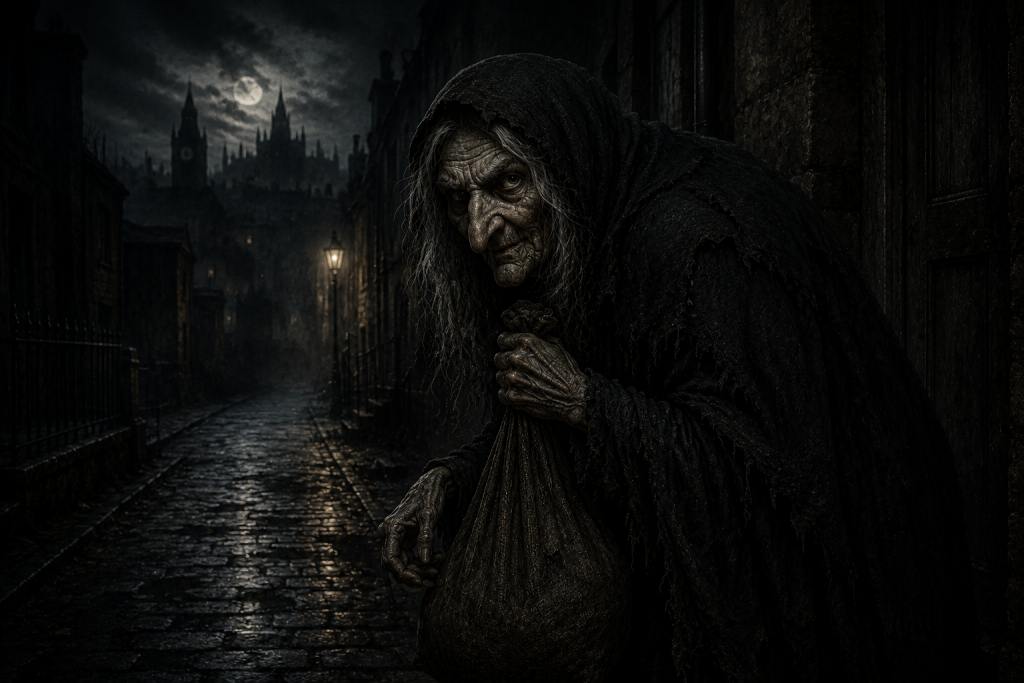

There is a particular quality of darkness that accumulates in places where the state has killed people on a schedule. Not the random violence of war or crime, but the organised, administered, eight o’clock in the morning darkness of judicial execution, where the paperwork has been completed and the chaplain has said what needs to be said and the trapdoor drops at the appointed time. Barlinnie Prison in Glasgow’s northeast has that darkness in its walls, and it has been there long enough that what lives in those walls has started to make itself known.
The Bar-L, as Glasgow has always called it, is the largest prison in Scotland, a Victorian institution built in the then-rural area of Riddrie between 1882 and 1897, its five great halls rising above what was once open countryside and is now absorbed entirely into the city that has grown around it. It has held some of the most notorious criminals in Scottish history. It has been the site of rehabilitation that became genuinely celebrated. And it has been the site of ten judicial executions, carried out between 1946 and 1960 in a purpose-built hanging shed in D Hall, at eight o’clock in the morning, with the same procedural thoroughness that any bureaucratic institution brings to any scheduled task.
The men who were hanged there were buried inside the prison walls in unmarked graves, as was the practice of the period, their remains the property of the state. They stayed there until 1997, when renovations to D Hall required their exhumation. Only at that point, nearly half a century after the last execution, did the executed men of Barlinnie leave the prison that had killed them.
Some things, the tradition suggests, have not left yet.
The Victorian Woman With the Lantern
The most consistently reported and most specifically located haunting at Barlinnie concerns a figure that does not belong to the prison’s own history at all, or at least not obviously so.
She is described as a woman dressed in Victorian clothing, carrying a lantern, and she has been reported in the area immediately outside the surgery wing of the prison and near the bricked-up entrance to what was the old execution block. The location is significant. The surgery wing and the execution block are adjacent in the geography of the prison, sitting alongside each other in the way that medical care and capital punishment were administered alongside each other in the Victorian penal system, the same institution responsible for the prisoner’s health also responsible, in the final analysis, for the prisoner’s death.
Who she might be has never been established with any confidence. The Victorian clothing places her in the period of the prison’s construction and early operation rather than in the more recent history of the executions, which occurred between the 1940s and 1960s. This temporal mismatch is one of the more genuinely puzzling aspects of her tradition. The Bar-L opened in 1882 and received its first prisoners that year. Whatever happened in or around the surgery wing in those earliest decades of the prison’s operation, before the official execution records that survive in documented form, is less thoroughly preserved in the historical record.
Several possibilities have been considered by those who have written about the Barlinnie haunting. She may be connected to the earlier Glasgow prison history that Barlinnie replaced, since the prison sits in a broader tradition of Glasgow penal history that includes the now-demolished Duke Street Prison, where the last public execution in Glasgow was carried out in 1865. She may be connected to an earlier use of the Riddrie site, though evidence for significant prior habitation at that specific location is thin. Or she may be one of those ghost tradition figures whose specific identity has simply not survived the oral transmission that carried the sighting reports themselves, her story known to those who first reported her and lost somewhere in the chain of retelling.
What survives is the specific description, the location, and the consistency. A Victorian woman with a lantern, haunting the space between where prisoners were cared for and where, at the appointed hour, they were killed. The lantern itself is a detail worth noting. In the symbolic vocabulary of Victorian mourning and memorial, the lantern carried by a female figure was a common image of vigil, of watching over the dead, of maintaining a light in the darkness for those who could no longer maintain one themselves. Whether the Barlinnie ghost is understood as a mourner, a watcher, or simply a presence that has not found its way out of the space where it once had reason to be, the image she presents is one of vigil rather than threat.
The Cell That Started Throwing Things
The Victorian woman is the most enduring ghost tradition at Barlinnie, but she is not the only one, and the second most documented incident at the prison is considerably more dramatic in its immediate presentation.
In August 1969, three prisoners sharing a cell at Barlinnie reported that their cell was haunted. The haunting had arrived, they said, on Friday 15 August, when something in the cell began throwing objects. A mirror went first, followed by mugs hurling themselves from a shelf. The three men, sharing a confined space with something they could not see but could clearly observe by its effects, were sufficiently frightened that one of them formally requested a transfer to a different cell.
What makes this account unusual, even within the broader tradition of prison ghost stories which are numerous and not always well-sourced, is the detail that the haunting post-dated the men’s arrival in the cell. They had occupied the space before the activity began, which removes the possibility that they had been primed by previous occupants’ accounts to experience something they were already expecting. The cell was quiet when they moved in, and then it was not.
A prisoner released on Monday 18 August confirmed the story to journalists outside the prison, reporting that all three cellmates had insisted the ghost was real and that the events had genuinely occurred. An official spokesman at the Scottish Home and Health Department declined to comment, citing their standard position of not commenting on matters of internal administration, which is a sentence that covers a great deal of ground without actually saying anything.
The incident was reported in the Aberdeen Press and Journal at the time, which places it in the documented record rather than purely in oral tradition. Whatever was throwing mugs around that cell in August 1969 was doing so in a prison that was very much in operation, surrounded by hundreds of witnesses, none of whom had any obvious reason to manufacture a haunting.
The Hanging Shed and What It Left Behind
The specific geography of where the executions were carried out at Barlinnie is worth understanding, because it explains both why the haunting tradition is concentrated in certain areas of the prison and why it has proven so persistent.
The execution suite, known within the prison as the Hanging Shed, was built into D Hall, the large Victorian hall whose renovations in 1997 required the exhumation of the executed men’s remains. The condemned cell, where the prisoner spent his final hours in the company of deathwatch officers who sat with him at all times, was described by those who documented it as two normal-sized cells knocked into one, an acknowledgement that the space needed to be large enough for the human weight of what was going to happen in it. The execution chamber itself was just a few paces away across the gallery.
Ten men were executed at Barlinnie between 1946 and 1960. Each was convicted of murder. Each was buried within the prison walls in an unmarked grave. The Hanging Shed was maintained even after capital punishment for murder was abolished in 1969, because the offences of treason and sedition still carried the death penalty, and Scotland was legally required to retain at least one facility capable of carrying them out. The gallows at Barlinnie were finally demolished in 1997 during the D Hall renovations that also disturbed the buried remains of the men who had died on them.
A filmmaker who documented the prison around that period, visiting the execution chamber before its demolition, recorded an observation so striking that it has been noted by multiple people who subsequently wrote about Barlinnie: he noticed a butterfly trying to escape from the window of the execution chamber, struggling against the glass, and when he looked more carefully he found a large group of them roosting on the ceiling. He described the image as taking on a clearly metaphorical quality in that specific space, butterflies in the room where the trapdoor had dropped, straining toward light through a window that would not open.
Whatever that observation means, it is not easy to set aside. The execution suite at Barlinnie attracted butterflies before it was demolished. The filmmaker who noticed it said he had never seen anything like it in his life.
The Unmarked Graves and the 1997 Exhumation
The decision to bury executed prisoners within prison walls in unmarked graves was standard practice in the Victorian and twentieth century British penal system, rooted in a specific legal principle: the remains of an executed prisoner became the property of the state at the moment of execution, and the state would determine their disposition. The family had no legal claim to the body. There would be no funeral, no grave with a name, no place to visit or to grieve at.
For the ten men executed at Barlinnie between 1946 and 1960, this meant decades of burial within the walls of the institution that had killed them. When the D Hall renovations of 1997 required the ground to be disturbed, the remains were exhumed and reburied elsewhere, though the records of precisely where this reburial took place are not widely published.
This detail carries its own weight in any consideration of why Barlinnie has generated the ghost tradition it has. The specific anxiety about the improperly buried dead, the dead who have not been given their proper acknowledgement, who have no marker and no named place in the landscape of the living, runs through a great deal of Scotland’s most deeply rooted supernatural tradition. The Barlinnie story sits within that broader pattern without requiring any supernatural belief to make its human logic clear.
People are bothered, in a way that goes beyond rational calculation, by the idea of the dead buried nameless and unmarked in the ground of an institution. They are bothered even when, as in the case of the Barlinnie executed, the legal and moral justification for the executions was never in significant public doubt. The problem is not the justice of the execution. The problem is the burial, the absence of the ordinary human acknowledgement that even the worst of us tend to be given in the end.
A Prison Still in Use
Barlinnie remains an operational prison, the largest in Scotland, currently housing close to fourteen hundred prisoners in a building designed for fewer than a thousand. Plans for its eventual closure and replacement with a new facility have been announced and revised several times without yet being fully enacted. The Bar-L endures, as Glasgow things tend to endure, resistant to the various schemes for its replacement that have accumulated around it across the decades.
This means that the ghosts of Barlinnie, unlike those of decommissioned prisons that have been converted into hotels or tourist attractions elsewhere in Britain, are not accessible for ghost hunting events or overnight paranormal investigations. The Victorian woman with her lantern walks in an active prison. The cell that threw mugs is part of a facility that still receives prisoners from the courts of the west of Scotland every working day. Whatever presence occupies the area outside the surgery wing does so alongside men who are there for very different, very contemporary reasons.
There is something about this that the more theatrical ghost traditions of converted Victorian jails cannot quite replicate. Barlinnie’s ghosts are not heritage. They are simply part of what the building is, accumulated across a century and a half of incarceration, execution, and the specific kind of institutional darkness that comes from administering punishment as a scheduled activity.
The woman with the lantern keeps her vigil outside the surgery wing. The trapdoor is gone now, demolished with the rest of the Hanging Shed in 1997. The men it dropped beneath it were moved to wherever the state decided to put them.
But the tradition of Barlinnie suggests that some things do not move when the institution decides it is time for them to go.
Some things stay with the building, and with the ground, and with the darkness between the surgery wing and the old execution entrance, where a Victorian woman walks with a light that has no obvious source, in a prison that is still very much in use, guarding something that the records have not quite managed to name.
If you enjoyed this article, the creatures and legends of Scotland are collected in my book Tales of Myth and Magic, Volume I: Scotland — 25 tales told in full, each traced to its earliest sources, with a map, glossary, and full bibliography. Available in paperback for £11.99.
Find Out More →Further Reading
If this article sparked your interest, these are the books worth reading next.
Scottish Urban Legends: 50 Myths and True Stories
by Aaron Mullins — fifty Scottish urban legends including stories from Glasgow, Edinburgh, and the Highlands. The kind of tradition that Maggie Murphy belongs to, collected properly in one volume.
Scottish Urban Myths and Ancient Legends
by Grace Banks and Sheena Blackhall — vampires, werewolves, devil encounters, and the school playground legends of Scotland. A genuinely good collection of the stories Scots have been telling each other for generations.
The Lore of Scotland: A Guide to Scottish Legends
by Jennifer Westwood and Sophia Kingshill — the most comprehensive collection of Scottish legend in print, covering Glasgow to Shetland, exploring origins and historical basis. Endorsed by Terry Pratchett as the real macabre.
For more on Glasgow’s haunted history, the Nora article covers the ghost of the Theatre Royal and the cleaning woman who wanted to be an actress. The Provan Hall article covers Glasgow’s most haunted medieval building. The Glasgow Folklore page has every article on the city’s dark history in one place.
Never miss a myth
Thank you for being here. The site is brand new and every subscriber genuinely means something to me. If you're here, you care about this stuff as much as I do - and that's all the reason I need to keep going. New stories, videos and dark folklore from around the world, straight to your inbox. No algorithm. Just the stories, when they're ready.