Lock the west-facing windows. That was the instruction, passed down through generations of Scottish Gaelic households with the quiet seriousness of something that genuinely mattered. Not a superstition exactly, not in the way that touching wood or avoiding ladders is a superstition. A precaution. A practical measure against a specific and understood threat.
The west was where the Sluagh came from. And if you left the window open, they might come in.
Of all the supernatural traditions in Scottish Gaelic folklore, the Sluagh is among the most ancient and the most disturbing. Not because of what they do, though what they do is disturbing enough. But because of what they are. These are not demons from some external darkness, not monsters from the deep places of the earth. The Sluagh are the dead. Specifically, they are the dead who cannot rest, the dead who were so steeped in sin and transgression in life that neither heaven nor earth nor the world beneath would receive them. They have been refused by every realm that exists.
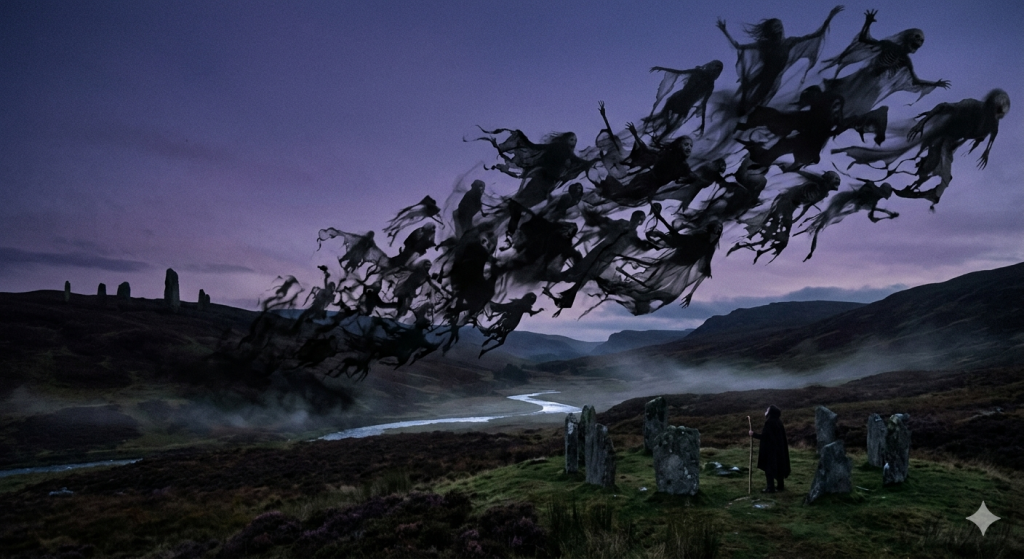
And so they fly. Forever. In great flocks across the night sky, neither at peace nor fully gone, seeking the living with a hunger that death itself has not extinguished.
What the Name Means
The word sluagh in Scottish Gaelic simply means a host or a crowd, a multitude of people or beings moving together. It is the same word used for an army, for a gathering, for any large group with collective purpose. The supernatural application of it tells you something important: these are not solitary wanderers. They move together, in numbers, in formation, the way a murmuration of starlings moves, vast and coordinated and belonging to a logic that is not individual.
The full traditional name is often given as Sluagh Sìth, the fairy host, though the relationship between the Sluagh and the fairy world is complicated and varies between sources and regions. In some traditions they are entirely distinct from the fairies, a separate category of being defined by their status as the sinful dead rather than by any inherent supernatural nature. In others they overlap with the Sluagh Mòr, the great host of the dead that rides through the sky in certain traditions of the Highland and Island communities.
What all versions agree on is the collective nature, the movement through the air, the direction from the west, and the danger they represent to the living.
The Sinful Dead
The theology embedded in the Sluagh tradition reflects a world in which Christian belief and much older pre-Christian ideas about the dead existed in a state of uneasy coexistence, each shaping and modifying the other over centuries.
The idea that the sinful dead could not rest, that they were refused by the earth and left to wander, is consistent with Christian thinking about the consequences of dying in a state of unrepentance. But the specific form that wandering takes in the Sluagh tradition, the flocking together, the riding of the night wind, the hunting of the living from the air, these belong to a much older stratum of belief about the dead and what they might become.
In the most detailed accounts, the Sluagh are specifically those who died with unresolved sin, without confession, without last rites, without the reconciliation that the Church offered as the gateway to peaceful rest. They were not evil in the way demons are evil. They were people, once. People who made bad choices, who died badly, who were refused the ordinary consolations of the dead.
That human origin is what makes them genuinely unsettling in a way that a straightforwardly monstrous creature is not. The Sluagh were somebody’s neighbours. Somebody’s family. People who grew up in the same townships, spoke the same language, knew the same hills. And now they fly on the west wind and reach for the living with hands that were once as ordinary as yours.
What They Do to the Living
The Sluagh did not merely observe the living. They interacted with them, and the interactions were not gentle.
They were said to swoop down on people caught outside at night, particularly those who were alone and in isolated places. Their aim was to carry off the living, physically lifting people from the ground and transporting them through the air on wild, disorientating journeys across the night landscape. Victims of these abductions might be taken miles from where they had been and left there, or they might be used as unwilling participants in the Sluagh’s own activities.
This is one of the most distinctive and specific aspects of the tradition: the Sluagh were said to force living people to participate in their hunts. The living person, carried along in the host, would be compelled to shoot at animals or even at other people below, using the fairy arrows, the elf-bolts, that appear in Scottish supernatural tradition in multiple contexts. Isobel Gowdie, in her confessions, described a similar experience of being taken by supernatural forces and made to shoot at targets with elf-bolts. Whether this reflects the same tradition, filtered through her specific circumstances and the expectations of her interrogators, is impossible to say with certainty. But the parallel is striking.
Wounds inflicted by elf-bolts sent by the Sluagh were known as elf-shot, and they caused wasting illnesses in animals and people alike. A cow that began to fail without obvious cause, a person who sickened slowly and could not be brought back to health by ordinary means, might be understood as elf-shot, the victim of a Sluagh attack they might not even remember clearly. The illness was real. Only the cause was supernatural.
The West Wind and the Dying
The association of the Sluagh with the west, and specifically with west-facing openings in a house, reflects a deep geographical symbolism in Scottish and Irish Gaelic tradition.
The west was where the sun went down. It was the direction of death, of the land beyond the sea that various traditions located in the waters to the west of Ireland and Scotland, the place where the dead went and from which they might return. When a person was dying, the west window or door of the house might be opened deliberately to allow the soul to depart. This same opening, in the Sluagh tradition, was what the host used to enter.
There is a terrible logic to it. The door opened for the departing soul could also admit what came the other way.
The timing of Sluagh activity in the tradition is consistently nocturnal and most associated with certain seasons, particularly the turning points of the year when the boundary between the living and the dead was understood to be at its thinnest. The Sluagh were most active when the world was already uncertain, already in transition, when the ordinary rules were temporarily suspended and the night was longer and stranger than usual.
Communities that lived with this tradition developed practices accordingly. Windows on the west side of houses were latched at night. Certain prayers and protective measures were observed. People did not travel alone after dark in exposed places if they could help it, and if they had to, they moved quickly and did not look up.
The Sound of the Host
People who claimed to have encountered the Sluagh, or to have been close to their passing, described it in consistent terms. A rushing sound, like wind but directional in a way that natural wind is not, coming from a specific point and moving toward another. Sometimes voices within it, or something that had the shape of voices, though not in any language that could be understood. Sometimes the sound of something like hunting, cries and movements coordinated in a way that suggested pursuit rather than mere passage.
Animals were said to react strongly. Dogs would not bark at the Sluagh but would cringe and refuse to move, pressing themselves against walls or under furniture. Horses would not face the direction the host was coming from. Cattle would crowd together and face inward. The animal response was understood as confirmation of what the tradition said: these were real, and they were present, and every creature with instincts understood it even if the rational human mind resisted.
The silence of birds is a recurring motif in encounter accounts, which will feel familiar to anyone who has read about encounters with other supernatural presences in wild Scottish landscapes. Whatever causes birds to go silent in the presence of things that should not be there, it is a detail that appears too consistently across too many independent traditions to be entirely coincidental.
The Sluagh and the Fairy Host
The relationship between the Sluagh and the broader tradition of the fairy host, the Sìth who ride out on certain nights and can sweep up the living in their passage, is one of the more complex questions in Scottish supernatural folklore.
In some accounts they are essentially the same thing, or at least travel together, the sinful dead incorporated into the fairy host and moving with them through the night sky. In others they are distinct, the Sluagh being a darker and more specifically malevolent entity than the fairy host proper, which could be dangerous but was not motivated by the particular hunger of the refused dead.
What is consistent is that both traditions share the same landscape and many of the same protective measures. Iron, prayer, the sign of the cross, staying indoors after dark, moving quickly through exposed places, not whistling at night, not looking up when you heard something passing overhead. The communities that lived with these traditions were not making a sharp theological distinction between different categories of supernatural threat. They were managing risk in a landscape that they understood to contain things they could not fully see or understand.
This is worth sitting with for a moment. These were not simple or credulous people. They were communities that had survived for generations in a demanding landscape through hard-won practical knowledge and careful observation of the world around them. The Sluagh tradition was not separate from that practical intelligence. It was part of it.
If you want more like this, the Tales of Myth and Magic newsletter delivers new creatures, legends, and forgotten folklore straight to your inbox.
No fixed schedule. No noise. Just the stories, when they are ready.
Sign up here →Why the Sluagh Still Matters
There is a version of encountering folklore like this where you hold it at arm’s length, appreciate it as cultural history, and move on. The Sluagh makes that difficult.
The idea at its heart is not an exotic one. It is the idea that how you live matters, that dying badly has consequences, that the dead do not simply dissolve into comfortable nothingness and leave the living in peace. That the refused and the restless might still be out there, moving in great flocks on the night wind, reaching for the warmth and the life that they cannot have and cannot stop wanting.
Every culture has some version of this fear. The Sluagh is Scotland’s version, shaped by the specific landscape and the specific theological history and the specific quality of the Highland night, which is dark in a way that those who have not experienced it cannot quite imagine.
Lock the west-facing windows.
It is not the worst advice anyone has ever given.
Further Reading
If this article sparked your interest, these are the books worth reading next.
Scottish Urban Legends: 50 Myths and True Stories
by Aaron Mullins — fifty Scottish urban legends including stories from Glasgow, Edinburgh, and the Highlands. The kind of tradition that Maggie Murphy belongs to, collected properly in one volume.
Scottish Urban Myths and Ancient Legends
by Grace Banks and Sheena Blackhall — vampires, werewolves, devil encounters, and the school playground legends of Scotland. A genuinely good collection of the stories Scots have been telling each other for generations.
The Lore of Scotland: A Guide to Scottish Legends
by Jennifer Westwood and Sophia Kingshill — the most comprehensive collection of Scottish legend in print, covering Glasgow to Shetland, exploring origins and historical basis. Endorsed by Terry Pratchett as the real macabre.
Never miss a myth
Thank you for being here. The site is brand new and every subscriber genuinely means something to me. If you're here, you care about this stuff as much as I do - and that's all the reason I need to keep going. New stories, videos and dark folklore from around the world, straight to your inbox. No algorithm. Just the stories, when they're ready.