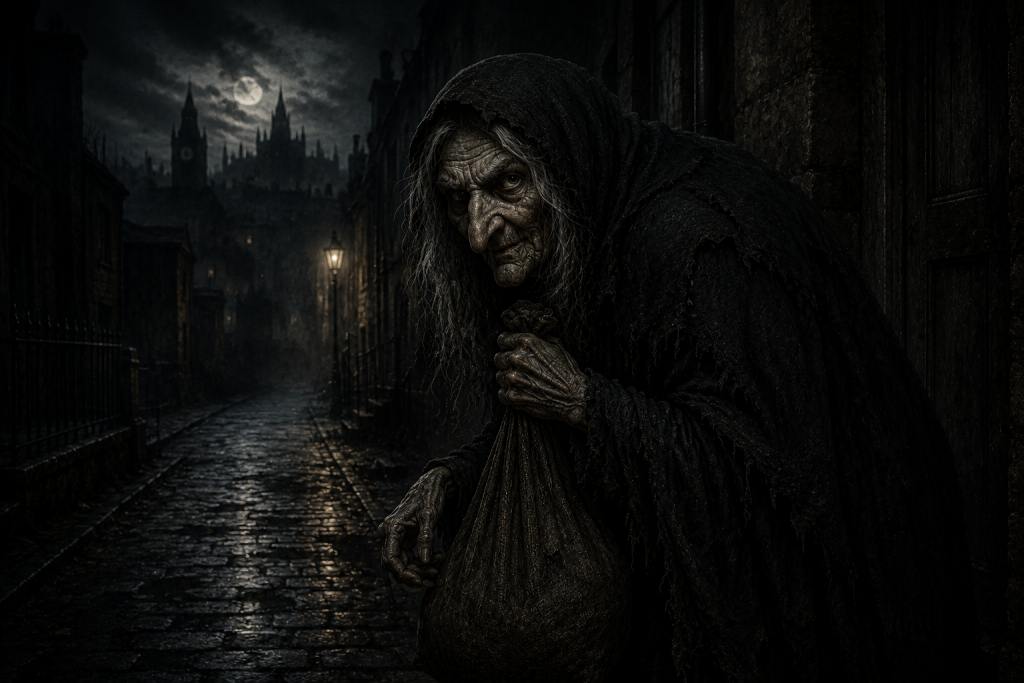

In the folklore of Shetland, at the very edge of Scotland where the North Sea meets the Atlantic and the winter nights are long enough to feel permanent, there is a creature that does not fit the template. The Wulver has the body of a man and the head of a wolf. It lives alone in a cave, fishes from a rock by the sea, and occasionally leaves fish on the windowsills of poor families. It does not hunt humans. It does not transform. It is not cursed. It simply exists, quietly, in its own form, in its own territory, getting on with its life.
In a tradition full of creatures that kill, steal, transform, and terrorise, the Wulver is conspicuous for doing almost none of these things. It is one of the most frequently cited examples of a benevolent supernatural figure in British folklore, and it has attracted significant attention from people interested in the more compassionate end of the folk tradition.
There is, however, a question worth asking about it that most accounts of the Wulver quietly avoid: how old is this tradition, and where does it actually come from?
What the Primary Source Actually Says
The Wulver is documented primarily in one source: Shetland Traditional Lore, a book published in 1932 by Jessie Margaret Saxby, a Shetland-born writer and folklore collector who spent much of her life recording the oral traditions of the islands. Saxby’s description of the Wulver is specific and relatively brief. She describes it as a creature with the body of a man and a wolf’s head, covered in short brown hair. It was not a werewolf in the conventional sense because it had never been human: it was simply what it was, a being of its own kind that existed naturally in its hybrid form. It lived in a cave and spent much of its time fishing from a rock in the sea, a location she identifies as the Wulver’s Stane.
The account of the Wulver leaving fish on windowsills for poor families also comes from Saxby, and she presents it as a tradition of the islands rather than as her own invention. But the fact that Saxby is the sole early written source for most of what we know about the Wulver raises a legitimate question. Saxby was a writer of considerable imagination as well as a folklore collector, and the line between faithful recording and literary embellishment is not always easy to draw in 19th and early 20th century folklore collecting, a period when writers like W.B. Yeats and Walter Scott were simultaneously collecting genuine oral traditions and shaping them substantially through their own literary sensibilities.
This does not mean the Wulver is simply invented. Oral traditions leave no paper trail before they are written down, and the absence of earlier written sources for a Shetland belief does not prove the belief did not exist. Shetland was a remote and largely self-contained community whose folklore had minimal contact with the mainstream collecting traditions of the 19th century until relatively late. What it does mean is that the Wulver should be understood as a tradition mediated through Saxby’s account rather than as something with a long documented history comparable to, say, the Kelpie or the Selkie.
The Norse Layer
Shetland’s folklore is not straightforwardly Scottish. The islands were part of Norway until 1468, when they were pledged to Scotland as security for the unpaid dowry of Margaret of Denmark on her marriage to James III and never redeemed. The Norse presence in Shetland is not historical background. It is living cultural texture: in place names, in dialect, in the persistence of traditions that have Norse rather than Scottish Gaelic roots.
The Wulver fits within this Norse context more naturally than it fits within the mainland Scottish or Irish tradition. The Norse tradition has its own wolf-beings: the ulfhednar, warriors who wore wolf skins and fought in states of animal frenzy, are documented in the sagas; the great wolf Fenrir is one of the most powerful figures in Norse cosmology; wolf-human hybrids appear in various forms across the Norse and Germanic traditions. The Wulver’s permanent wolf-headed form, without transformation and without the curse that typically accompanies lycanthropy in the Western tradition, is more consistent with Norse categories than with the continental European werewolf tradition.
The fishing habit is also worth noting in its Norse context. Shetland communities were fishing communities in a very direct sense: fishing was not a leisure activity or a supplementary food source but the primary economic activity of the islands, and the relationship between the people and the sea was practical and daily rather than metaphorical. A supernatural creature that fishes for its food and shares its catch with the poor is a figure that reflects the values and the economy of a fishing community in a way that fits naturally with Shetland’s specific cultural context.
The Wulver’s Stane
The specific location where the Wulver is said to fish, the Wulver’s Stane, is the detail in Saxby’s account that most strongly suggests a genuine local tradition rather than a purely literary invention. Place names connected to supernatural figures are one of the most reliable indicators that a belief has genuine community roots: they suggest that the figure was real enough to the people of a specific place that they named a physical feature of the landscape after it.
Shetland has a number of such locations connected to its supernatural tradition, including sites associated with the Trows, the Shetland troll figures who are the islands’ most extensively documented supernatural inhabitants. The Wulver’s Stane belongs to the same pattern of landscape-embedded supernatural geography, and its existence as a named location rather than a purely narrative element gives the Wulver a geographical specificity that purely literary inventions tend not to have.
Whether the stone existed before Saxby named it in print, or whether her account created the named location retrospectively, is impossible to determine at this distance. What can be said is that named supernatural locations in Shetland tend to reflect genuine belief rather than literary confection, because the communities that sustained those names were small enough and connected enough that a purely invented location would not have survived as a local designation.
Why the Wulver Matters
The Wulver occupies a specific and useful position in the broader tradition of wolf-human hybrid beings. Across European folklore, the relationship between humans and wolves is almost always adversarial. The werewolf is a cursed or infected person who becomes a predator. The wolf is the enemy of the shepherd and the farmer. The wolf at the door is a metaphor for existential threat. The idea of a wolf-headed being that fishes quietly and leaves food for the poor inverts all of these associations completely.
It is tempting to read the Wulver as a simple inversion: good werewolf rather than bad werewolf. But Saxby’s account suggests something more specific than that. The Wulver is not a werewolf at all. It has never been human. It does not transform. It is not caught between two states. It is simply a being of its own kind, with its own nature, its own habits, and its own relationship to the human community that shares its landscape. The kindness it shows is not the gratitude of a cursed person for human acceptance. It is the ordinary behaviour of a creature that happens to have more fish than it needs and neighbours who have less.
That quality is what makes the Wulver enduringly interesting. It belongs to a tradition within British and Irish folklore of supernatural figures whose relationship to the human world is defined by something other than threat: the Brownie who helps with household work, the Wulver who leaves fish, the protective fairy who guards a specific family across generations. These figures suggest that the folk tradition was not simply a catalogue of dangers but a more complex attempt to understand the relationship between the human community and the non-human world that surrounded it.
The Wulver in Context
If you are interested in the Wulver because of its relationship to the werewolf tradition, the Dark Origins of the Werewolf article covers the broader history of lycanthropy belief from ancient Mesopotamia through to medieval Europe. The Werewolf Trials of Europe article examines the documented legal cases in which people were tried and executed for the crime of transformation, which gives the Wulver’s gentle nature an interesting contrast with what the mainstream tradition believed wolf-human beings were actually like.
For more on the supernatural tradition of the Scottish islands, the Trows article covers the Shetland troll figures who are the Wulver’s closest neighbours in the islands’ folk tradition. The broader Scotland category has more on the creatures and legends of the Scottish tradition.

If you enjoyed this article, the creatures and legends of Scotland are collected in my book Tales of Myth and Magic, Volume I: Scotland — 25 tales told in full, each traced to its earliest sources, with a map, glossary, and full bibliography. Available in paperback for £11.99.
Find Out More →Further Reading
If this article sparked your interest, these are the books worth reading next.
The Beast of Gévaudan
by Jay M. Smith — the most thorough historical investigation into the creature that terrorised southern France between 1764 and 1767, and what the historical record actually reveals about what it was.
The Werewolf Book: The Encyclopedia of Shape-Shifting Beings
The most comprehensive reference on the werewolf tradition across world cultures — every regional variant, every historical case, every folkloric and literary expression of the shape-shifting being.
The Werewolf in Lore and Legend
by Montague Summers — the classic scholarly treatment of werewolf belief, drawing on primary sources from across Europe. Dense, serious, and still the best single academic treatment of the tradition.
Never miss a myth
Thank you for being here. The site is brand new and every subscriber genuinely means something to me. If you're here, you care about this stuff as much as I do - and that's all the reason I need to keep going. New stories, videos and dark folklore from around the world, straight to your inbox. No algorithm. Just the stories, when they're ready.