
Glasgow’s Theatre Royal on Hope Street is the oldest continuously operating theatre in Scotland, a fact that sits comfortably alongside its reputation as one of the most haunted buildings in the city. A building that has been staging performances since 1867 has had time to accumulate a great deal of history, and history in a theatre tends to accumulate with a particular intensity that other buildings do not quite match. The emotions that pass through the walls of a working theatre across a century and a half, the ambition, the humiliation, the triumph and the failure, leave something behind. Or at least, that is one way of accounting for what staff and visitors at the Theatre Royal have been reporting for as long as anyone can remember.
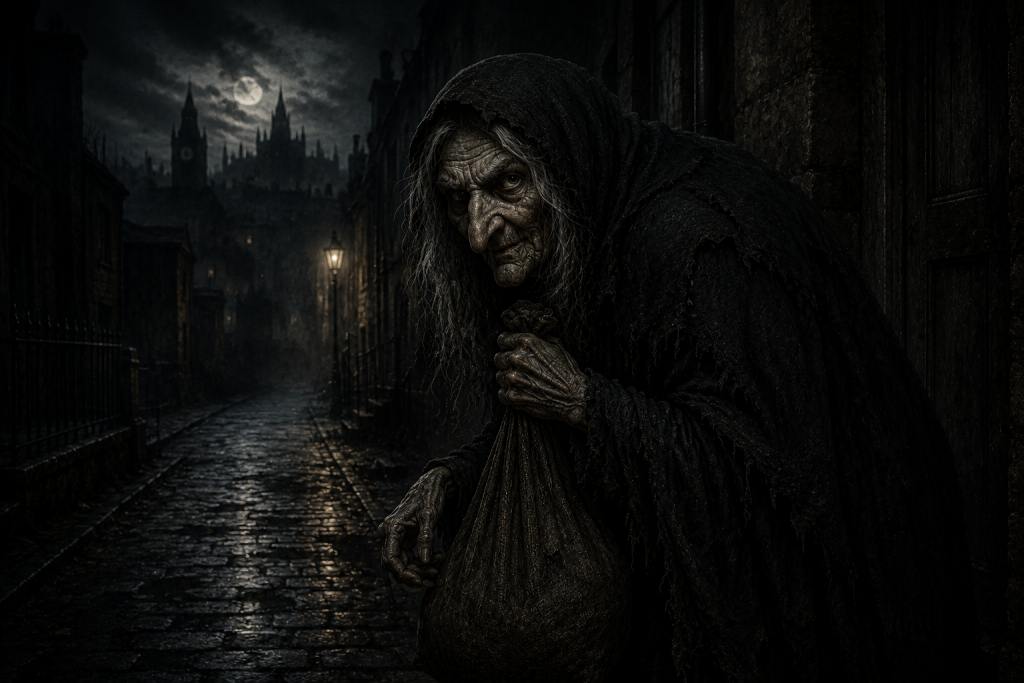
The ghost most closely associated with the building is not a grand historical figure, not a murdered aristocrat or a wronged queen or any of the dramatic personae that haunt Scotland’s castles and priories. She is a cleaning woman who wanted to be an actress, and the tradition attached to her name is one of the most quietly heartbreaking in all of Glasgow’s ghost story canon.
Her name was Nora.
The Building and Its History
The Theatre Royal opened in 1867 on Hope Street in the heart of Glasgow’s city centre, originally as the Royal Colosseum and Opera House before taking its current name. It is Glasgow’s oldest theatre and Scotland’s longest-running, a distinction it has maintained through fire, rebuilding, and the various institutional transformations that have made it, at different points in its history, the home of Scottish Television, Scottish Opera, and Scottish Ballet.
The building that stands today took its current form after a fire destroyed much of the original structure in 1895, and the rebuilt theatre retains its Victorian grandeur in the form of its distinctive facade on Hope Street and its ornate interior, including the upper circle that has become so closely associated with its most famous resident ghost.
Glasgow was known, in the Victorian era and well into the twentieth century, as one of the hardest audiences in Britain to perform for. The city’s working-class theatregoing culture had no patience for mediocrity, and the tradition of driving unpopular performers from the stage with rotten fruit and, in the industrial city’s particular variation on the custom, rivets from the shipyards, was not simply apocryphal. Performers who played Glasgow knew what they were walking into, and the pressure of that audience was something every actor who took to the Hope Street stage understood in their bones before they walked out in front of it.
Nora understood it too, in the end. She just understood it from the wrong side of the experience.
The Story of Nora
The version of Nora’s story that has been most consistently told across the years runs like this.
Nora worked as a cleaning woman at the Theatre Royal, one of the invisible army of people who maintain the physical fabric of any working theatre, scrubbing the stairs and polishing the floors and emptying the bins in the hours before and after the performances that everyone else comes to see. She had worked there long enough to know the building intimately, its backstage passages and its front-of-house spaces, the specific sounds the upper circle made when it was empty and the way the light fell differently on the stage from different parts of the auditorium.
She also had a dream, which was that she should one day be on that stage rather than cleaning it.
Whether she was a genuinely talented amateur, or simply a woman with an ambition that exceeded her ability, or something in between those two things, is not something the tradition preserves with any clarity. What it does preserve is that she pestered the theatre’s management about her ambition with a persistence that eventually produced a result. She was given an audition. She was given her chance.
It went badly. The audience, following the established Glasgow theatrical tradition, made their verdict clear with the particular cruelty that theatrical audiences have always been capable of directing at performers who have misjudged their ability. She was laughed off the stage.
The humiliation was absolute. The tradition holds that Nora took her own life.
She has been in the upper circle of the Theatre Royal ever since, making herself known through the sounds that drift down from that part of the building when no living person is up there to account for them. Moaning. Doors banging. The movement of the fold-down seats flipping up and down without anyone sitting in them. Staff at the theatre have described an atmosphere in the upper circle that shifts from merely atmospheric to something more specifically uncomfortable at certain times and in certain parts of the space.
The paranormal investigator Peter Underwood, one of the most prolific researchers of haunted buildings in Britain, encountered what he described as poltergeist activity at the Theatre Royal during the 1970s when the building was operating as Scottish Television’s headquarters. He had arrived simply to be interviewed rather than to conduct any investigation, which is the kind of detail that gives an account a texture of genuine surprise rather than the predetermined expectation of a formal ghost hunt.
A Story With a Literary Shadow
The Nora tradition at the Theatre Royal has attracted specific scholarly attention from the folklorist Geoff Holder, who has pointed to a possible origin for the story that sits in the theatre’s own documented history rather than in any verifiable account of a real woman’s life and death.
In 1894, a play called A Life of Pleasure transferred to the Theatre Royal Glasgow from London, and its central character was a woman named Norah Hanlan. The play’s plot involves seduction, abandonment, prostitution, and eventual suicide, its arc tracing the destruction of a woman by the cruelty of others in a form that would have been thoroughly familiar to Victorian theatrical audiences accustomed to this kind of morality-adjacent melodrama. Norah is wronged, Norah suffers, Norah dies.
Holder has suggested that the ghost of Nora in the theatre may be an example of what happens when theatrical fiction and the living folklore of a building begin to influence each other, the character’s name and fate from the 1894 production gradually migrating into the building’s own ghost tradition, reshaped into the cleaning woman with theatrical ambitions that the story has taken in the retellings that followed. This is not as unusual a process as it might initially seem. Theatres are buildings specifically given over to the creation and maintenance of emotional narratives, and the boundary between the stories performed within their walls and the stories told about the buildings themselves has always been permeable.
Whether Nora was a real woman who worked in the Theatre Royal and died as the tradition describes, or a fictional character who wandered off the stage in 1894 and never quite found her way back out of the building, or some combination of both, the tradition has proven durable enough to survive without a verified historical foundation.
The moaning in the upper circle continues to be reported regardless.
The Fireman Who Never Left
Alongside Nora, the Theatre Royal carries a second ghost tradition with considerably more specific historical grounding.
In 1969, an electrical fire broke out in the theatre, and the Fire Brigade was called to tackle it. Sub Officer Archibald McLang of Queens Park Fire Station was among the crew that entered the building through the Hope Street entrance to fight the fire. The precise sequence of what happened during the firefighting operation has not been fully established in the public record, but McLang’s body was found the following day. He had died in the building he had entered to protect.
He is said to have been seen in the theatre since, most consistently reported in the area of the orchestra pit, where witnesses have described a figure standing and staring toward the musicians during performances, present and then not present in the way that figures in these accounts tend to be, noticed and then gone before anything more could be registered.
The fireman ghost carries a different emotional weight from Nora’s story. Where Nora’s tradition is built around ambition and humiliation and a tragedy of the self, McLang’s presence, if it is a presence, represents something simpler and in its own way more straightforwardly sad: a man who died doing his job, in a building he was trying to save, who has perhaps not entirely left the place where his life ended.
What Haunts a Theatre
It is worth asking, about the Theatre Royal specifically and about theatre hauntings more broadly, why these buildings seem to generate ghost traditions with such particular consistency and intensity.
In the span of time since 1867, hundreds of thousands of people have passed through its doors carrying with them the full range of human emotion that attending a performance tends to generate: hope and anticipation before a show, satisfaction or disappointment after, the specific heightened state that live performance produces in both audience and performer, where the ordinary emotional registers of daily life are temporarily amplified and made more immediately present.
Theatres also carry within their walls the concentrated ambition and fear of every performer who has walked their stages, the specific vulnerability of someone about to stand in front of a live audience and risk the kind of public failure that Nora’s story describes. These are not quiet buildings. Even empty, a working theatre retains the accumulated emotional resonance of everything that has been felt within it.
Whether ghost traditions like Nora’s represent the literal persistence of a dead woman’s presence in the upper circle of the Hope Street building, or whether they represent the way that certain kinds of human experience leave enough of an impression in a specific physical space to generate ongoing perception of something that cannot be immediately explained, is a question that the tradition does not try to resolve and that this article will not try to resolve either.
What the tradition does preserve is the specific quality of Nora’s story, which is not simply a ghost story but a story about a particular kind of cruelty, the cruelty of a laughing audience, and about the kind of ambition that does not fit neatly into the social role its owner has been given, and about what can happen when those two things meet in a Victorian theatre in Glasgow.
Nora Tonight
The Theatre Royal on Hope Street continues to host performances for Scottish Ballet and a programme of touring productions throughout the year. The upper circle is still in use, its fold-down seats occupied by living audience members who came to see a show rather than to encounter anything more ambiguous.
The moaning has been reported. The doors bang. In 2006 or 2007, a workman carrying out maintenance in a roof space was hit on the head by a flyer, thrown from somewhere in the space around him in a manner he could not account for. The vestibule and main hall have been described by staff as having an unpleasant atmosphere that does not correspond to anything physically obvious about the spaces.
In 2025, the Theatre Royal was chosen as the Glasgow venue for the touring production of Ghost Stories, Jeremy Dyson and Andy Nyman’s celebrated horror theatre show, which the venue’s own publicity described with the observation that the building already has its own paranormal activity, including resident ghost Nora. The choice of venue for a show about ghosts, in a building that already has one, is the kind of thing that happens in Glasgow’s oldest theatre as a matter of course.
Nora never made it as an actress. The Theatre Royal is now, in a sense, the stage she finally got to keep, the one venue in Glasgow where she will always be on the bill, where her name is always mentioned before the curtain goes up and where her presence, whatever it consists of, seems disinclined to accept any verdict other than her own.
She is, by all accounts, a persistent presence.
Glasgow audiences have always responded to that.
If you enjoyed this article, the creatures and legends of Scotland are collected in my book Tales of Myth and Magic, Volume I: Scotland — 25 tales told in full, each traced to its earliest sources, with a map, glossary, and full bibliography. Available in paperback for £11.99.
Find Out More →Further Reading
If this article sparked your interest, these are the books worth reading next.
Scottish Urban Legends: 50 Myths and True Stories
by Aaron Mullins — fifty Scottish urban legends including stories from Glasgow, Edinburgh, and the Highlands. The kind of tradition that Maggie Murphy belongs to, collected properly in one volume.
Scottish Urban Myths and Ancient Legends
by Grace Banks and Sheena Blackhall — vampires, werewolves, devil encounters, and the school playground legends of Scotland. A genuinely good collection of the stories Scots have been telling each other for generations.
The Lore of Scotland: A Guide to Scottish Legends
by Jennifer Westwood and Sophia Kingshill — the most comprehensive collection of Scottish legend in print, covering Glasgow to Shetland, exploring origins and historical basis. Endorsed by Terry Pratchett as the real macabre.
For more on Glasgow’s haunted history, the Ghosts of Barlinnie article covers the Victorian woman with the lantern and the prison that kept its dead. The Provan Hall article covers Glasgow’s most haunted medieval building. The Glasgow Folklore page has every article on the city’s dark history in one place.
Never miss a myth
Thank you for being here. The site is brand new and every subscriber genuinely means something to me. If you're here, you care about this stuff as much as I do - and that's all the reason I need to keep going. New stories, videos and dark folklore from around the world, straight to your inbox. No algorithm. Just the stories, when they're ready.