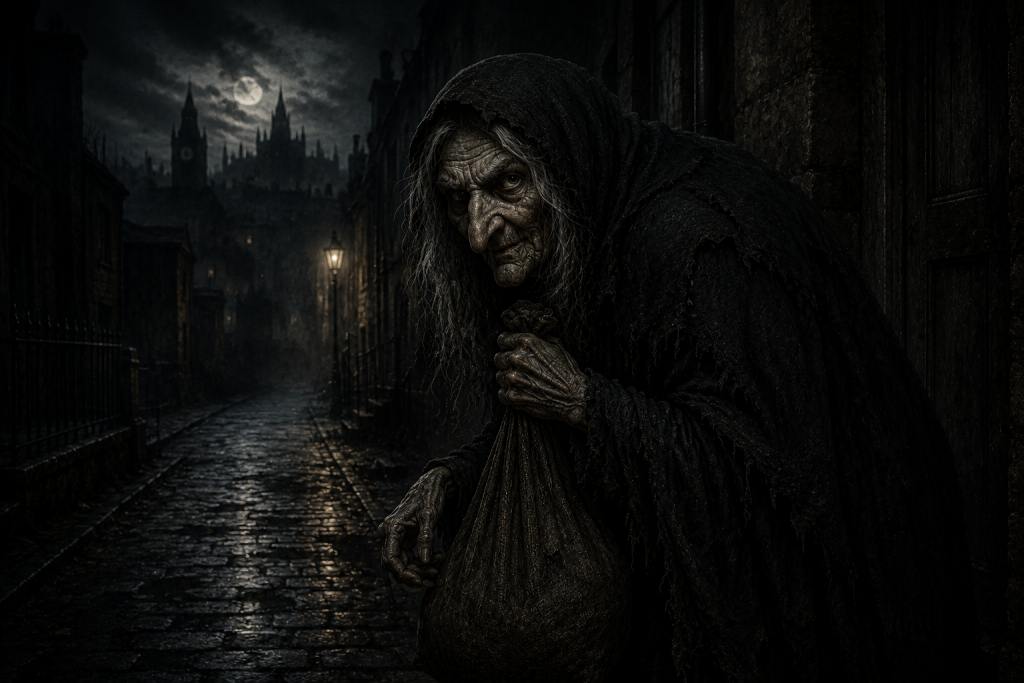

Beneath the Royal Mile in Edinburgh, under the weight of three centuries of accumulated city, there is a street. It runs at an angle to the road above it, narrow and stone-floored and dark, its walls still carrying the marks of the people who lived and worked and died there across the seventeenth century. The buildings that lined it were not demolished when the city built over them. They were simply sealed, their upper storeys removed, their lower reaches left intact and enclosed and forgotten in the darkness beneath the new construction.
The street is called Mary King’s Close, and it has been underground since 1753. The question that the people who walk through it tend to ask, quietly and sometimes without quite intending to, is whether the people who once lived there have been underground that whole time too.
Who Mary King Was
The close takes its name from a woman who is herself an unusual figure in the history of seventeenth century Edinburgh. Mary King was a merchant, a dealer in fabrics and cloth who managed her own stall on the high street, built her own business, and after her husband’s death became a burgess, a citizen with formal standing and a seat on the town council. In a period when women’s economic and civic participation was severely limited by the structures of the society around them, Mary King operated with a degree of independence and authority that was genuinely exceptional.
She is first recorded as a resident of the close that now bears her name around 1630, and she appears in various records thereafter as a businesswoman of some standing. She died in 1644, four months before the plague arrived in Edinburgh.
The timing is noted in the tradition of the close with a specificity that suggests it registered with the people who came after her. Mary King built a life in these walls and died before the worst of what the walls would witness. The close remembers her name. What came next is what gave it its reputation.
The City Above the City
Before the plague and the burial and the centuries of darkness, it helps to understand what Mary King’s Close was and what Edinburgh was like when it was a living street.
Edinburgh in the seventeenth century was a city constrained by its own geography in ways that shaped every aspect of how its people lived. The medieval town sat at the top of a granite ridge, bounded by the Flodden Wall, unable to expand outward and therefore expanding upward instead. The tenement buildings of the Old Town rose to heights that contemporaries found extraordinary, genuine skyscrapers of their age, some reaching seven storeys or more. The wealthy lived in the upper floors, where the air was cleaner and the light reached. The poor lived at the bottom, at street level and below, in the semi-darkness of the closes, the narrow alleys that ran between the great tenement blocks like the ribs of a skeleton.
Life at the lower levels of the closes was not comfortable by any measure available to the twenty-first century imagination. Without a proper sewer system, the households of the upper floors disposed of waste by emptying their buckets into the street below, preceded by the warning cry of Gardy Loo, a corruption of the French gardez l’eau, watch out for the water, that gave visitors to Edinburgh something to pay attention to when walking the closes. The streets ran with sewage. The rats were everywhere. The fleas that lived on the rats were equally everywhere, and when those fleas became infected with the bacterium Yersinia pestis, the bubonic plague, the conditions of Mary King’s Close provided it with everything it needed to spread.
The Plague of 1644
The plague that arrived in Edinburgh in 1644 was not the first the city had experienced, but it was among the most devastating. The close, with its overcrowded tenements and its populations living in intimate proximity in the semi-darkness of the lower levels, was precisely the kind of environment in which the disease moved fastest.
There is a persistent myth attached to Mary King’s Close that has proved extraordinarily durable in the popular imagination, and it needs to be addressed directly because the truth is both more complicated and, in its own way, equally disturbing. The myth holds that the city authorities sealed the close in 1644, locking the infected residents inside and leaving them to die in the dark while the city above went about its business.
This did not happen in the way the legend describes, and being honest about it does not diminish the horror of what did happen. The close was quarantined, which is both true and the source of the legend. But quarantine in this instance meant isolation and management rather than abandonment. Food and coal were delivered to those inside. White flags in the windows signalled that a household needed supplies, and those supplies were brought. The plague doctor, George Rae, was present in the close throughout the outbreak, tending to the sick in his extraordinary protective costume, a beaked mask filled with aromatic herbs designed to filter the miasmatic air, a long waxed leather coat, leather trousers and gloves, the full apparatus of seventeenth century medical protection against a disease that was not yet understood.
Rae’s methods were brutal by any modern standard. To treat the plague’s characteristic buboes, the swollen lymph nodes that gave the disease much of its horror, he would slice off the top of the affected swelling and drive a red-hot poker into the wound to cauterise it. The treatment was agonising. It was also, by the standards of the disease and the period, relatively effective. Rae survived the outbreak. He spent ten years afterward attempting to collect the salary the council owed him for his work in the close, reportedly dying without receiving a penny of it.
The wealthy fled the city when the plague arrived. The poor did not have that option. The people who remained in Mary King’s Close during the outbreak of 1644 remained because they could not leave, and many of them died there. The final death toll across Edinburgh during the outbreak was estimated at between a fifth and a half of the city’s population. The close was abandoned in 1645, when the last of its residents had either died or left.
After forty years, people began moving back in. And almost immediately, the stories began.
The First Hauntings
The close was not empty in the supernatural sense for very long after the plague passed. Within decades of the outbreak, accounts of strange experiences in the lower levels of the close were circulating in Edinburgh with enough consistency to suggest that something in the place had shifted permanently.
The most detailed early account concerns Thomas Coltheart, a respected lawyer who moved into the close in 1685 with his wife. Their maidservant fled almost immediately, claiming the house was haunted and refusing to return. The Colthearts, presumably made of sterner stuff, remained.
What happened to them has been recorded in various contemporary and near-contemporary sources with a specificity and a strangeness that resist easy summary. Coltheart and his wife saw a man’s disembodied head floating through the house. Mrs Coltheart fainted. The head disappeared, then returned after supper accompanied by a child’s spirit and a severed arm that beckoned to them. A ghostly dog appeared, running through the living room, followed by a spirit cat, and the room filled with small figures who danced.
This account reads, from a modern perspective, like either a detailed hallucination, a shared psychotic episode, or something that the existing categories of explanation genuinely struggle to accommodate. What is clear is that it was taken seriously by the people of Edinburgh who heard it and that it contributed to a reputation for the close that survived for centuries, through the burial of the street, through the decades of sealed darkness, and into the present day.
If you want more like this, the Tales of Myth and Magic newsletter delivers new creatures, legends, and forgotten folklore straight to your inbox.
No fixed schedule. No noise. Just the stories, when they are ready.
Sign up here →The Building of the New City
The close’s burial was not primarily a response to its reputation, though the reputation may have made the decision easier. In 1753 the city of Edinburgh undertook the construction of the Royal Exchange, a grand civic building intended to provide a home for the city’s commercial life. The site chosen for it was the upper end of Mary King’s Close.
Rather than demolishing the existing structures, which would have required more effort and expense, the builders did something that Edinburgh’s geology and topography made possible. They removed the upper storeys of the buildings, used the lower levels and the street itself as foundations and cellars for the new construction, and sealed everything beneath. The Royal Exchange was completed on top of what had been a living, inhabited street. The close became the building’s foundations.
The Royal Exchange was later repurposed as Edinburgh’s City Chambers, which it remains today. The building that stands above Mary King’s Close on the Royal Mile is not aware, in any obvious external way, of what it is standing on. But the street below it was not demolished. It was enclosed, and preservation, in a place where the walls still hold the marks of the seventeenth century, has its own particular quality.
Annie’s Room
The ghost tradition of Mary King’s Close has accumulated numerous figures across the centuries of its haunted reputation, but none has achieved the specific and touching presence of the girl known as Annie.
In 1992, a Japanese psychic named Aiko Gibo visited the close as part of a tour. When she reached a particular small room, she pulled back, claiming she could not enter because it was too strong. She later returned alone. She found, or claimed to find, the spirit of a small girl crying in the corner of the room, separated from her family, sad because she had lost her beloved doll. The girl told Gibo her name was Annie. She was approximately ten years old and showed visible signs of the plague.
Gibo bought Annie a doll and left it in the room. This single act initiated something that has continued for over thirty years. Visitors from around the world have brought toys, dolls, stuffed animals, and small gifts to Annie’s Room, leaving them for the child who may or may not be there. The room is now filled with them, a slightly uncanny accumulation of offerings that visitors find either deeply touching or deeply unsettling, and frequently both at the same time.
Whether Annie was a real child who died of plague in the close in 1644, whether the room holds anything of her presence, whether Aiko Gibo encountered a genuine spirit or a product of the close’s atmosphere on a suggestible mind, are questions the room does not resolve. What is not in question is that something about the tradition of Annie has resonated with an extraordinary number of people who visit the close and feel moved to leave something behind for a girl who died in darkness three and a half centuries ago.
The toys donated to Annie are regularly given to children in need in Edinburgh. The ghost child’s room has become, among other things, a small and persistent act of charity.
What the Walls Hold
Beyond Annie, the accounts of unexplained experience in Mary King’s Close span the full range of reported paranormal phenomena. Temperature drops in specific locations that do not correspond to obvious draughts or ventilation. The sound of footsteps in empty rooms. A translucent figure captured in the background of an infrared photograph taken after the building was closed, by a camera with no human operator present. Visitors feeling the sensation of being touched or followed. The specific quality of unease that some people report in certain rooms and others in the same rooms do not feel at all.
The disembodied head seen by Thomas Coltheart has appeared in other accounts across the centuries, which is either evidence of a persistent apparition or evidence of a persistent story being applied to new experiences. The two possibilities are not always as distinct as they might appear. A story that attaches to a place and is told to every visitor creates conditions in which a specific kind of experience is more likely to be reported, and whether what is being reported is the story reproducing itself or something genuine that the story is pointing toward is not always easy to determine.
What is easier to determine is the quality of the place itself. Mary King’s Close is dark, and old, and the walls are close enough that the feeling of enclosure is real rather than suggested. The street level is below the contemporary street above, which creates a specific acoustic quality, a muffled separation from the city above that makes the silence of the close feel deeper than ordinary architectural silence. The air does not move in the way it does in open spaces.
Standing in the close, particularly in the lower rooms where the ceiling comes down and the stone walls show the marks of centuries of habitation, the accumulated weight of what happened here is genuinely palpable. This is not a reconstructed historical experience or an immersive simulation. This is the actual street, the actual walls, the actual darkness that the people of 1644 inhabited and suffered in. The close has not been sanitised into something comfortable. It has been preserved in a form that allows you to feel, with some accuracy, what it would have been like to be there.
The Real Mary King’s Close Today
The attraction known as The Real Mary King’s Close opened to the public in 2003, offering guided tours through the underground network of streets and rooms. It is consistently one of Edinburgh’s most popular visitor experiences, and the guided tours, led by costumed interpreters who take the historical and the supernatural traditions of the close equally seriously, give the space a context that the bare experience of the underground streets would not provide alone.
The close can be visited during the day, which gives it a different quality from the Covenanters’ Prison at Greyfriars, and the daytime experience is not significantly less atmospheric than the evening one. The darkness underground does not change with the time of day above.
Annie’s Room is on every tour. The toys accumulate. The temperature in that specific room is noted, the quality of the air is commented on, and visitors who feel nothing in the rest of the close sometimes feel something there and cannot account for it.
A Street That Remembered Itself
The persistence of Mary King’s Close as a haunted location across four centuries reflects something specific about the way certain places accumulate and retain what happened within them. The close was buried but not emptied. The stories that began circulating within decades of the plague were still circulating when the street was built over in 1753, and they were still circulating when the close was rediscovered and opened to the public in the twentieth century.
The myth of the sealed-in dead is not literally true. But the truth it misrepresents is not comfortable. People did die in Mary King’s Close in 1644, in large numbers, in terrible conditions, in the dark of a quarantined street that the wealthier residents of the city above them had fled. Their deaths were not caused by abandonment but by disease, which is not the same as the legend but is not entirely different from it in its emotional register.
The close was sealed over. The city continued above it. The people who had lived and suffered and died in the street beneath were not remembered by the city that built on top of them, except in the tradition of hauntings that refused to stop being reported regardless of what the rational mind made of them.
Edinburgh built a city on top of its dead and the dead kept making themselves known through the foundations. This is not an unusual arrangement in a city this old. It is simply that Mary King’s Close is the place where the arrangement is most visible, most accessible, and most specific.
The close is still down there. The walls still hold whatever they hold. Annie’s Room still accumulates its offerings from people who feel moved, despite knowing what they know about the provenance of the story, to leave something for a child who never found her doll.
Go down the stairs from the Royal Mile and pay attention.
The close has been waiting to be noticed for a very long time.
If you enjoyed this article, the creatures and legends of Scotland are collected in my book Tales of Myth and Magic, Volume I: Scotland — 25 tales told in full, each traced to its earliest sources, with a map, glossary, and full bibliography. Available in paperback for £11.99.
Find Out More →Further Reading
If this article sparked your interest, these are the books worth reading next.
Scottish Urban Legends: 50 Myths and True Stories
by Aaron Mullins — fifty Scottish urban legends including stories from Glasgow, Edinburgh, and the Highlands. The kind of tradition that Maggie Murphy belongs to, collected properly in one volume.
Scottish Urban Myths and Ancient Legends
by Grace Banks and Sheena Blackhall — vampires, werewolves, devil encounters, and the school playground legends of Scotland. A genuinely good collection of the stories Scots have been telling each other for generations.
The Lore of Scotland: A Guide to Scottish Legends
by Jennifer Westwood and Sophia Kingshill — the most comprehensive collection of Scottish legend in print, covering Glasgow to Shetland, exploring origins and historical basis. Endorsed by Terry Pratchett as the real macabre.
Never miss a myth
Thank you for being here. The site is brand new and every subscriber genuinely means something to me. If you're here, you care about this stuff as much as I do - and that's all the reason I need to keep going. New stories, videos and dark folklore from around the world, straight to your inbox. No algorithm. Just the stories, when they're ready.