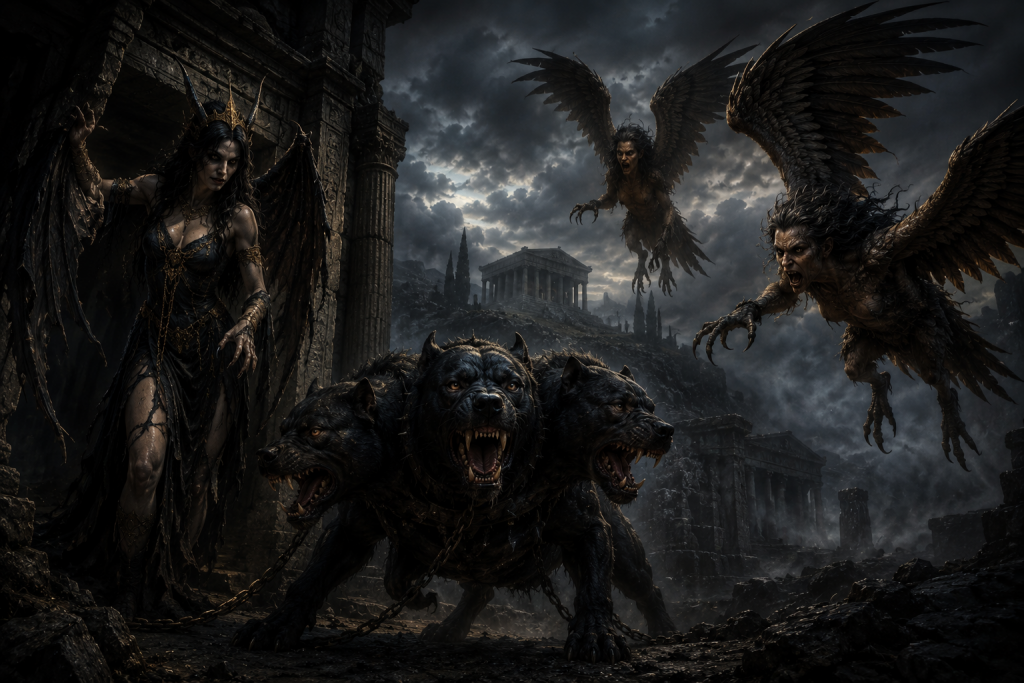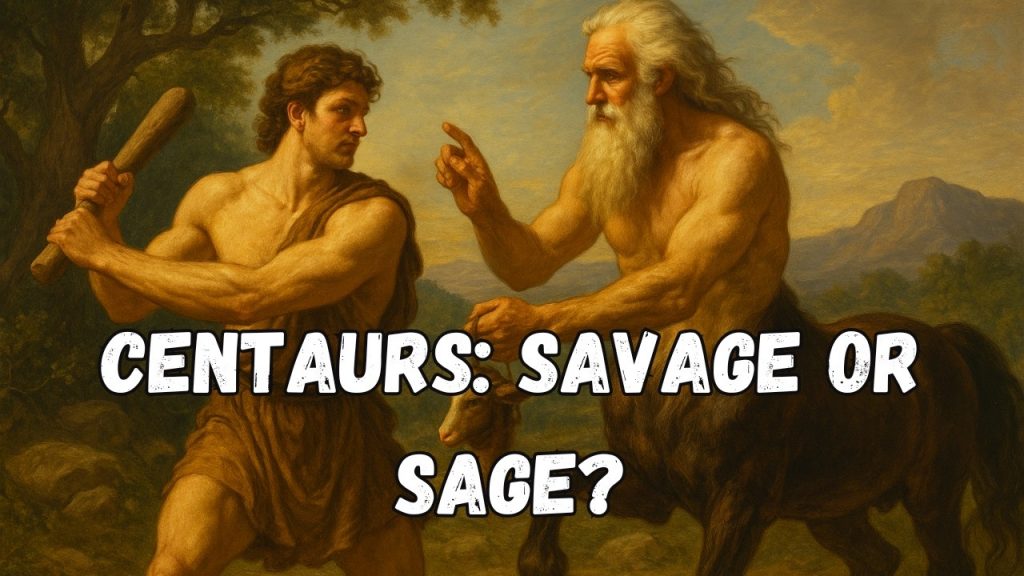
They galloped out of the wild places, half-man and half-horse, their hooves shaking the earth of ancient Greece. Neither fully civilised nor entirely bestial, centaurs occupied a terrifying middle ground that the Greeks found endlessly fascinating and deeply unsettling. These were not gentle creatures of fairy tale. They were violent, unpredictable, and powerful enough to tear a man apart with their bare hands.
And yet, there was more to them than savage fury. Within the chaos of centaur legend runs a quieter current of wisdom, tragedy, and a strangely poignant longing for something the wildest of them could never quite reach.
What Exactly Was a Centaur?
In Greek mythology, a centaur was a creature with the upper body of a human and the lower body and four legs of a horse. The name itself likely derives from the Greek kentauros, though the etymology has been disputed for centuries. Some scholars have linked it to words meaning “hundred killers,” while others suggest a connection to a Vedic term for heavenly beings who guarded the divine drink soma.
They were typically depicted as male, bearded, and carrying weapons such as rocks, uprooted trees, or occasionally bows. Later artistic traditions occasionally introduced female centaurs, known as centaurides, though they appear far less frequently in classical sources.
The standard centaur was not a creature you wanted to meet after dark. Or at all, really.
If you like Greek Mythology, check out more here!
The Origin Story: Born of Lust and Cloud
The birth of the centaurs is a story that begins, as so many Greek myths do, with an act of breathtaking hubris.
A Thessalian king named Ixion murdered his father-in-law to escape paying a bride price, making him one of the first murderers in Greek mythology. Zeus, in a remarkable moment of mercy, took pity on him and invited him to Olympus. Ixion repaid this generosity by attempting to seduce Hera, queen of the gods.
Zeus, suspicious, crafted a cloud in the shape of Hera and sent it to Ixion’s bed. The cloud, known as Nephele, bore Ixion a son named Centaurus. This strange, misshapen offspring later mated with the wild mares of Mount Pelion in Thessaly, and from those unions came the centaurs.
It is a lineage soaked in transgression. The centaurs were quite literally descended from an act of violation and deception, born of a false goddess and an earthly crime. The Greeks understood that such an origin could only produce chaos.
The Lapiths and the Centaurs: A Wedding That Ended in Blood
The most famous centaur myth is also one of Greek mythology’s defining stories of civilisation versus savagery. It concerns the Lapiths, a people of Thessaly, and their neighbours the centaurs.
The Lapith king Pirithous invited the centaurs to his wedding feast, seeking to extend an olive branch between the two peoples. It was a generous gesture. It was also a catastrophic mistake.
The centaurs, unused to wine and entirely lacking the self-control that civilisation demands, became drunk and violent. Eurytion, one of the centaurs, attempted to carry off the bride Hippodamia. Others seized the Lapith women and boys. The feast collapsed into a full-scale battle.
What followed was the Centauromachy, one of the great symbolic battles of Greek mythology. The hero Theseus, who was a guest at the wedding, fought alongside Pirithous, and together the Lapiths drove the centaurs from Thessaly entirely.
The battle was so significant to the Greeks that it was carved onto the Parthenon in Athens, displayed at the temple of Zeus at Olympia, and referenced again and again in art and literature. It represented the triumph of reason and law over brute instinct. It was the moment humanity drew a line.
Nessus: The Centaur Who Had the Last Laugh
Not all centaur stories end with their defeat. One of the most bitterly ironic involves Nessus, a centaur who was shot by the hero Heracles while attempting to assault Heracles’ wife, Deianira.
As Nessus lay dying, he whispered to Deianira that his blood, collected from the wound, would serve as a love potion if Heracles ever strayed. It was a lie, or perhaps a half-truth told with malicious precision. The blood of a centaur slain by one of Heracles’ famous poisoned arrows was saturated with the venom of the Lernaean Hydra.
Years later, when Deianira feared she was losing her husband’s affections, she rubbed the centaur’s blood into a robe and sent it to Heracles as a gift. The moment he put it on, the Hydra’s venom began burning into his skin. Heracles, the greatest hero of the ancient world, was brought to his knees by a dying centaur’s revenge.
He eventually chose to end his suffering on a funeral pyre on Mount Oeta. The centaur had his revenge from beyond the grave.
Chiron: The Centaur Who Was Different
It would be wrong to paint all centaurs with the same dark brush. Ancient sources were careful to distinguish the wild, drunken majority from a small number of remarkable exceptions.
The most celebrated was Chiron, son of the Titan Cronus and the sea-nymph Philyra. Unlike the Ixion-descended centaurs, Chiron was born of divine parentage and possessed a temperament entirely unlike his kin. He was patient, learned, and extraordinarily wise.
Chiron became one of the great teachers of the ancient world. Among his students were Achilles, Jason, Asclepius, and Heracles himself. He taught medicine, music, hunting, prophecy, and the art of war. Asclepius, who became the god of medicine, learned everything he knew at Chiron’s knee.
His death is one of mythology’s genuine tragedies. Heracles accidentally wounded him with one of the poisoned arrows during a visit to the centaurs, and the wound, being immortal, could not kill him but caused unbearable, unending pain. Chiron eventually bargained with Zeus to be allowed to die, surrendering his immortality so that Prometheus could be freed. Zeus placed him among the stars as the constellation Centaurus, or by some accounts as Sagittarius.
The Greeks used Chiron to show that nature was not destiny, that even the wildest bloodline could produce greatness. But they made sure it cost him everything.
If you want more like this, the Tales of Myth and Magic newsletter delivers new creatures, legends, and forgotten folklore straight to your inbox.
No fixed schedule. No noise. Just the stories, when they are ready.
Sign up here →Pholus: A Feast, A Flask, and a Pointless Death
Another centaur marked out as civilised and wise was Pholus, who hosted Heracles during the hero’s quest to capture the Erymanthian Boar. Pholus entertained his guest generously and opened a great jar of wine that had been set aside as communal property of all the centaurs in the region.
The scent of the wine drifted across the hills and drove the other centaurs wild. They arrived in a frenzied mob, and Heracles was forced to drive them off with his poisoned arrows. Pholus, curious about the arrows that had felled so many of his kin, picked one up to examine it. It slipped from his fingers and pierced his foot.
He died immediately. Not in battle, not through any act of violence or passion, but through simple terrible curiosity. It is the kind of death that feels almost modern in its bleakness, a good person undone by chance.
The Centaur in the Night Sky and in the Natural World
The Greeks were not alone in imagining composite man-beast figures, but the centaur became one of the most enduring. By some ancient accounts, the sight of nomadic steppe horsemen, seen at a distance for the first time by peoples unfamiliar with horse riding, may have seeded the original myth. A rider on horseback, seen at speed across open ground, could suggest a creature that was neither fully human nor fully animal.
The constellation Centaurus remains visible in the southern sky. Its brightest star, Alpha Centauri, is the closest star system to our own sun. Somewhere in that ancient act of naming, a Greek stargazer looked up and chose to immortalise the creature there among the fixed lights of the universe.
The centaur also gave its name to centaurea, a genus of flowering plants said to have been used by Chiron for healing. Common knapweed and the cornflower both belong to it. The wise old teacher survives, quietly, in the meadows.
Beasts at the Edge of the Human World
The centaur was never simply a monster. It was a mirror. The Greeks used it to ask uncomfortable questions about what separated the civilised from the savage, whether reason was truly the barrier between humanity and the animal world, and what happened when that barrier broke.
At the wedding of Pirithous, civilisation almost lost. In the cave of Chiron, it triumphed. In the story of Nessus, it was betrayed. In the death of Pholus, it was simply unlucky.
The centaurs were not creatures the Greeks feared without fascination. They thundered through the hills of Thessaly, tangled in myth and marble alike, and they have never quite stopped running.
Further Reading
If this article sparked your interest, these are the books worth reading next.
The Iliad — Homer (Penguin Classics)
by Homer — the primary source for everything in this article, and still the most vivid account of the Trojan War ever written.
The Odyssey — Homer (Emily Wilson translation)
by Homer, translated by Emily Wilson — the best modern English translation, and the book that contains Odysseus’s own account of the horse.
The Trojan War: A Very Short Introduction
by Eric Cline — the clearest and most up to date account of what archaeology actually tells us about Troy and whether any of it happened.
Never miss a myth
Thank you for being here. The site is brand new and every subscriber genuinely means something to me. If you're here, you care about this stuff as much as I do - and that's all the reason I need to keep going. New stories, videos and dark folklore from around the world, straight to your inbox. No algorithm. Just the stories, when they're ready.